

A developer’s proposal to replace an auto body shop near Fields Corner with a seven-story, 108-unit building drew questions about parking, traffic, building height, and the wisdom of placing apartment dwellers in the middle of an active industrial district during a city-sponsored public meeting on Monday evening.
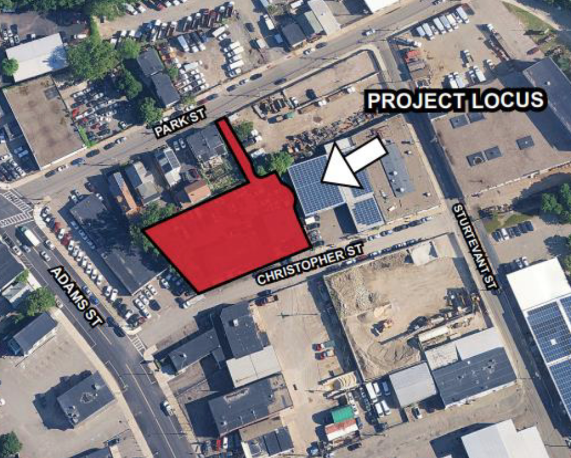
The project, proposed for the nearly 24,000-square-foot Chevy Auto Body property at 80 Christopher St., would include 20 income-restricted apartments, 22 automobile parking spaces, bicycle storage, a small retail space, community rooms, a courtyard, and a roof deck.
The site is surrounded by some of Dorchester’s most intensive industrial operations, including a stone-crushing yard, construction and utility businesses, auto shops, and the Boston Duck Tours headquarters.
The Reporter first detailed the proposal in February after initial plans were filed by a Quincy-based development group led by Colman Grealish.
Attorney Mike Ross, representing Grealish and his team, said the latest plans presented at Monday’s Boston Planning Dept. meeting will likely change in response to city and neighborhood feedback.
“This is the first cut of this project, but it’s going to change,” Ross said.

A rendering shown during Monday’s presentation.
Ross said his clients want the Boston Planning Department to extend the public comment period for the project — set to end on August 21— because the review is taking place during the summer, when civic groups and residents are less active.
The building would rise about 74 feet, exceeding the district’s current 45-foot height limit. The six residential floors would each contain eight studios, six one-bedroom apartments, and four two-bedroom apartments, although Ross said the developers have heard requests for more family-sized, three-bedroom units.
Ross acknowledged that the limited parking would make the apartments largely unsuitable for tenants who depend on personal vehicles.
“It’s not a good project if you have a car. It’s not a good home if you have a car,” he said, adding that the site is just an eight-minute walk from the Fields Corner MBTA station on the Red Line.
William “Buddy” Christopher, the architect on the project, said the team recognizes the importance of the project.
“We really want to make sure that these initial buildings that are coming out really do set a precedent for good quality and real understanding of what they’re about,” Christopher said.
The building would be designed as a largely environmentally controlled structure, Christopher said, with relatively few operable windows. That feature is intended, in part, to protect residents from dust, odors, and other impacts associated with neighboring industrial businesses.
“We do think that there is the situation always around industrial areas of smells and dusts and things like that,” he said. “That’s the main reason we made the building environmentally sealed, so that we could control those kinds of things.”
But, several people on the Zoom call questioned whether the two uses can coexist.
Hiep Chu of the locl civic association said he was not necessarily opposed to the proposal, but asked: “If I live there and I can’t open my window, do I want to live there?” Chu said. “I mean, probably not.”
Chu asked city planners to clarify the long-term vision for the Christopher Street, Park Street, and Adams Street industrial district. He questioned what would happen if residents moved into the building and later complained about noise, dust, truck traffic, or other impacts from businesses that had operated in the area for decades.
“I have nothing against this particular project,” Chu said, but added that it appeared as though “people want to do whatever they want to do and the city goes along with it.”
He asked: “If this particular project is up and then the tenants begin to complain about Tri Construction, which has been there forever, how are we going to deal with or respond to a situation like that?”
He also pressed the city to extend the public comment period beyond August, noting that the Fields Corner Civic Association would not resume regular meetings until September.
“If we do extend, we need to extend into September,” Chu said.
Ed Crowley, who lives nearby, called the proposal “immense” and said neighboring companies are worried about inserting scores of new residents onto a street regularly used by trucks, construction equipment, and Duck Tour vehicles.
“It’s not a good place to start with a seven-story building,” Crowley said.
Charlie Tevnan, an attorney speaking for the owners of Tri Construction, said they share many of those concerns.
“The access point on Christopher Street is a big concern because it is of such a heavily industrial use,” Tevnan said, pointing to “multi-ton trucks” traveling along the street several times each day. He described Tri’s stone-crushing yard directly across from the development site as “about as industrial a use as there can be.”
Tevnan also said the owners believe the development should secure a two-way vehicle connection to Park Street rather than directing most traffic onto Christopher Street. The developer owns a narrow strip connecting the property to Park Street but would need an easement over neighboring land to make it wide enough for two-way traffic.
Ross said the Park Street connection could ultimately become a vehicle entrance, an exit, a pedestrian walkway, or a bicycle path, depending on negotiations and public feedback.
Other participants raised concerns about water pressure, electrical capacity, affordability, spillover parking in Clam Point, and the long-term planning vision for an area still zoned and operated as an industrial district.
Jackie West Devine of Fields Corner Main Street said the proposal was promising, but asked planners and developers to consider whether the surrounding area will remain industrial for the long-term— or not.
“If it’s going to continue to be construction all around it, it’s not going to retain residents,” she said. “If the love isn’t there, then the soul’s not there.”
The Planning Department is expected to compile the public testimony and its own internal review before sending comments to the development team.
