
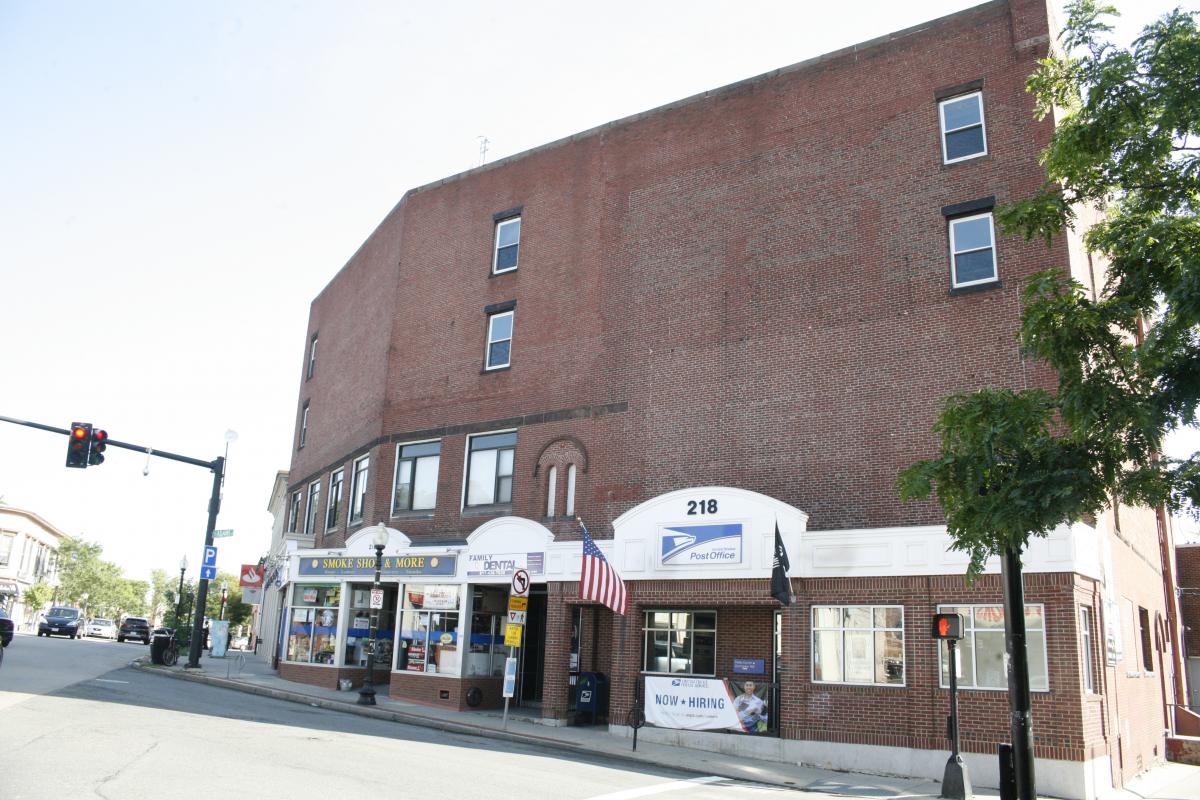
Above, a construction site on Washington Street in Dorchester in May 2026. Seth Daniel photo
In 2023, activists scored a victory in a years-long push to open up construction details to civilian flaggers when the City of Boston negotiated a contract with the Boston Police Patrolmen’s Association (BPPA) that allows civilians to fill in when police officers are unable to cover assignments.
But more than three years later, construction details are still exclusively in the hands of police officers.
“They’ve created a policy that makes it seem like civilian flaggers are a possibility, but it’s not happening,” said Fatema Ahmed, executive director of the Muslim Justice League.
Asked last week about the delayed implementation, Mayor Michelle Wu said city officials are working on a new detail assignment system. Currently, they are still being assigned to officers through individual police precincts, such as Area C-11 in Dorchester.
“I am very impatient on this front, and we’ve been working through all of the pieces of this,” Wu told The Reporter. She said that the city has procured a technology platform for the new system, but there’s more work to be done.
“There’s the process of opening it up, hiring, recruiting, and training the civilian flaggers themselves,” she said. “And I think that’s where we are.”
All construction work on streets in Boston that affects traffic flow requires a police detail. Although civilians work as flaggers in other Massachusetts cities and towns and on state highways, Boston police officers have for decades had exclusive rights to construction details on the city’s streets.
Their leaders have long argued that deploying off-duty police officers to construction sites throughout the city promotes safety because officers working details can respond to emergency calls.
For their part, critics say their doing so calls into question the need for the details.
Despite the BPD’s longstanding insistence on filling all details with officers, the department has had difficulty meeting the demand. In 2023, 52,462 details – 43 percent of the total number requested by construction firms – went unfilled, according to the city’s records.
Under the system agreed to by the city and the BPPA three years ago, police officers will have top priority in filling details, followed by university police officers, retired Boston officers, and civilians.

Last year, the city selected the Edward Davis Company as the vendor for managing civilian contracts. Company head Edward Davis is a former Boston Police commissioner.
City Councillor Ben Weber, who last year served as chair of the council’s Public Safety and Criminal Justice committee, expressed frustration with the slow pace of implementation of civilian flagging.
“It’s not rocket science,” he said. “We should be able to put civilian flaggers on the streets. We fought hard to allow civilians to be able to do this kind of work.”
