
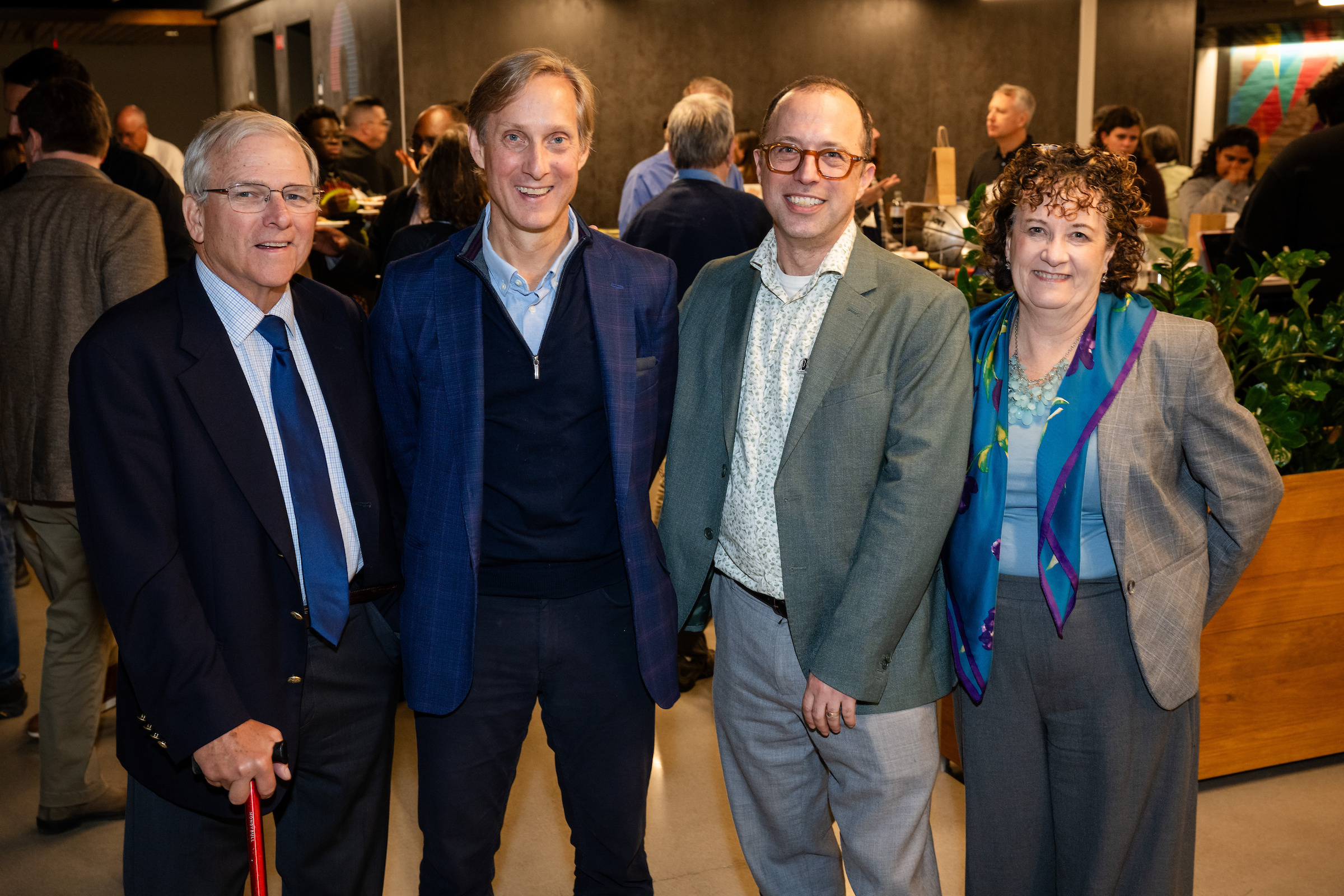
Photo above: Alicia Reeves-Cobb posted results at the Adams Street Library on Tuesday, Sept. 1 after a long day of helping voters and tabulating results as a city of Boston poll worker. Seth Daniel photo
Copyright © 2026 Boston Neighborhood News, Inc. This content may not be re-published or re-used without written permission.
In the Sept. 1 primary election, Dorchester voters followed the larger pattern by supporting Democratic incumbents, yet with a noticeable difference in races for state Senate and the US House of Representatives.
Throughout most of Dorchester, the tightest race in the Democratic primary, and the most locally contentious, was for the 1st Suffolk State Senate seat representing a district that also includes all of South Boston and Chinatown, along with part of the South End.
The district’s fourth-term incumbent from South Boston, Nick Collins, came out as the unopposed-in-November Democratic nominee, with 53.8 percent of the vote. The stronger of two challengers from Dorchester, Latoya Gayle, gained 43.5 percent of the vote. Collins won 43 precincts across the district, while Gayle prevailed in 39.
Though Collins ran more strongly in South Boston—winning all but one precinct – Gayle was more competitive in the district’s Dorchester precincts, where unofficial numbers show her with 48 percent of the vote and Collins at 48.9 percent.
One factor in the results was support for Gayle by Boston Mayor Michelle Wu, who also backed the challenge by her former senior policy adviser, Daniel Lander, to state Sen. Will Brownsberger, whose Suffolk & Middlesex District includes Allston-Brighton and most of the Fenway. As of this week, the results were being recounted, with Brownsberger reportedly maintaining a small lead. (Brownsberger has since been confirmed as the winner.)
Both senators were key opponents of the home rule legislation first filed by Wu in 2024 that would have temporarily slowed the shift in the property tax burden from commercial to residential owners. In both of their districts, the race assumed the character of a contest between the incumbents and the mayor. In the 1st Suffolk District, Collins highlighted the tax issue by drawing attention to his own legislation aimed at relief for homeowners, along with criticizing the Wu administration’s assessment of property values.
The best numbers for Collins in Dorchester were from Ward 16 (Fields Corner/Neponset), where he came out ahead of Gayle by an unofficial count of 2,086 (58.7 percent) to 1,395 (39.3 percent).
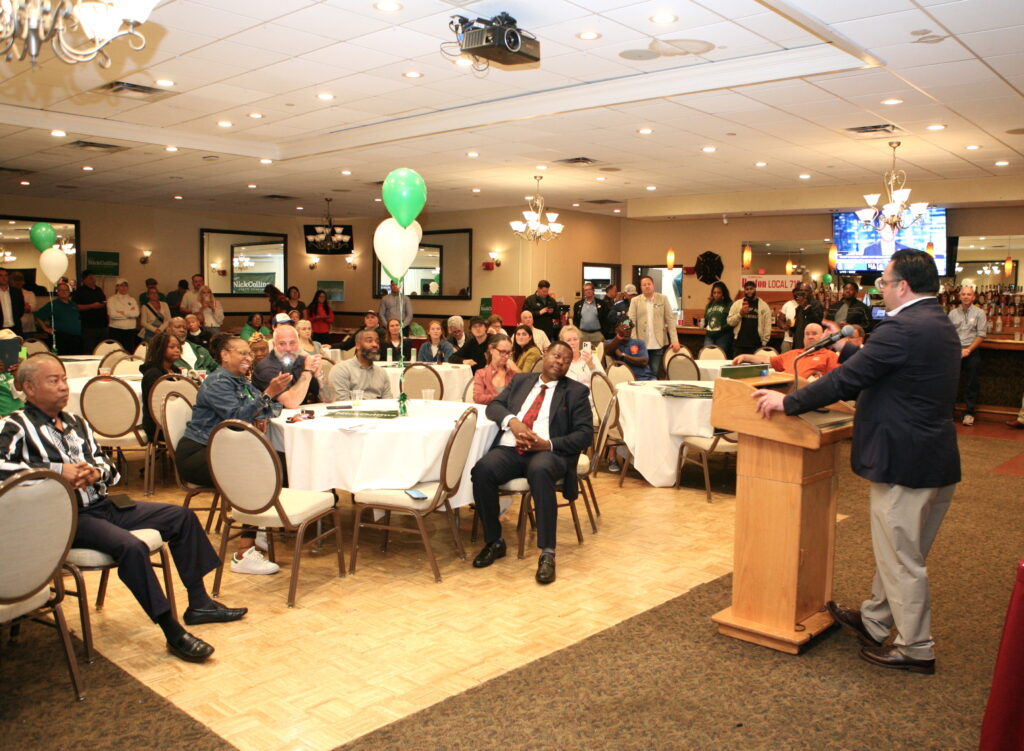
The scene inside Florian Hall on Election night as Nick Collins addressed supporters two hours after the polls closed. Seth Daniel photo
The tilt toward Collins in Ward 16 was greatest in Precinct 12, around Florian Hall, and Precinct 9, east of Adams Street, between Ashmont Street and Gallivan Boulevard. Florian’s precinct 12 had a voter turnout rate of 44.2 percent, Boston’s highest and more than double the citywide figure of 19.5 percent.
In last year’s preliminary election for mayor, the two Ward 16 precincts were carried by challenger Josh Kraft, who outpolled Wu in Precinct 12 by 358-156. In the 2024 presidential election, the same two precincts were carried by Donald Trump and JD Vance.
Gayle’s best showings in Dorchester were in Ward 13 (Uphams Corner, Jones Hill, Columbia-Savin Hill) and Ward 17 (CodmanSquare/Lower Mills). She carried all but one of the Ward 13 precincts in the district, but Collins carried the perennially high-turnout Precinct 10 (Savin Hill).
Gayle also carried Dorchester’s Ward 15 (Fields Corner/Meeting House Hill), by 626-571.
In South Boston, the only win for Gayle was in Precinct 11 (Fort Point). And she and Collins both carried a number of precincts in the South End.
The other candidate in the race, second-time challenger Juwan Skeens, received 506 votes.
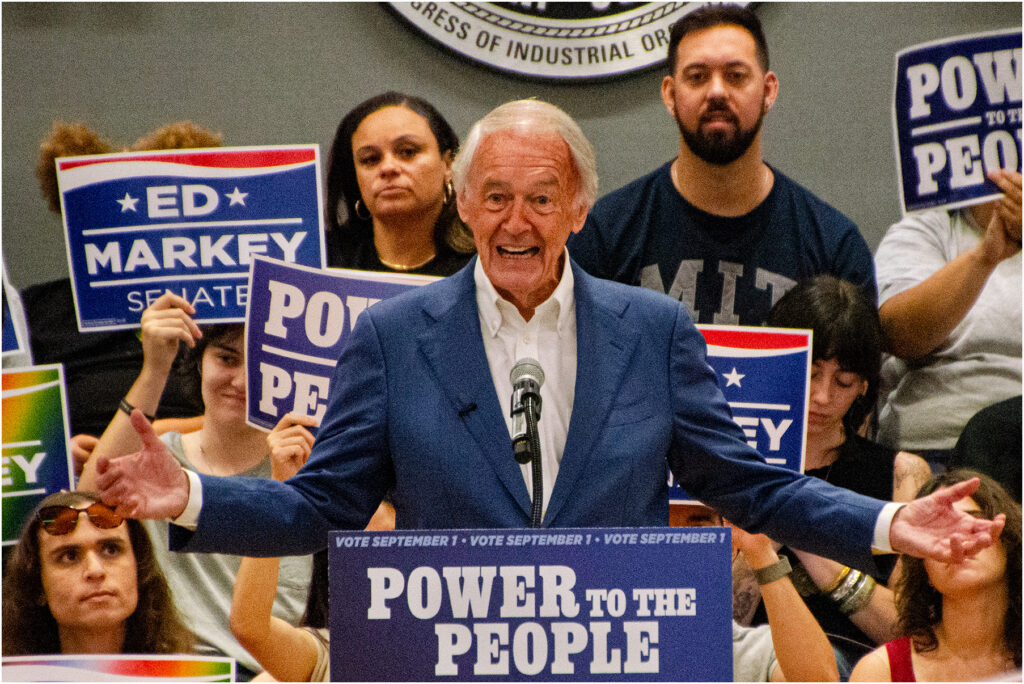
Sen. Markey, who won 3-1 over his challenger Rep. Seth Moulton last Tuesday in Boston, is shown at a Aug. 29 rally at Dorchester’s IBEW Hall. Chris Lovett photo
Trump also loomed in the Democratic primary for US Senator between incumbent Ed Markey and the Massachusetts 6th District US Rep., Seth Moulton—though as a foil for both candidates. Statewide, Markey received almost two-thirds of the vote. He scored 71.6 percent of the vote in Boston, to 25 percent for Moulton, and swept all precincts in Dorchester.
Markey surpassed his 2020 primary margin over another Democratic challenger, former 4th District US Rep. Joe Kennedy III. Six years ago, Kennedy got 40.1 percent of the vote in Boston, while carrying the predominantly Black wards 12 and 14 (Roxbury, parts of Dorchester and Mattapan). Last week, Markey swept the same wards.
In the race for the 8th District House seat in Congress, Stephen Lynch was nominated for his 14th term, winning 55.7 percent of the vote over a Progressive challenger, attorney Patrick Roath. In addition to South Boston, along with parts of Dorchester, Jamaica Plain, Roslindale, and West Roxbury, the district also includes communities south of Boston.
The only candidate for the seat in the Republican primary was Robert Gerald Burke, an “American Citizens First” advocate who also ran for the seat in 2022 and 2024.
Though Dorchester results in the Democratic primary followed the trend for the rest of the 8th District, they were at odds with the total from precincts in Boston, where Roath got 55.7 percent of the vote. In Dorchester precincts, Lynch picked up 58.4 percent of the vote, to 41.6 percent for Roath.
Boosting Roath’s total was support from Progressive strongholds in Jamaica Plain and Roslindale, where some voters were also drawn to the race between state Sen. Mike Rush and Progressive challenger Persis Yu. Her upset victory came despite the support by the mayor for Rush, who had backed her property tax home rule petition.
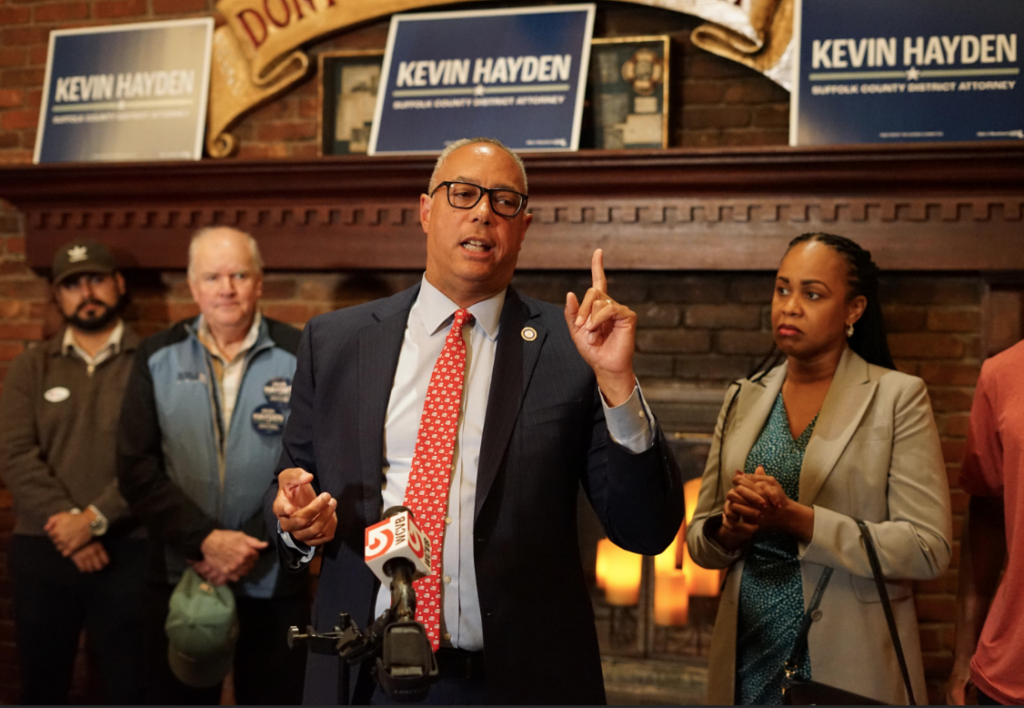
DA Kevin Hayden was dominant in Dorchester last Tuesday. He is shown above speaking on Election night at a victory party held in Allston. Yawu Miller photo
In the Democratic primary for Suffolk County District Attorney, incumbent Kevin Hayden received 49.4 percent of the vote in Boston, with the remainder almost evenly split by two challengers – Linda Champion, who finished slightly ahead of the former US Attorney and Suffolk County DA Rachael Rollins.
Though Hayden carried all five wards in Dorchester, Rollins carried Roxbury’s Ward 12, along with adjacent precincts west of Washington Street. In Ward 14 (Grove Hall, Four Corners, Franklin Field), the race was very tight, according to unofficial results, with Hayden edging Rollins by only two votes.
In the Republican primary for governor, Mike Minogue received 71.8 percent of the vote in Boston, over 27.7 percent for Brian Shortsleeve. Minogue’s share in Boston was slightly below the statewide figure of 75.8 percent.
In the days leading up to the election, television attack ads emphasized Minogue’s past support for Trump. In Dorchester, Minogue’s highest vote counts were in Ward 16’s precincts 9 and 12.
Copyright © 2026 Boston Neighborhood News, Inc. This content may not be re-published or re-used without written permission.
