
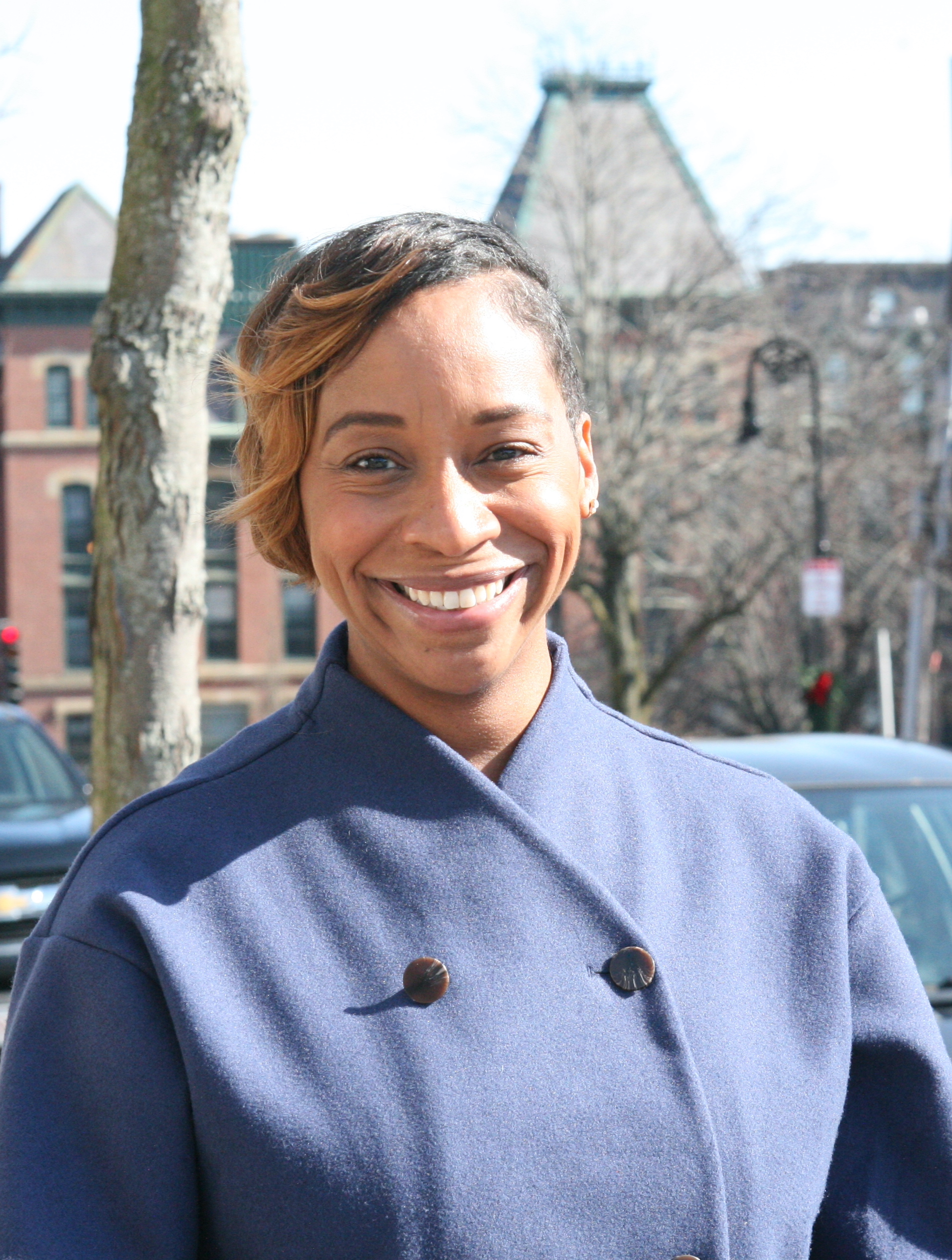

After all guests placed a flower on the gravesite and shared a moment of silence, Reverend Mariama White-Hammond offered a benediction. Cassidy McNeeley photos
Copyright © 2026 Boston Neighborhood News, Inc. This content may not be re-published or re-used without written permission.
Last Wednesday (Sept 2.) Rita Steele and her mother, Hilarie Jackson, crammed into the Gilman Chapel at Cedar Grove Cemetery with about 100 other observers and listened closely as the names of 133 Black women interred beneath two vague markers in the burial ground were read out loud. As the 35th name was announced, “Sarah Smith,” the two women cheered.
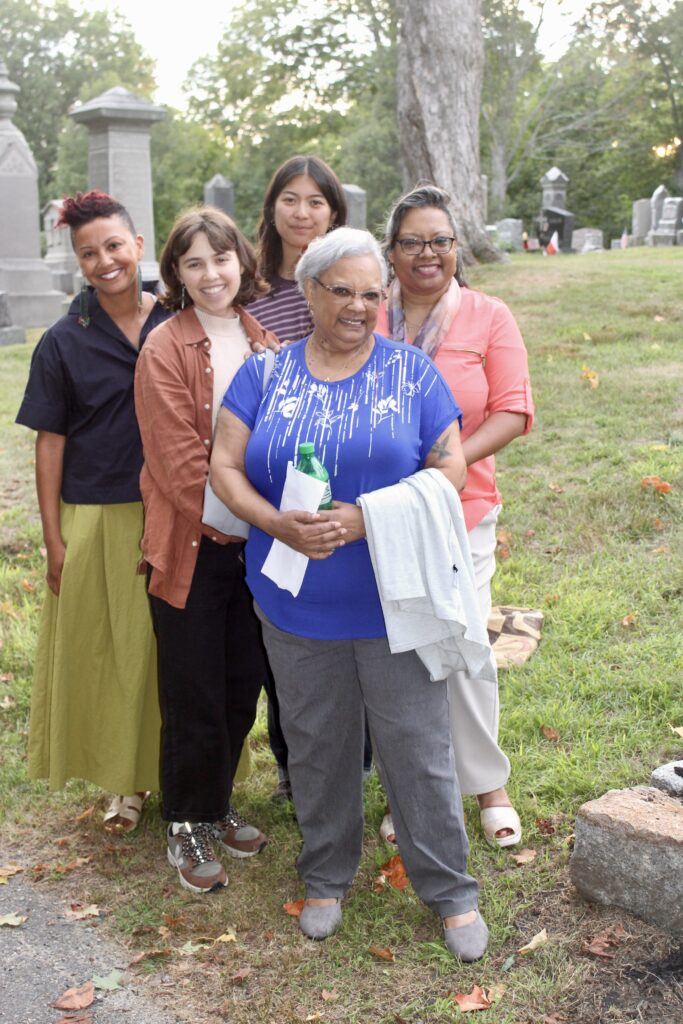
MIT professor Dr. Karilyn Crockett (left), with students Maya Bickel (second from left) and Am Chunnananda (back), who researched Sarah Smith, stand with descendants Rita Steele (right) and Hilarie Jackson (front).
Two years ago, as she sought more information about her family’s roots, Steele discovered that she is Sarah Smith’s fifth great-granddaughter.
“I was trying to identify my family’s Native American ancestry,” she explained. “Sarah Smith’s name was one of the ones that I had.”
From Sarah’s death certificate, Steele learned that her great-grandmother had died at a place in Boston called the “Home for Aged Colored Women.”
She gained more information about the home by reading the work of Dorchester resident Joyce Linehan, who had called attention to the burial site in Cedar Grove and a project led by the Boston Women’s Heritage Trail and students at MIT to identify and memorialize the women who lived there.
“I reached out to and Joyce said my great-grandmother is one of these women. Needless to say, that’s when all the things started coming together,” Steele said.
Last week, she and Linehan saw the first phase of that project come to life when local artist Ekua Holmes unveiled a temporary memorial to honor the women buried there who for decades have been largely unknown.
In creating the design, Holmes said, she asked, “How can we use the language of flowers to honor the 133 Black women at Cedar Grove?” A community workshop inspired the “idea to combine multiple portraits into a single portrait to reflect both the individuality of each woman and her presence in the greater community.”
Said Jackson of the overlapping portraits: “It took me two times to look at it, to see it.”
She described the experience as a “tear-jerking” moment, knowing that somewhere inside the artwork was Sarah Smith.
“Through collage I’m able to piece together a fractured world with a goal to transform remnants of the past into the cohesive and meaningful present,” said Holmes. “The information we have about the 133 women comes to us in fragments. Names, dates, geographic locations, family connections, glimpses of stories. Sometimes there’s a great deal of information, and sometimes there is very little, but every fragment is a part.”
She added: “Even though the historical records may not tell us everything about them, their presence alone deserves to be acknowledged. Tonight we are not simply unveiling a collage; we are making an act of recognition and reparation. We are saying that these 133 black women belong to the story of this place; they belong to the history of Boston, and they belong in our memory.”
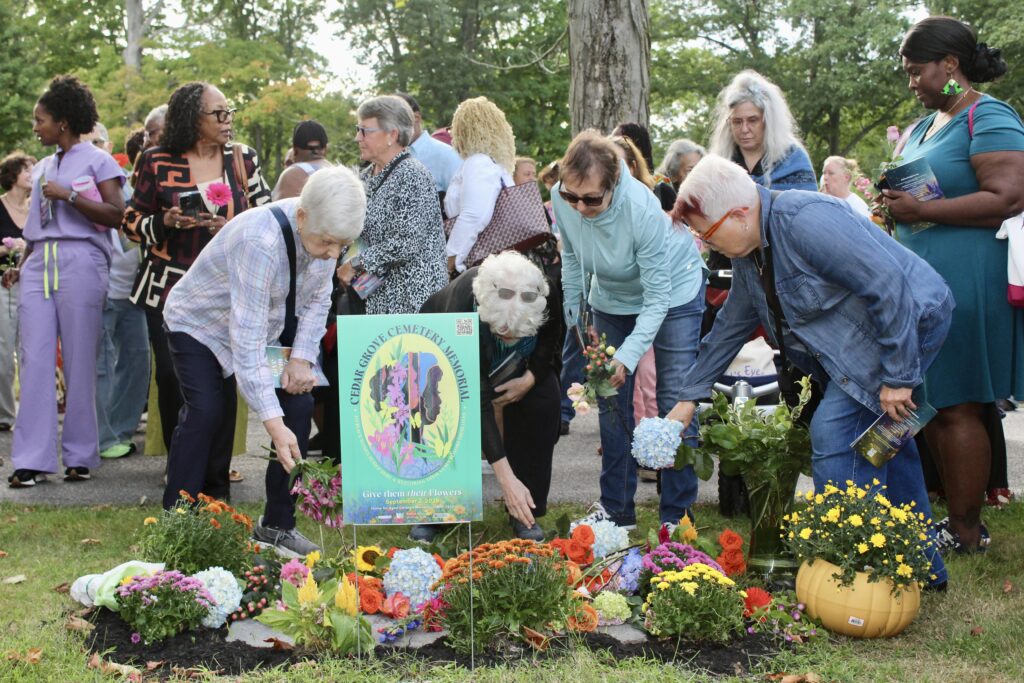
Behind the temporary memorial made by local artist Ekua Holmes, community members give the women their flowers.
After the unveiling, guests listened to a poem written by Porsha Olayiwola, former Poet Laureate for the City of Boston, and on exiting the chapel, picked up two flowers before processing to the sites where they laid a flower on each marker and shared a moment of silence.
“We recognize that in many spiritual traditions, it is said that as long as a person’s name is called out, they are not gone,” said Reverend Mariama White-Hammond, standing beside the first gravesite. “People need to know their stories, and we need to right the wrong. Not just say their names, but fill out their stories and then tell them.”
Diana Lam, who leads the Boston Women’s Heritage Trail, reminded everyone that the celebration was not the end, but just the beginning.
“Phase two calls us to carry this work forward to a strong fundraising campaign to create a permanent memorial worthy of these 133 women here at Cedar Grove Cemetery and beyond,” she said. “We cannot change the circumstances of burial, but we can change what happens now. We can speak their names, we can honor their lives, we can tell their stories, and we can ensure that future generations know that these women were here. Tonight, and in the years ahead, we give them their flowers.”
Copyright © 2026 Boston Neighborhood News, Inc. This content may not be re-published or re-used without written permission.
