

Copyright © 2026 Boston Neighborhood News, Inc. This content may not be re-published or re-used without written permission.
For the third year in a row, the Boston Police have acquired and deployed social media surveillance technology without obtaining approval from the Boston City Council in apparent defiance of a 2021 ordinance requiring them to do so.
The department began using LifeRaft in June of this year, a month after their annual surveillance report was due to be submitted to the councillors, who learned of the deployment in the report, which wasn’t released until last week.
“The Boston Police Department’s undisclosed deployment of ‘LifeRaft’ directly violates the 2021 Ordinance on Surveillance Oversight and Information Sharing, which mandates that the Council be notified before any surveillance technology is used,” District 7 Councillor Miniard Culpepper said in a statement.
He added: “Bypassing this law undermines public trust and defeats the purpose of the legislative oversight designed to protect residents’ rights.”
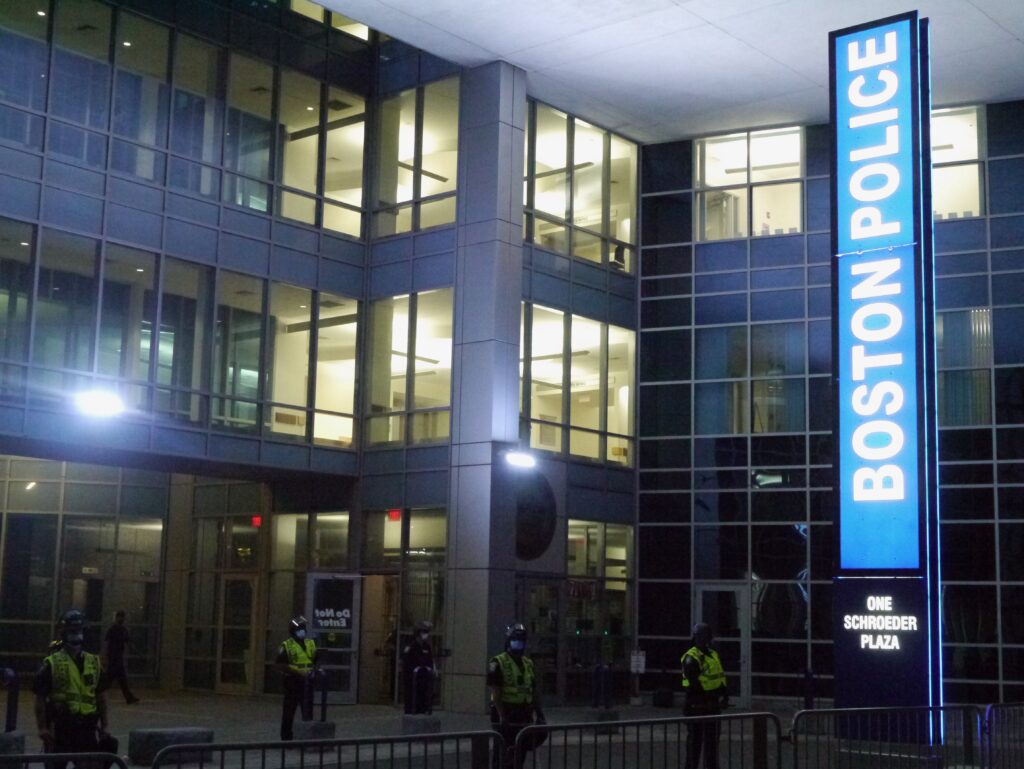
Boston Police are shown outside BPD headquarters at One Schroeder Plaza. Yawu Miller photo
Last year’s report, due in May of that year but released in July, revealed that the department had acquired and deployed three social media surveillance tools. While the department cited “exigent circumstances” in its reason for deploying the technology — namely the 2024 presidential election — it re-deployed one of the monitoring software packages called Chorus Intelligence Suite in February of 2025 without citing a specific threat.
The council voted in July of last year to block the department from using the software, but police have continued using Chorus and Site Feed social media monitoring, according to the report released last week.
“It’s pretty alarming that the Boston Police Department appears to be continuing using two social media tools that the City Council voted down,” said Kade Crockford, director for Technology and Justice programs at the ACLU of Massachusetts. “The initial disclosure last year about its use of these technologies was concerning in itself.”
A spokesperson for the Boston Police Department said Tuesday that they would “publicly discuss these matters” at a hearing— “likely in the next few weeks.”
In a statement, the spokesperson added: “Useful technology is essential to the Department’s ability to identify criminal threats to public safety, including threats of individual or mass violence, situational awareness of online forums utilized by various types of criminal actors and to hold those responsible for violence or criminal activity accountable. Social media analysis tools improve personnel efficiency and increase analytic accuracy when reviewing large datasets, while focusing our efforts toward the bad actors.
“Like any tool we utilize, technology must be used in a way that preserves public trust and fulfills our mission of Community and Constitutional Policing,” the statement concluded.
The social media monitoring tools are part of an array of surveillance technologies that the department is required to disclose to the council before they purchase or acquire them.
While Flock license plate readers have made headlines locally and nationally in recent weeks, they are just one of the 19 categories of electronic surveillance the department lists in its report. Others include gunshot detection devices, the gang database (now referred to as the Associative Violence Information System), aerial drones, and cell site simulators, which trick mobile phones into connecting with them rather than with a real network.
The department’s deployment of surveillance technology has sparked concern among civil liberties groups and activists in recent decades as Boston police have surveilled nonviolent protests, including the 2011 Occupy Wall Street movement encampment in Dewey Square, the Black Lives Matter movement and protests from 2014 to 2020, and, most recently, pro-Palestinian demonstrators protesting Israel’s siege of Gaza and settler attacks in the West Bank.
At the same time, activists say, police failed to monitor the white supremacist Patriot Front group that in July 2022 marched through downtown Boston and assaulted a Black pedestrian. While independent journalists recorded the march from start to finish, no Boston Police officers were deployed to the scene.
Crockford notes that Boston Police deployed 13 drones over the March 28 “No Kings” rally on the Boston Common without citing in their report any pending threats to public safety.
“In the absence of a threat to the people protesting, what it looks like is surveillance of the people protesting,” Crockford said. “This was a place where people were engaged in First Amendment protected speech and protest. I hope the Boston City Council asks them why they were there.”

Just as the BPD has a longstanding pattern of covert investigations into nonviolent progressive movements, so, too, has the FBI. And under the current presidential administration, the Department of Justice has this year investigated groups including Texas and Minneapolis activists opposed to ICE, school districts suspected of promoting “gender ideology” in K-12 schools, and others suspected of being President Trump’s ideological foes.
“We don’t know what they were investigating,” Crockford said of the BPD drones deployed at the “No Kings” rally. “We know the FBI has been directed by the Trump Department of Justices to wage war on left-wing activists.”
The BPD’s deployment of surveillance, much of which is housed in the Boston Regional Intelligence Center office, where Boston police officers share space with an officer from the Department of Homeland Security and FBI agents, has raised questions about the sharing of information with ICE agents.
The nonprofit Citizens for Juvenile Justice in April released a report, titled ICE Out, that detailed how the flow of information from Massachusetts police departments is aiding federal immigration enforcement officers who are targeting non-criminal immigrants for deportation.
Because Boston shares information with the FBI and the FBI shares information with ICE, Citizens for Juvenile Justice Executive Director Leon Smith says, Boston police are at the very least indirectly aiding the Trump administration’s deportation regime through the BRIC while state police are doing so through the Commonwealth Fusion Center.
“There’s a history with both of them sharing information with the Department of Homeland Security,” he said. “People have a right to be suspicious.”
In Boston, as is the case in other cities, funding for surveillance technology comes through the federal Urban Area Security Initiative grants that are channeled through the BRIC. For instance, BPD paid for its drones with $15,000 in city funds and $60,000 in the same Urban Area Security Initiative funding that funds the BRIC.
But as federal officials in recent years have increased their demands that UASI funding be used to foster collaboration between the Department of Homeland Security and local police departments, local activists have called for the city to turn down the grant. Those same concerns prompted Brookline Town Meeting members to call for the municipality to withdraw from the BRIC.
While the Council is charged with overseeing BPD surveillance, it seems unlikely anyone on the body understands the extent to which the department is sharing information with federal officials. If there’s one government entity BPD officials are not sharing information with, it appears to be the City Council.
As part of the report, Boston police officials are required to list any public complaints about the use of surveillance tech. In their report, police officials appear to have copied and pasted the same response, noting that complaints should be made through the Internal Affairs Division and that none have been received.
For several of the more controversial technologies deployed, the officials acknowledge “general discussion surrounding the use of technology in the city” but note that such discussions take place outside the police department .…”as a result, the Department has been unable to locate any specific complaints relative to this technology.”
Last year and in 2024, police brass heard hours of testimony in the Council chamber detailing concerns and complaints about surveillance technology. None of that was acknowledged in the report.
Culpepper, for one, says he wants answers. He is calling on the police to suspend their use of LifeRaft and comply with the city ordinance mandating Council oversight.
“The Council must understand when LifeRaft was acquired, how it is being used, what safeguards govern its use, what information is collected and retained, and why the Council was not properly informed before its deployment,” he said. “Oversight cannot happen after the fact. And public trust depends on government following the very rules it has established to protect that trust.”
Copyright © 2026 Boston Neighborhood News, Inc. This content may not be re-published or re-used without written permission.
