

Tracking a petition
Copyright © 2026 Boston Neighborhood News, Inc. This content may not be re-published or re-used without written permission.
Darrin Howell says he is not the edgy young man he was at 21.
To that point, the 44-year-old Dorchester native is looking to convince a state board, Gov. Maura Healey and the Governor’s Council that what he did as a young man shouldn’t continue to be counted against him.
Howell has worked in City Hall, ran for state representative twice, volunteered for Toys for Tots, and has been working as a political and labor organizer for several years while raising his twin daughters and buying a home. But on more than one occasion, the criminal charges that sent him to jail for a year 23 years ago have barred him from opportunities and success.
Last week, he took another step in the state pardon process that could free him of that obstacle and help him to help others in the same situation.
“I have been providing service to the community for a long time now and wanted to see if it was enough to have this changed,” he said. “It doesn’t erase the past, but it would stop the limits to my future. I didn’t have to do this. I have a great job and a healthy life. I think if we’re going to evaluate the 21-year-old me, you have to take into consideration the 44 year-old me.”
On Sept. 16, he appeared before the Massachusetts Advisory Board for Pardons to plead his case. The case remains open for additional testimony before any board reviews. It has already been more than a year since he filed his petition and could take even longer to gain a pardon.
“I started going through this process partly out of curiosity so I could find out what this system is about,” he said. “If you think it’s going to be overnight, think again. There are stages to the process and so patience is part of the process.
“It was really triggering, though, hearing the things that I did,” he continued. “There were people that are aware of my past but didn’t know these details. I have been very up front about my lifestyle back then with everyone, but I didn’t want to ever go into the details…To me, it was a lot to take in but there’s a peace that can come from this process.”
Howell is not alone in facing consequences in the present for youthful offenses, particularly in communities like Dorchester and Mattapan.
Terrance Williams, who was himself pardoned by Gov. Healey in 2023, encouraged Howell to pursue his case. Williams was convicted of a felony as a juvenile, a fact that prevented him from accessing a firearms license for job opportunities at private security firms.
“I have been telling people that Gov. Healey is willing to give people a second chance right now depending on what the charges were,” Williams told The Reporter. “After I received my pardon, God gave me a mission to help others with this and go out and spread the word to everyone that if they made a mistake years ago, this is their pardon time.
“That’s what I’ve done. I’ve talked to hundreds of people and three of them have acted, including Darrin. I was so excited he did that.”
Williams said that service and engagement was a key part of his pardon process, showing that he had done things to improve community life.
“Darrin fits that to a T,” he continued. “He was just a young man who was misguided and misdirected – probably by peer pressure – and took the wrong path. But that’s all changed.”
Filing a petition doesn’t cost anything except time and effort,” said Williams, who added, “I hate to bring race into it, but you might have a young white male with better connections who might have done the same crime but got off because they had connections to get it overlooked.
“Black kids in urban neighborhoods don’t have that. They don’t have mentors to help them in those situations. Maybe it’s stupid and something they regret, but it follows them, and this is a process to stop that.”
Howell was convicted of domestic violence offenses against his pregnant girlfriend 23 years ago. The charges included assault and battery with a dangerous weapon, illegal possession of a firearm, possession of a firearm without a permit and witness intimidation. Including holding time, he served about one year in South Bay House of Correction, with twin daughters being born while he was there.
Upon release, he began to rebuild his life – which eventually led him to an open door as constituent services director for the late District 7 City Councillor Chuck Turner.
Despite those open doors, many still remain closed to this day, including a trip to a White House recognition ceremony with then-President Barack Obama.
“There was an opportunity at the time to bring some folks together in an effort to recognize us,” said Howell, who had been advocating for the SEIU union and the American Jobs Act. “President Obama wanted to thank us at the White House. My boss wanted me to go because she thought it would be the experience of a lifetime for me. I didn’t think it would happen because of my past.”
Nevertheless, they submitted his name for a background check, made the accommodations, ands he prepared to go the nation’s capital. But the night before, the stop signs blinked for Howell.
“That night it came back that I wasn’t going to be able to go in to meet President Obama with the delegates,” he said. “I traveled with them anyway, and was told again at the White House I couldn’t go in because of my background. That moment stayed with me – Nov. 1, 2011.”
Ironically, when he was working on the Markey for US Senate campaign and Obama spoke at a rally in the Reggie Lewis Center, Howell was asked to sign a permission slip to allow his twins to recite the Pledge of Allegiance, the same signature that had barred him from attending the White House event a few years earlier.
“There was a time when I signed the paperwork for my twin daughters to say the Pledge of Allegiance at events, and my signature allowed them to get the clearance that I couldn’t get previously,” he said, noting the irony.
It also held him back from gaining employment when he was rebuilding his life after incarceration. He said before incarceration he often used temporary job agencies to get good jobs in places like banks and professional offices. After incarceration, those same jobs were not available because they weren’t “CORI friendly,” he said, and he was frustrated with limited opportunities at warehouses or in manual labor. On one occasion after getting out, he had used an agency to gain employment at a health care facility and the background check hadn’t registered yet. When he was offered a full-time position there because he was thriving, everything changed once his record was disclosed and he was not hired.
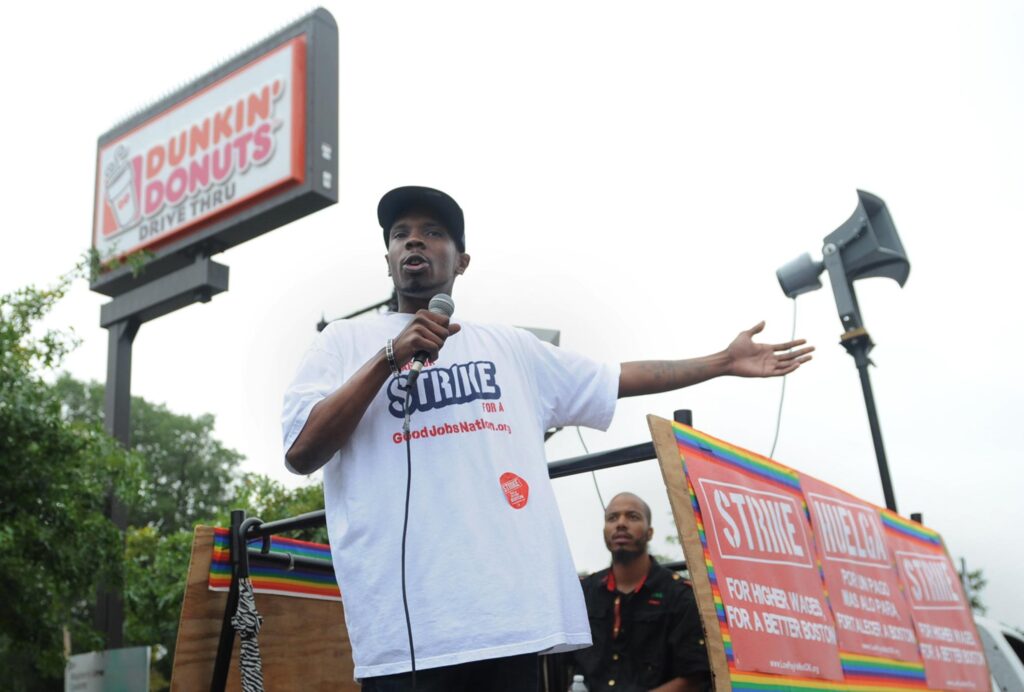
Darrin Howell, seen here during a union labor strike, is encouraging others in his situation to try to file for a pardon as well.
“I’m not allowed security clearances, and a background check will always be a barrier for me,” he said. “When the biggest professional opportunities come up in the world I’m in with politics and labor spaces, if there’s a background check, I’ll be denied.”
Feeling boxed in several years ago after being excluded from the White House and other events, Howell wrote to Obama, who did write him back a letter sympathetic to his cause. Howell said he has included that in his testimony.
Yet, he said, he also learning about this system so that he can help others through his own experiences. He said he feels like a guiding hand can reposition many lives away from having a life-long blot on their names.
“I have already helped several people fill out the petition successfully while I’m going through the process myself,” he said. “I think many more folks can demonstrate how they changed from challenges in their youth and show that they’ve gone on to be productive adults.
“I’m doing it to show that I’m ready to put my darkest moments out there and be judged on whether or not I’m worthy of moving away from that time on paper.”
Copyright © 2026 Boston Neighborhood News, Inc. This content may not be re-published or re-used without written permission.
