


Copyright © 2026 Boston Neighborhood News, Inc. This content may not be re-published or re-used without written permission.
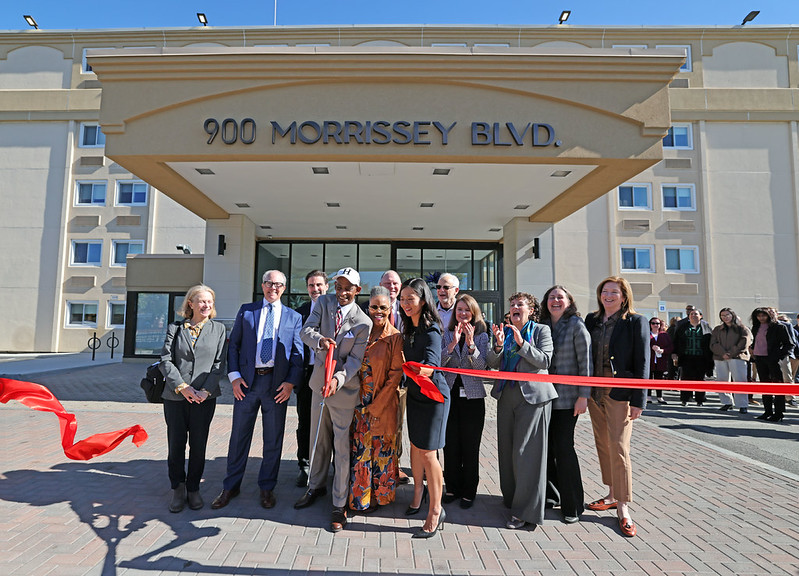
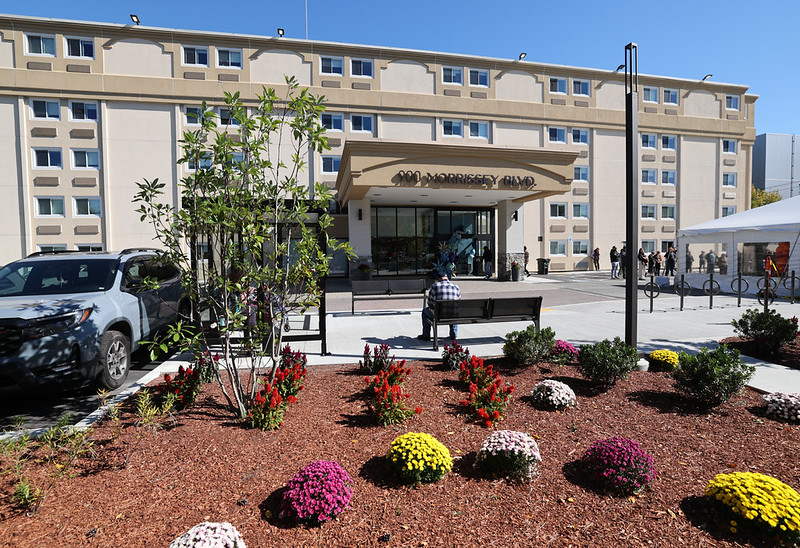
Mayor Michelle Wu joined housing officials and advocates on Wednesday (Oct. 7) to dedicate a refurbished hotel-turned-housing complex at 900 Morrissey Blvd. The event marked the completion of a four-year effort to create 99 new permanent homes for older Bostonians who have experienced homelessness in their past.
The former Comfort Inn is now operated by The Community Builders, with Pine Street Inn providing round-the-clock supportive services for residents. All 99 furnished studio apartments are deeply affordable, with Boston Housing Authority vouchers supporting the units.
The average age of the tenants living at 900 Morrissey is 68, according to Pine Street Inn president and executive director Lyndia Downie.
“More importantly everyone here is a tenant, with a key, they signed a lease, they’re a friend, they are neighbor now. They are not worried about where they’re going to sleep tonight,” said Downie, who saluted Mayor Wu and others for supporting the transition.
“Boston is taking every opportunity to ensure that all our residents have a fair chance at a safe and stable place to live,” Wu said at the Oct. 7 opening. She called the residences “thoughtfully designed for our older residents” and thanked Pine Street, The Community Builders, state agencies, and other partners who financed the conversion.
Pine Street Inn and The Community Builders first unveiled plans in 2022 to purchase the 131-room hotel and convert it into roughly 105 to 110 apartments for people moving out of homelessness. The proposal — and roughly $50 million investment— drew opposition from some residents, particularly due to its proximity to the Richard J. Murphy School and concerns about public safety and the concentration of social-service programs in Dorchester.
But supporters successfully argued that permanent supportive housing for mainly older adults in need of on-site assistance was in fact a better alternative than a hotel with a constant turn-over of transient people.
The plan was eventually downsized to 99 apartments, with a preference for residents age 62 and older, on-site staff and security, and extensive supportive services. The Boston Planning and Development Agency board approved the project in May 2023 after a public review that generated hundreds of comments.
Pine Street provides case management and assistance to help tenants connect with health care and other services. The conversion was financed through a mix of city, state, federal, and private funds, including Boston’s American Rescue Plan allocation, state affordable-housing programs, MassHousing financing, and philanthropic support from the Yawkey Foundation and Pine Street Inn.
City housing chief Sheila Dillon said the project responds to a shift officials are seeing within Boston.
“As our homeless population ages, it is critical that we create supportive housing that meets the unique needs of this demographic,” she said.
City officials say nearly 9,000 households experiencing homelessness have moved into permanent housing since Wu took office, while 668 new permanent supportive housing units have been created.
The Reporter’s John P. Forry contributed to this report.
Copyright © 2026 Boston Neighborhood News, Inc. This content may not be re-published or re-used without written permission.
