
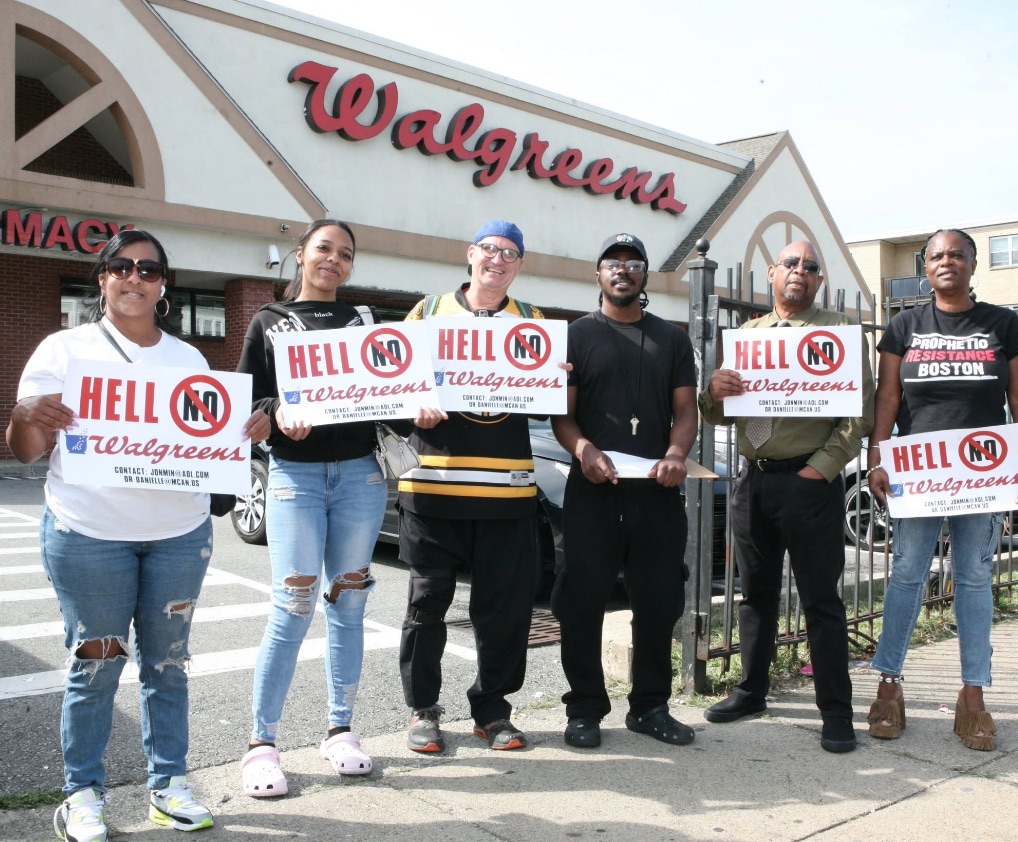

A small group of protestors who object to a spate of Walgreens store closures in Boston’s neighborhoods rallied outside one of the few surviving chain locations in Mattapan in Sept. 2025. Seth Daniel photo
By Anna Saldinger, Special to the Reporter
Pharmacist Mike Wilson has managed to keep the lights on at Dorchester Ave’s Crawford Drug by offering services that chain stores won’t match. His store near St. Mark’s church section is an oasis in a neighborhood that has, increasingly, become part of a larger “pharmacy desert” in Boston.
“We have the time to speak to people on the phone or here in the store. If you call a chain store, you won’t even get somebody to pick up,” said Wilson, who is president of the Massachusetts Pharmacy Association. “You have to leave a message and maybe they call you back. Maybe they don’t.”
More than a half-million Massachusetts residents live in an area with insufficient pharmacy access, according to data from the Massachusetts Health Policy Commission. Boston neighborhoods have become particularly hard hit as chain stores have closed in rapid succession, including Walgreen locations in Codman Square, Morton Street, and Gallivan Boulevard.
Wilson attributes the chain pharmacy closures, in part, to low reimbursements determined by insurance benefit managers. He says that Crawford Drug makes just three cents on each bottle of their lowest-profit drug, a prescription-strength ibuprofen. After paying for the label alone, the pharmacy loses money on each prescription. He describes the long-term impact of these margins on pharmacies as “death by a thousand cuts.”
Shoplifting thefts have also been cited as a reason that some of the larger chain stores have retreated from the Boston market.
State Rep. Chris Worrell, who represents the Fifth Suffolk district that includes parts of Dorchester and Roxbury, has been concerned about the attrition since his first term in the House, when a Walgreens closed on Warren Street. In the aftermath, he heard stories from constituents reeling from the loss of access.
“You do not know what it means to have a pharmacy within five minutes away from your house when your kids are sick, coughing, when you need it yourself, or if your partner needs it,” Worrell said. “I mean, it’s life and death.”
Last summer, Worrell proposed an amendment to a Senate primary care bill that would mandate a study of pharmacy deserts in Massachusetts, followed by state assessments of pharmacy services every five years.
Pharmacies would be required to notify the state 60 days before closing so that customers and local officials have time to prepare for the aftermath. And the Board of Registrations in Pharmacy would have to hold a public hearing for residents, elected officials, and other interested parties, where people would have the opportunity to voice their concerns and the board would share alternative pharmacy options for those affected by the imminent closure.
Wilson is concerned about how the amendment’s requirement to report a closure in advance would impact independent pharmacies already under stress.
“It’s a little bit of a Catch-22,” Wilson said. “You don’t want to put the cart before the horse and say we’re going to close and then people leave and you definitely close.”
A six-member House and Senate conference has until midnight next Jan. 5 to address differences in the versions passed by each branch. If the clock runs out, the pharmacy desert amendment will expire along with the rest of the bill.
Worrell doesn’t believe that his amendment is one of the sticking points in the negotiation, and he thinks that a bill will pass “before the year is over.” The legislation was approved by the House this summer, and he reports support in the Senate.
He said that crossing the finish line is a matter of “getting people to the table.”
Copyright © 2026 Boston Neighborhood News, Inc. This content may not be re-published or re-used without written permission.
