
By Jack Schwed
Copyright © 2026 Boston Neighborhood News, Inc. This content may not be re-published or re-used without written permission.
Roxbury and Dorchester residents who live in the B-2 police district are concerned about open drug use, the homeless, traffic and pedestrian safety, and enforcement of scooter and moped laws. That’s according to a recent public safety survey conducted by the Boston Police Department’s B-2 District that drew 78 responses.
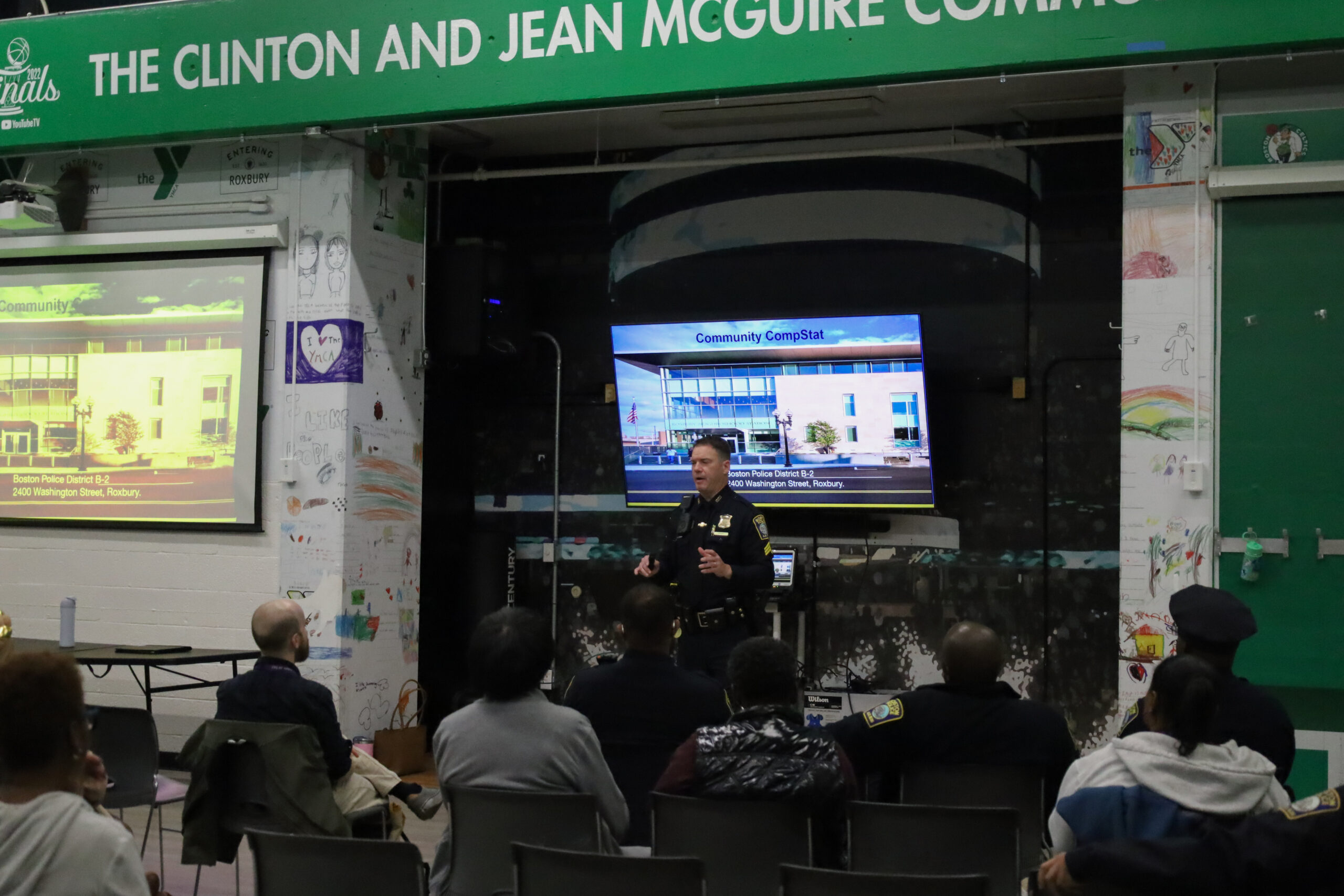
The district, alongside the BPD-operated Boston Regional Intelligence Center, addressed these concerns last Tuesday (Oct. 27) at its first Community CompStat Meeting at the Roxbury YMCA, breaking down crime trends and providing a forum for neighbors to discuss public safety issues.
Captain Adam Mammone, BPD’s B-2 commandersince March, said the goal is to host these meetings about once a month to listen to the community and develop strategies to tackle its issues.
“The police are the community, and the community are the police,” Mammone said. “Without each other, without that teamwork, without that bond, it’s more difficult, because the community is the eyes and ears for us.”
Lieutenant Zachary Crossen said scooters and mopeds are often used to conduct criminal activities, as perpetrators can flee easily using them. Enforcement against violations by riders of these vehicles became a major focus starting in late summer, in what Crossen called “Operation Kickstand.”
The number of robberies involving mopeds fell 67percent from June and July to August and September, when the enforcement efforts were implemented, according to BPD data. The total number of gunshots fired increased by 5 percent, but the number of victims hit dropped by 71 percent.
Crossen shared a case in which BPD officers attempted to stop a moped operator driving on Blue Hill Avenue without a license plate or helmet, causing the driver to crash into a car and flee into Franklin Park.
The officers discovered an unregistered handgun, illegal drugs and a knife hidden on the suspect and on the moped. The suspect, who was a repeat offender, faced outstanding warrant, firearm, drug trafficking and motor vehicle crimes.
Lieutenant Detective Dario Fancelli highlighted a series of armed robberies involving mopeds over the summer, in which the perpetrators held women at knifepoint for their gold chains and then rode off. The suspects, who were later detained and convicted, had connections to the South End and Dorchester and had been selling the chains downtown, police said.
When the unit tracked the perpetrators to a street in Dorchester, it went door to door, asking homeowners to provide security camera footage, and each person was receptive, Fancelli said. That footage helped them find an exact address, he noted.
Mohamed Abanoor, BPD B-2’s mental and behavioral health liaison, said he conducts outreach with un-housed individuals and substance users to offer mental health resources.
Since June, the department has had 369 outreach or enforcement interactions for “quality of life” issues, such as disturbances, intoxication and noise, according to BPD data. Of them, 11 percent resulted in mental health or rehabilitation referrals, 26 percent in criminal summons, and 18 percent in arrests — with charges for drinking in public, trespassing, and drug possession and distribution. Remaining outcomes involved documenting the interactions without punitive action.
Citywide calls for so-called part one “major crimes,” such as domestic assault and theft, dropped 5 percentbetween Jan. 1 and Oct. 23 compared with the same period last year, according to the data.
Commercial burglary saw the biggest decrease at 39percent, followed by rape and attempted rape at 30 percent. Domestic aggravated assault rose 38 percentand automobile theft 32 percent, the officers reported.
The number of citywide “quality of life” service calls decreased by one percent for the same time period. The largest decrease was 87 percent for prostitution, and the biggest increase was 86 percent for panhandling.
At the end of the meeting, audience members were encouraged to share public safety issues affecting them. Dorchester and Roxbury residents voiced concerns about illegal parking and open drug use.
Staci Davis, who lives on Fayston Street in Dorchester, said cars frequently park illegally on her street and occasionally in front of her driveway. She said this worries her because her mother is on dialysis and has appointments early in the morning.
“I know you guys come out doing your job, but it just seems like, ‘Just move your car,’ and that’s it,” Davis said. “It’s almost giving them license to do it again because they know nothing’s gonna happen.”
Elaine Derosa, another meeting attendee and Fayston Street resident, echoed this sentiment in an interview.
“We can’t get in and out to go to work or doctor’s appointments,” Derosa said. “We’re always on the phone with the police, trying to get things resolved. So, we’re coming to the meeting today to see what else I can do.”
Crossen, who works the midnight shift, told Davis he would have an officer hold the spot in the mornings of her mother’s dialysis appointments so a car cannot block her driveway.
Sister Virginia Morrison Muhammad, executive director of the Grove Hall Neighborhood Development Corporation, raised concerns about people congregating and using substances in the parking lot near her workplace.
“I live here, work here, worship here,” said Muhammad, a longtime Dorchester resident, in an interview. “It’s great that law enforcement and community come together to try to solve some of the critical problems that impact our community.”
This story is the product of a partnership between the Dorchester Reporter and the Boston University Department of Journalism’s Newsroom Initiative.
Copyright © 2026 Boston Neighborhood News, Inc. This content may not be re-published or re-used without written permission.
