

By Daniela Ginsburg, Special to the Reporter
Lines formed at some polling stations across Massachusetts, which opened at 7 a.m. on Tuesday and ran until 8 p.m. for the 2026 midterm elections. The Reporter asked voters which ballot questions they considered most important to Dorchester and the greater Boston area.
Florian Hall
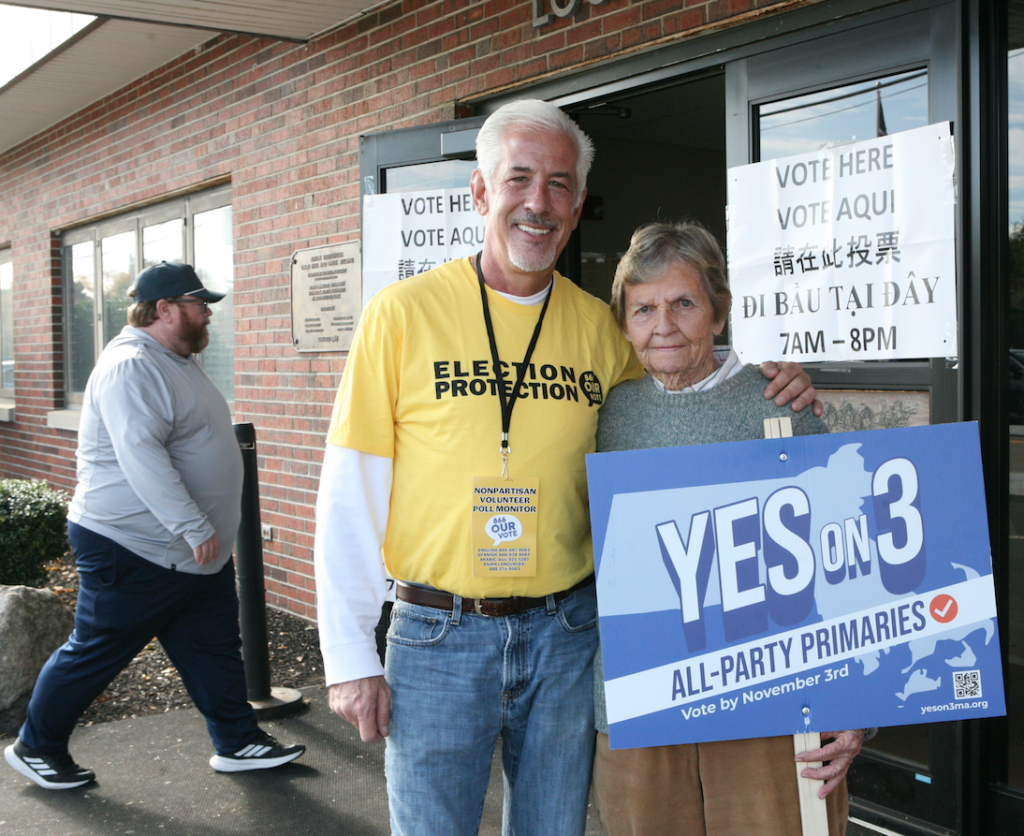
Since 7 a.m., 83-year-old Dorchester resident Mary Ann Brown (shown above) held a “Yes on Question 3” sign outside the Florian Hall entrance. She believes it is the most impactful question on the ballot for Massachusetts voters.
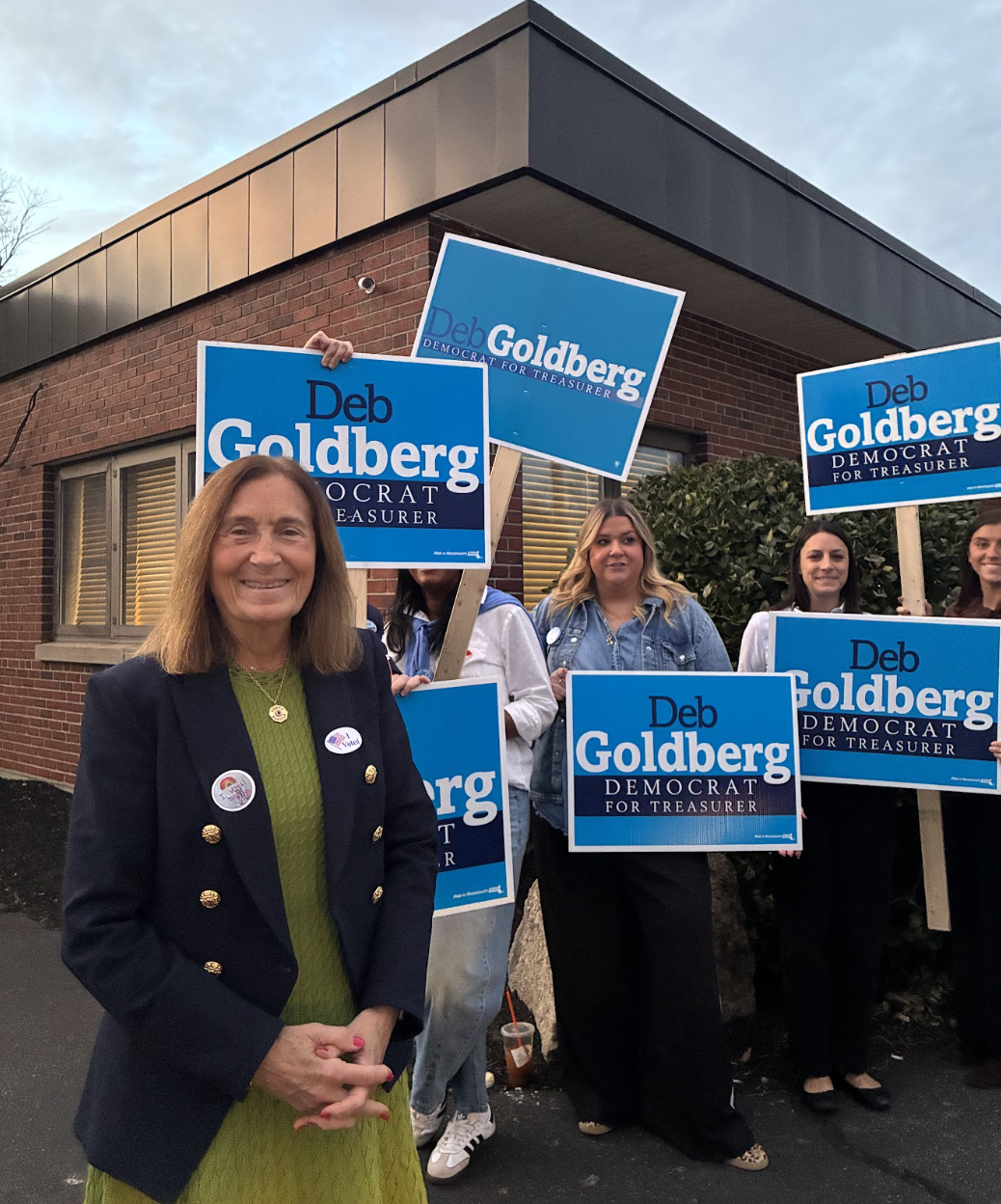
Standing outside the station, Deb Goldberg, treasurer and receiver general of Massachusetts, spoke with voters — something she said her father had taught her as a little girl — to connect “one on one.”
She comes to the Florian Hall station every year because of its ties to her family’s firefighting history, with her grandfather having helped found the 100 Club and her grandmother having served as a volunteer firefighter during World War II, she said.
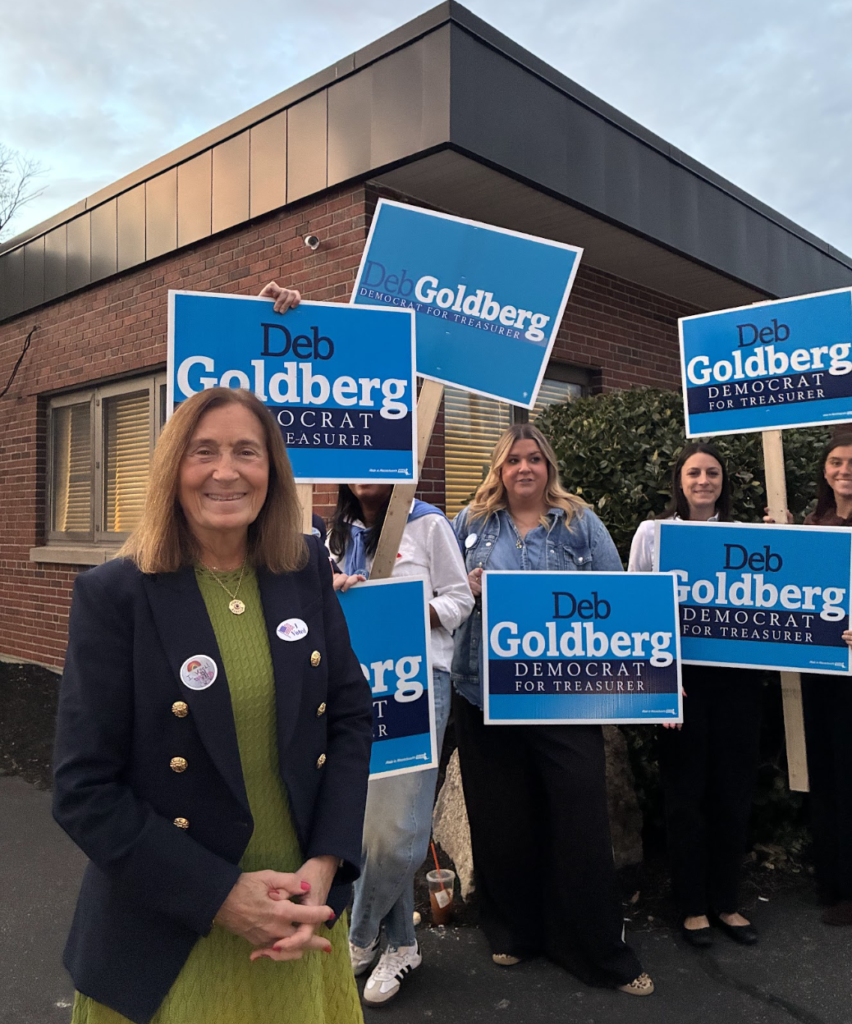
Standing outside Florian Hall, Deb Goldberg, treasurer and receiver general of Massachusetts. Photo by Daniela Ginsburg
Goldberg said she does not support all-party primaries because she believes the current process provides essential training for leaders. For Question 9, she voted to maintain gun restrictions and said for years she has filed a bill to have the state pension fund divest from companies that sell guns.
“I have always felt that people who run statewide should really serve at the local level first,” Goldberg said. “It’s where the rubber hits the road.”
Goldberg won re-election handily on Tuesday.
Dorchester resident Maura Browne, 40, said there is a need to protect green spaces amidst increasing urban development in Boston. She said there’s been a trend of single-family homes being converted into multi-condo spaces.
She believes the trends result in a reduction of green space, and that her voting focused on maintaining the character of neighborhoods.
Dorchester resident Sarah Ohagan, 47, said she voted to keep any policies the same, and didn’t want to vote on changing measures.
Adams Street Branch of the Boston Public Library
Living right around the corner on Rosaria St. from the Adams Street branch, Denise Maller, 54 said the branch had a “big turnout” inside.
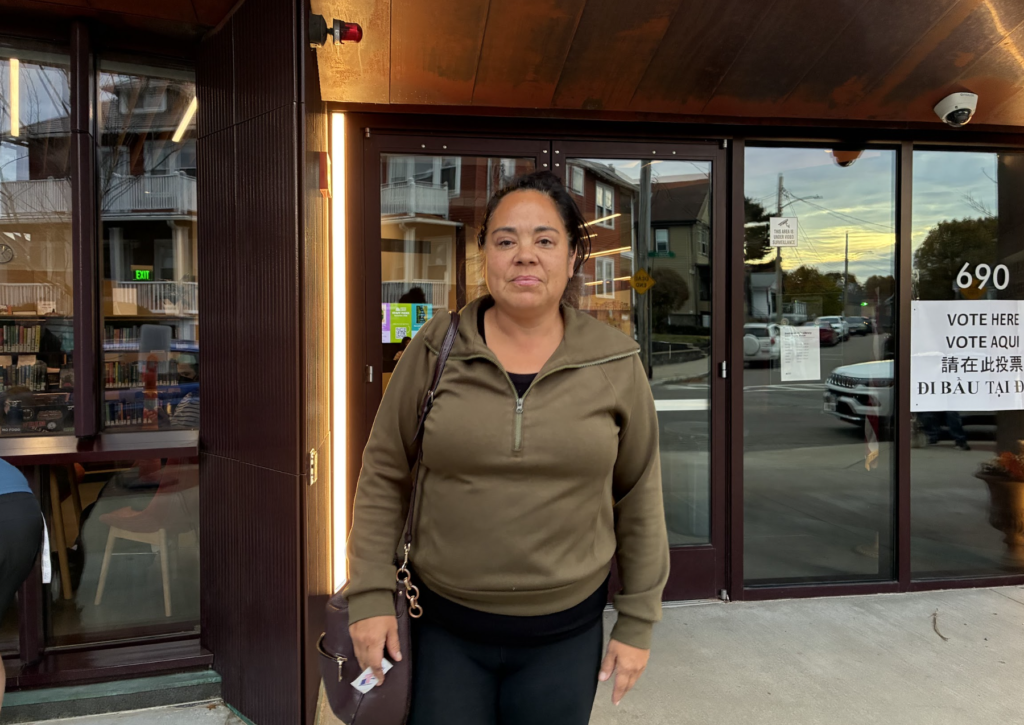
Dorchester resident, Denise Maller, 54 outside the Adams Street Branch of the Boston Public Library voting station. Photo by Daniela Ginsburg
Maller said she voted Republican most of her life, but that the past few years have pushed her towards registering as Unenrolled and that she voted for change on Question 3.
“I think it’s important to hear more voices, I think that will encourage more people to step up and run for office,” Maller said. “I think, especially with the younger generation coming out, I think it’s important to have them involved in it as well.”
Not all residents waited in line to vote — Dorchester resident Caroline Nguyen, 30, dropped off her mail ballot at the branch’s ballot drop-off box outside. She said Question 3 would affect the structure of future elections and could have positive or negative impacts, depending on a resident’s perspective.
Returning his books at the library, Sebistián Molano, 44, who voted earlier at the Saint John Paul II Catholic Academy Neponset Campus, said he’s noticed an increase in voter turnout this election cycle.
Molano said he voted for Question 6, a conservation measure, because “It’s November 3, and it’s 70 degrees in Boston, and we’re wearing shorts.”
For ballot Question 9, he voted to keep the laws the same and said that as a parent, the idea of raising kids who go through active shooter drills at school is “very scary.”
Lower Mills Branch of the Boston Public Library
Living just a block away from the Lower Mills Branch, Dorchester resident Lisa Kane, 59, said she voted to repeal the use of legalized marijuana because she believes it impacts public safety.
For ballot Question 8, Kane described the legalization of marijuana as “sudden” and said its effects were not efficiently examined.
“I was always put off when I would be walking down the street and a car would drive by and you would just smell the marijuana,” Kane said. “I’m thinking, ‘Well, he passed me if I feel safe, but I wouldn’t want to be on the road with that driver.’”
For ballot Question 3, as an unenrolled party voter, Kane said she liked the idea of having non-party voting for primaries since it would allow her to move between parties without having to choose one when she registers.
“I don’t think you should be strictly aligned with only one party, you should choose a person, not necessarily just a party,” she said.
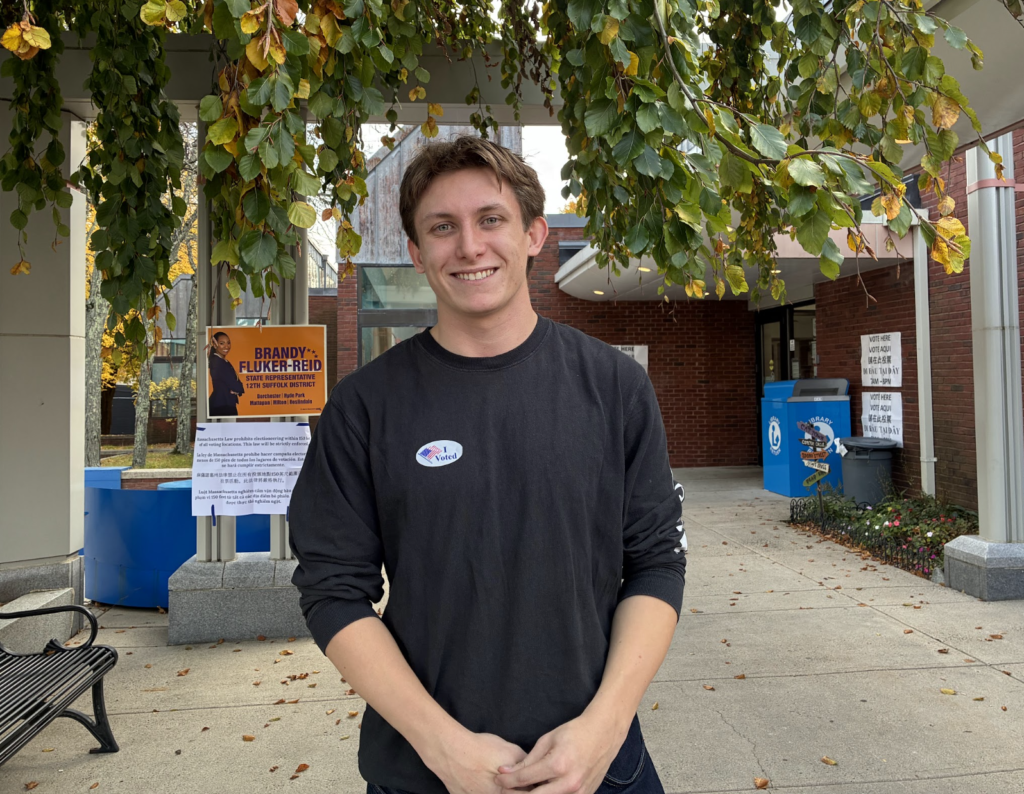
Dorchester resident, Aaron Cassidy, 20, outside Lower Mills Branch of the Boston Public Library on Nov. 3. Photo By Daniela Ginsburg
Aaron Cassidy, 20, Dorchester, said ballot questions, specifically 8 and 9 — regarding marijuana legalization and gun reform — contained confusing phrasing that could lead to voter error.
Cassidy said he did a lot of research on questions to ensure he’d vote for what he wanted correctly. He said that people going through ballot questions quickly may be voting for or against laws they support since the wording was unclear.
Dorchester resident Pat Jean, 33, a social worker who works in the mental health field, voted to keep legalized marijuana because it’s a better alternative to more harmful substances. Jean said the marijuana market creates jobs and provides a regulated alternative to illegal street sales.
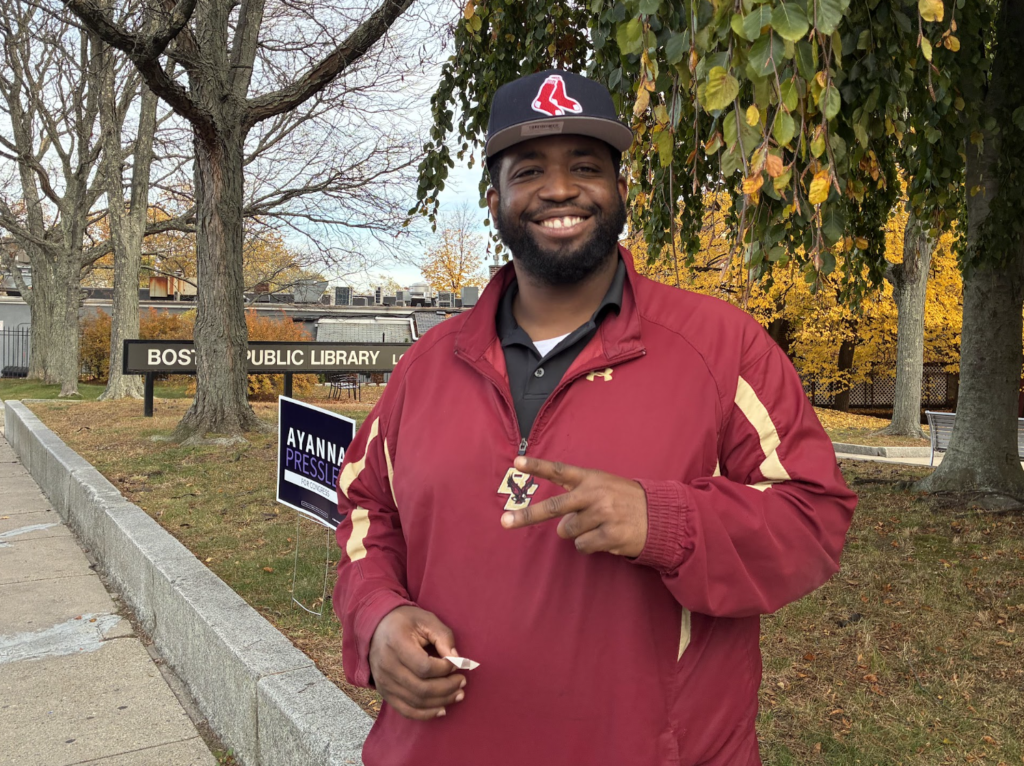
Dorchester resident Pat Jean, 33, outside the Lower Mills Branch of the Boston Public Library voting station on Nov. 3. Photo by Daniela Ginsburg
Jean (above) also voted ‘no’ on ballot Question 9 — the change option that repeals the 2024 law and reverts to the state’s previous gun regulations. As a gun owner himself, he said, “We need the right to bear arms,” and residents should have the legal right to carry in Massachusetts, since it’s legal in other states.
“I think that what all you guys see on news and TVs, I think it’s all like propaganda,” Jean said. “You go to New Hampshire, guns are legal…I feel why not Massachusetts make it all legal?”
This story is the product of a part of a partnership between the Dorchester Reporter and the Boston University Department of Journalism’s Newsroom program.
