
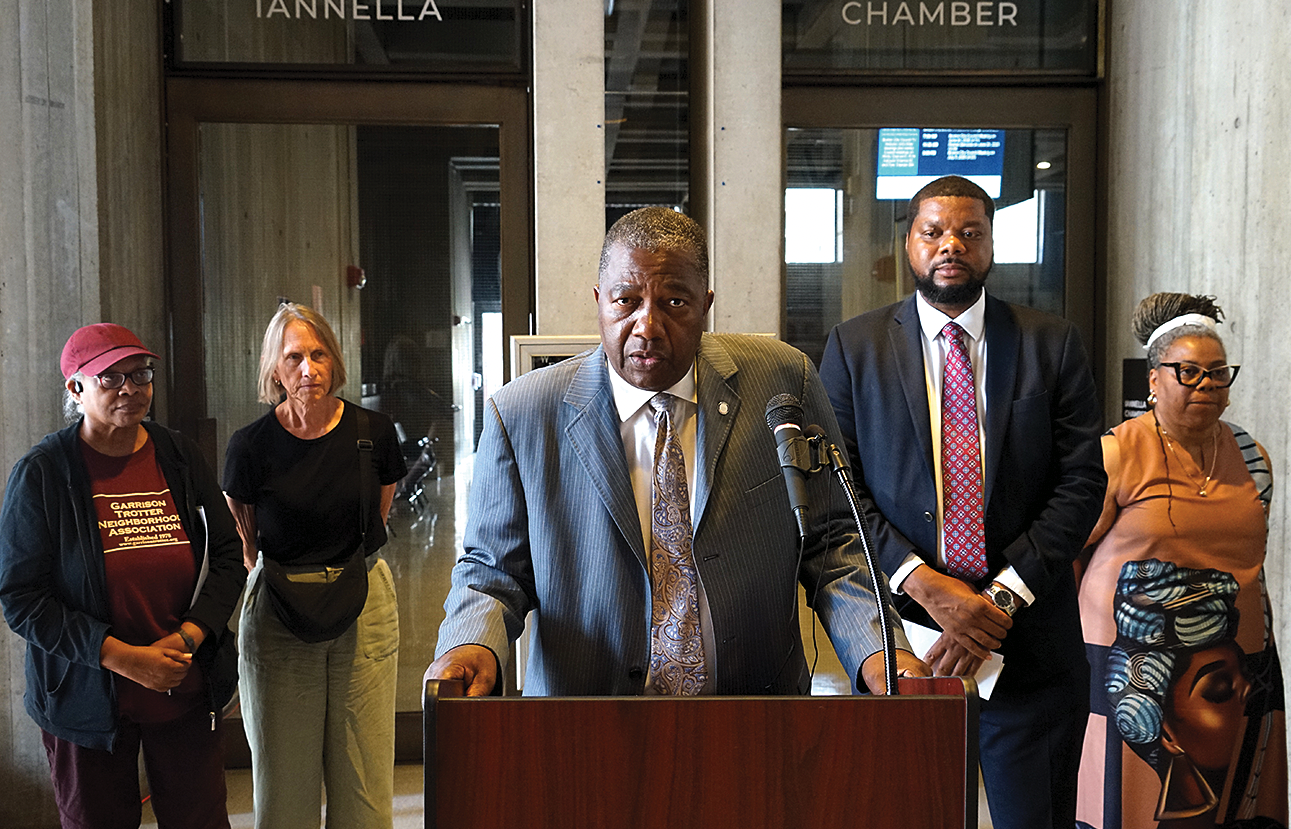
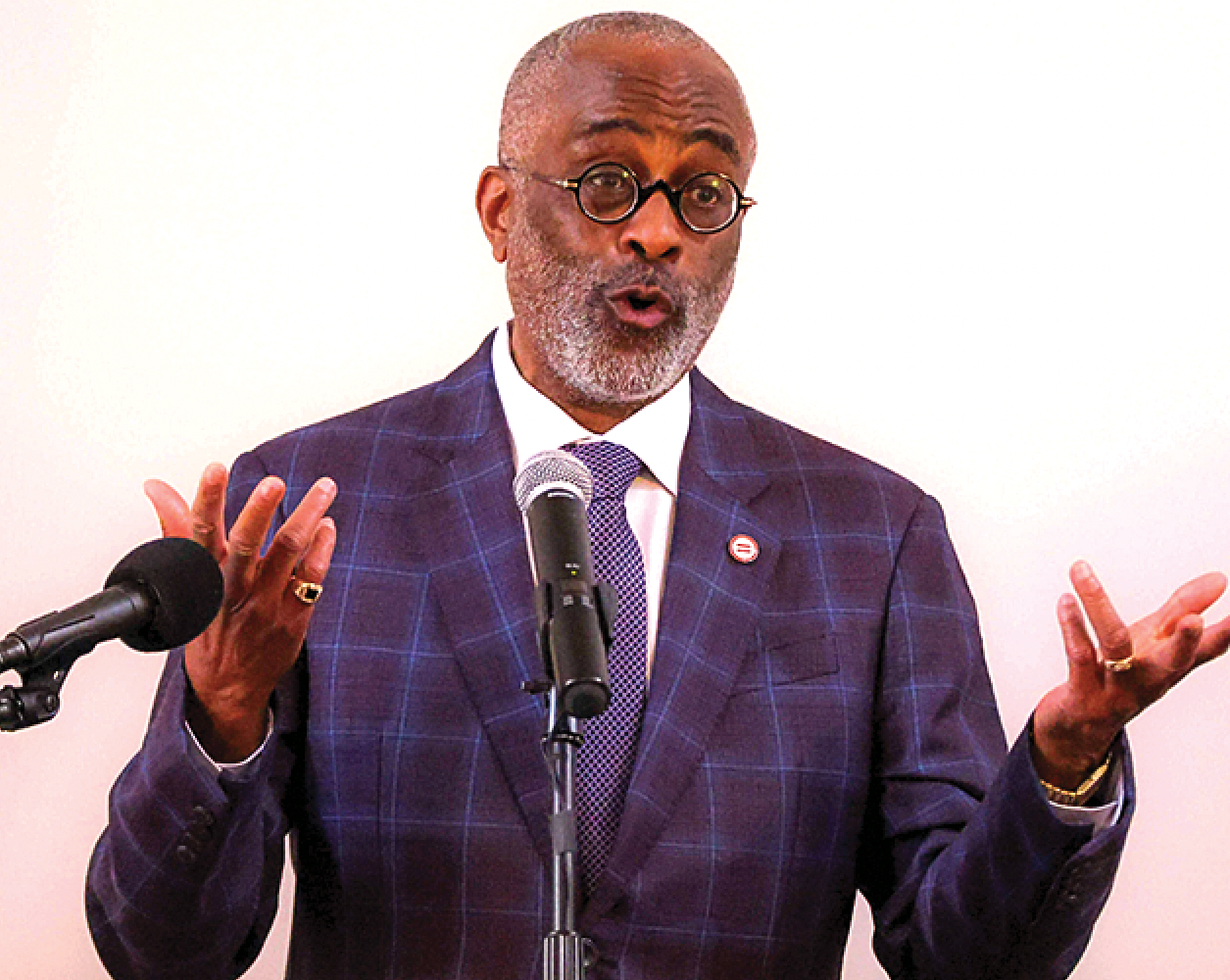
Above, Attorney Joseph Feaster, chairman of the Boston Reparations Task Force. WBUR photo
Copyright © 2026 Boston Neighborhood News, Inc. This content may not be re-published or re-used without written permission.
Members of the Boston Reparations Task Force are debating a path forward in the wake of the city’s move to drop a study of slavery in Boston that found itself mired in controversy.
Historians and an archeologist who have examined Boston’s history with slavery discussed possible paths forward after the city opted not to use a Tufts University study on slavery in Boston when the researcher who prepared the project was found to have falsified past academic research.
While the task force will still use a second report that covers the period from 1940 forward, task force members said the period from 1630 until the town abolished slavery in 1783 is essential to studying reparations.
Task force Chairman Joseph Feaster said the group will not yet make public the Northeastern study.
“Every single person has said that if you’re going to do reparations for slavery, you cannot not include the period in which slavery happened,” he said.
Historians who have studied that period in Boston suggested several paths forward for the commission, including producing another report to replace the one generated by Tufts.
The archeologist India Glenn said she is working to map where 2,300 people enslaved in colonial Boston lived. Working for the task force in 2025, she plotted 92 of the 1,040 properties of slave owners in Boston on an interactive map. Since then, she has assembled a team of researchers and unearthed the deeds of 356 properties belonging to enslavers and produced profiles on them.
“By providing tangible, publicly available information, that allows people to connect with the city they walk through every day, with the hands that worked to create it,” Glenn told the task force members. “Our team’s final goal is to have this research one day integrated into the Boston Public Schools curriculum.”
The historian Caitlin De Angelis suggested the task force convene a conference of historians who have studied slavery in and around Boston, noting that she has worked on three such projects in recent years.
“One of the things that I have observed as I’ve been working on these three projects is that there are so many projects like this in Boston and the immediate area,” she said. “There are churches that are working in their own archives, there are schools, there are museums. There’s so many projects and so much expertise in the community. But there’s not a lot of talking to each other.”
DeAngelis said that the historians, people who’ve researched their own family histories, professors who’ve written books and articles could participate in panel discussions, then produce a report from the conference.
“It’s so hard to get someone who would be able to be an expert on all of those things, but you have all these experts,” she said. “You can bring them together.”
The English began importing enslaved Africans and enslaving Native Americans in Boston in the 1630s, when Massachusetts Bay Colony was founded. The newly formed state of Massachusetts outlawed slavery in 1783, the year the Revolutionary War ended with the Treaty of Paris.
Slavery was then outlawed in Boston and in the towns that Boston annexed decades later: Roxbury, Dorchester, East Boston, Charlestown, Brighton and Hyde Park.
In the decades leading up to the Civil War, however, many Boston merchants, mill owners, and businessmen continued to profit from slavery. The Boston Reparations Task Force has sought to quantify the harms Bostonians inflicted on Black people during and after slavery.
Since it was founded in 2022 the task force has wrestled with the thorny questions of who should receive reparations. The Liberian-born historian George Walters-Sleyon alluded to the controversy in his opening remarks to the task force last week.
“Now first of all, let me just say this: My presence here has sort of raised some kind of hullabaloo,” he said.
Some members of the task force, including Nyheim Way, president of the Sons and Daughters of Freedman, advocate for reparations to be limited to African Americans who are descended from those enslaved in the United States. While the English enslaved Africans and Native Americans in Boston, Barbados, and throughout the colonies prior to the abolition of slavery in Massachusetts, Way said the goal of the task force should be to quantify the harms done to the African American descendants of Africans who were enslaved in the United States.
“I want to be clear that this is not a history project,” Way said. “It is a project that requires the history. And we need the history to quantify the harms so that this task force can submit the proper recommendations to the City of Boston to remedy the American Freeman families. Their history is the foundation. But the measurement is the purpose.”
Glenn, however, argued that the project should have the aim of setting the historical record straight in Boston, a city where historians have long stressed the population’s abolitionist leanings while downplaying its role in slavery.
“Right now, we are at a crossroads,” she said. “We can either choose to continue Black Boston’s legacy of progress and innovation, or fall into the trap of failing to take every opportunity we are presented with to ensure that our ancestors and their descendants are included in our history books.
She added: “If we claim to care about reparations, rigorous research must be completed, and Glenn archaeology is capable, prepared, and eager to complete mapping slavery so that reparations can become a reality for Boston.”
Copyright © 2026 Boston Neighborhood News, Inc. This content may not be re-published or re-used without written permission.
