
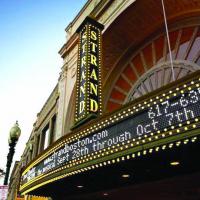

On Nov. 11, 1918 — 108 years ago today — the Strand Theatre officially opened its doors in Dorchester’s Uphams Corner, welcoming 1,800 patrons to what was hailed as New England’s most beautiful movie palace.
The grand opening coincided with Armistice Day, the end of World War I, as jubilant crowds filled Dorchester’s streets to celebrate the Allied victory. The Strand’s marquee glowed with red, white, and blue lights, marking both the historic occasion and the debut of Nathan Gordon’s $1 million theater on Columbia Road.
In a November 2002 article for the Dorchester Reporter, historian and author Peter F. Stevens recounted the excitement surrounding the Strand’s opening night and the extraordinary architectural splendor that made it a landmark of the silent-film era.
By Peter F. Stevens
On the night of November 11, 1918, the people of Dorchester were celebrating, and Upham’s Corner was the place to be. Cheers and honking horns pealed throughout the city, as they had all day. Residents whose faces were streaked with tears of elation hugged one another, for the news that World War One — “The War To End All Wars” — was finally over had arrived at Dorchester’s telegraph offices early in the afternoon and was trumpeted in “Extra” editions of all the local newspapers. Germany had surrendered, Dorchester’s Doughboys would soon be coming home from the nightmarish trenches of the Western Front, and the town was in a festive mood.
Nathan Gordon was opening his Strand Theatre, on Columbia Road, that night at 8 o’clock, and the people clotting Dorchester’s streets all day inevitably headed toward the glittering movie and vaudeville palace, whose marquee pulsed with specially arrayed red, white, and blue lights that testified to America’s decisive role in the victory over Kaiser Wilhelm and “the Hun” and drew a horde of moviegoers and curiosity-seekers to the gleaming theater.
Caught up both in the euphoria of victory and at the visage of the grandly styled emporium, Boston’s newspapers lauded the movie house that Gordon had built. The Boston Traveler gushed: “Telegrams and messages of congratulations on the crowning success of his career are pouring into Mr. Nathan Gordon’s office.
“The Strand is New England’s most beautiful theatre, and Boston and New England have reason to feel proud of this wonderful theatre, and cause for congratulating themselves that Mr. Gordon is a New Englander, and has erected this monument to his career in his home town.”
According to many film historians, Gordon was the man who designed the region’s early movie map. He was already the owner of 75 movie theaters when the Strand, designed by a Boston architectural firm, bathed Upham’s Corner in a splash of patriotic light on November 11, 1918.
Gordon had started out in the movie-house business with a diminutive nickelodeon in Worcester in 1903 and had opened Boston’s first bona fide movie theater, Washington Street’s Olympia, which would one day become the Pilgrim Theatre. In 1916, he scrutinized Marcus Loew’s refurbishment of the Music Hall into the Orpheum, which made his own theater appear shabby in comparison. Gordon announced a year or so later that he intended to build Boston’s first million-dollar movie theater — outdo his rival Loew, as well as net a fortune.
Built at a cost of a million dollars — a staggering sum for the era — the Strand’s opening-night marquee proclaimed that the feature silent reel was “Queen of the Sea,” starring Annette Kellerman, a well-toned silent-screen starlet who gained notoriety for her brief flash of nudity in the film “Daughter of the Gods.”
In the silent-film era, a theater’s organist was a key ingredient of the viewer’s experience, the music swelling or softening with each scene. The Strand featured a massive Wurlitzer organ priced at $75,000, and for opening night, Gordon had hired organist Arthur Martell, dubbed “America’s great motion picture musical interpreter”; he not only provided the musical accompaniment to the film, but also for live headliner Emilie Earle, “the songstress deluxe.”
Taking in the opening-night show were 1,800 patrons who gaped at the Strand’s huge dome, its vibrant murals, its massive, stained-glass arched windows, a marble aquarium, dazzling chandeliers, shimmering mirrors, sweeping mezzanine, and 100-foot-long lobby.
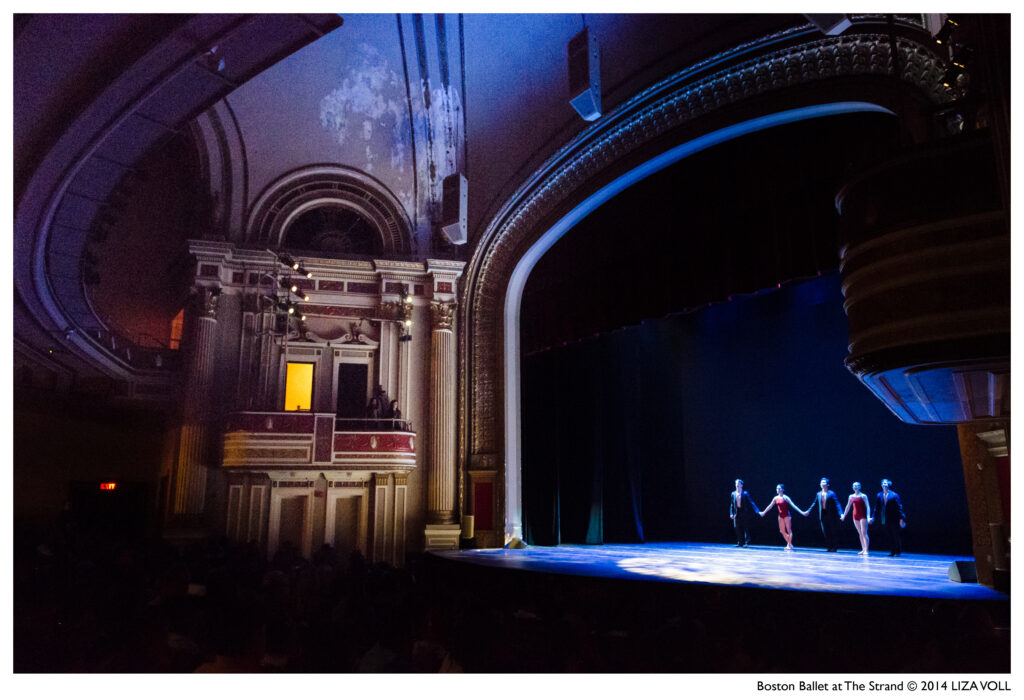
Architectural historian Douglass Shand Tucci writes: “Certainly, it [the Strand] was, and is, a splendid prototype [of early movie palaces]; a vast cream and gold and crimson temple erected to the glory of ‘photoplay’ by McGahey and O’Connor after the designs of Funk and Wilcox of Boston. Its…auditorium, surprisingly intimate and with startlingly good acoustics, was the wonder of its day — most notably…for the rich polychromatic lighting that derived from well over two thousand light bulbs in an age when most homes were still lit by flickering gas jets.”
The Strand quickly became the place to be in Greater Boston, lines of people stretching far down the block hours before a show began, eager to take in the “flickers” and vaudeville acts. In the months following the theater’s gala opening, locals watched the first-run silent films of D.W. Griffith, R.C. Fields, Rudolph Valentino, Charlie Chaplin, Buster Keaton, the Gish sisters, the Barrymores, and many other titans of the movies filled the Strand’s massive screen. Later, the “talkies” debuted in the Dorchester theater with the Marx Brothers’ film “Coconuts.”
Vaudeville lovers also streamed into the Strand throughout the Roaring Twenties, mesmerized by such stars as Milton Berle, Fannie Brice, Fred Allen, Jack Haley and Eddie Bracken. Understandably popular on the theater’s stage was Ray Bolger (later the Straw Man, in “The Wizard of Oz”), who grew up in Dorchester.
The Golden Age of America’s movie palaces was in full swing in the 1920s, and nowhere was that fact more discernible than on Upham’s Corner. Change, however, loomed for both the Strand and its legions of patrons. The crash of the stock market in 1929 and the onset of the Great Depression would reshape the Strand’s role from a glittering symbol of the Roaring Twenties to a haven for people wracked by the economic woes of the 1930s and seeking a few hours’ solace in front of the Dorchester theater’s movie screen.
Editor’s note: This article originally appeared in the Dorchester Reporter on November 14, 2002. It is republished to mark the 108th anniversary of the Strand Theatre’s opening on November 11, 1918.
