


On July 1, the UP Academy Holland reverted in name and function to the John P. Holland Elementary School, officially exiting state receivership status after 12 years under the management of the non-profit UP Education Network.
In December, the state Department of Elementary and Secondary Education (DESE) voted to allow the K-6 school on Olney Street, with an enrollment of 628 last year, to exit the UP network’s oversight, which began in 2014 when it became Level 5 and was labeled a “chronically underperforming school” that required a takeover.
“I commend the students, families, educators, staff and leaders of Holland, both past and present, for their relentless striving toward excellence that has improved student learning outcomes, including meeting 90 percent of the school’s annual improvement targets in the 2025 state accountability results,” wrote DESE Commissioner Pedro Martinez in December.
“I am grateful,” he added, “for the commitment of UP Education Network to sustaining the school’s transformative culture throughout its period of state receivership, by continuously refining professional learning systems and investing in innovative learning experiences for all students.”
The Holland is one of the few schools put into receivership in the early 2000s that emerged better and didn’t close, said Hillary Casson, CEO of UP Education Network and before that a long-time administrator at the Holland. The Paul Dever School on Columbia Point was also put into receivership around the same time, but didn’t improve greatly and closed this June.
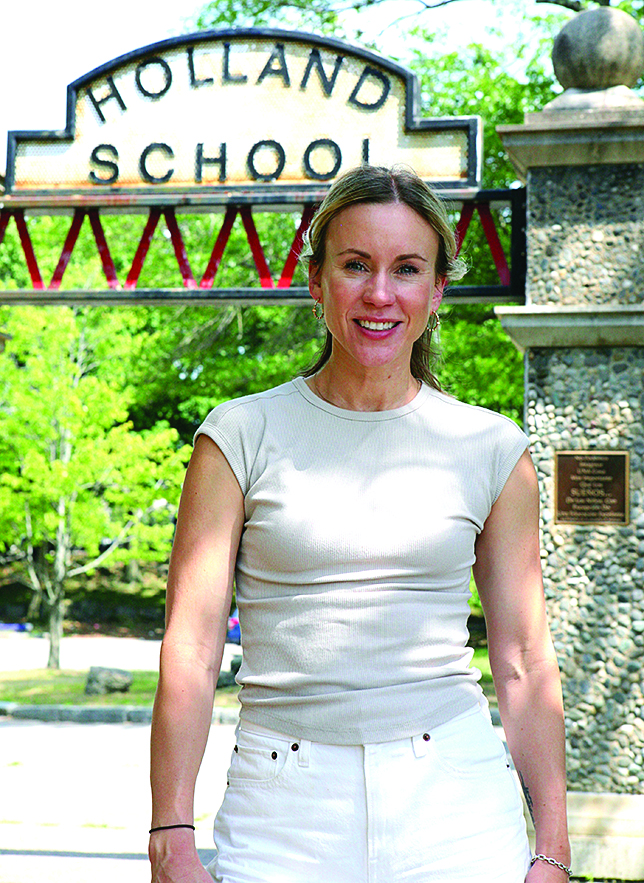
Hillary Casson, UP Educational Network CEO in front of the school last week.
Seth Daniel photo
“It shouldn’t be lost that the Holland is the first school that’s exited chronically underperforming status on successful terms,” Casson said in an interview at the school on July 13. “There are proof points here. There are opportunities to figure out why things worked here. We should figure out how we are going to transfer these successes to whatever the new school intervention approach becomes.”
Casson has spent most of her time a an educator at the Holland, serving as assistant principal when it went into receivership, and later becoming the principal in 2016 – overseeing a time of great improvement for teachers, students and families.
She left to lead the UP Education Network; a non-profit formed in 2010 to work with Boston’s underperforming schools that continues to operate the UP Dorchester in-district charter school on Westville Street (the former John Marshall School). But even after leaving, she continued to be a principal coach at the Holland until last year.
Her identity has become “uniquely tied to the school,” she said. And with that she hopes that while the takeover model is no longer preferable statewide, the lessons of the Holland can be applied to other schools in need of change.
In only four years the school went from being one of the worst in the state, in the first percentile, to hitting the 32nd percentile of schools and hitting 95 percent of their academic targets in 2017. They’ve maintained scores in the 20th and 30th percentile ever since and continue to meet their academic targets annually.
This past year, the school was the second highest school for English Language Arts (ELA) growth in Dorchester and a top 10 percent districtwide. Additionally, Holland third graders outperformed BPS and statewide students in math among high-needs schools with 53 percent meeting or exceeding expectations.
“There’s certainly more work to do, but it’s a huge improvement since we started this,” said Casson. “We reached the 32nd percentile and that wasn’t a flash in the pan. We didn’t tank. That goes to the longevity of the improvement.”
Casson recalls a moment in the summer of 2016 when they were digging into test scores, which she described as “pretty bad,” but found some bright lights in the fifth grade. They felt they could expand that success school-wide.
“There was hope,” she said. “I sat down with the retained staff that summer and said, ‘Let’s get this done. Will you hard charge at this with me?’ And they did.”
With everyone rowing in the same direction, their theme was “Brains On,” and everyone bought into it. Soon enough, they had surged in their scores, meeting 95 percent of their academic targets that year.
“It was a big jump, but I saw the evidence in the classroom and teachers engaged with every kid and it was a quick turnaround in payoff,” she said. “That was a team effort. You only achieve growth at a school with community buy in and we had finally achieved that.”
Some of the keys to the success include having time to make changes. While 12 years might be excessive, she said, there wasn’t pressure to get things done fast.
Meanwhile, receivership status allowed them to make changes quickly even with resistance, and to change working conditions without union negotiations. With the same amounts of funding, they had flexibility to use their funding differently – and they focused on teacher development.
In teacher trainings, known as professional development, they focused narrowly on two or three key points and stressed them every session. Instead of widening the focus and overwhelming everyone, they kept things simple.
“We were able to really put on blinders to other things and say what it is we would be obsessed with for that particular school year,” she said.
That created teachers who felt fulfilled and growing in their skills, resulting in 80 to 90 percent teacher retention rates at the Holland over time. That includes new Principal Amelia Massoud-Tastor, a teacher during receivership who worked her way up to school leader.
Those “autonomies” to act quickly were also leveraged with special learner populations. With an enrollment in 2014 of around 850 students in K-6, the Holland was large and had several offshoots like a special Vietnamese program and a Spanish-language program.
They quickly found that the language programs were segregating the school – with classrooms comprised of only Vietnamese students, only Dominican Republic students, or only Black students. Making a quick change, they began teaching by English proficiency instead of by native language. So, the medium ability students were grouped with others of the same level no matter what their native language.
“We made that change and showed great improvement,” Casson noted. “That’s an example of the autonomies we had. Our Language Learners had the largest growth in the state after we did that.”
More than academics, Casson said, the school has become a place where people are happy, and parents are confident their children with be safe and well educated. That, along with the documented improvements, she described as “a gift.”
“I do feel it’s changed, and people feel happy when they’re here,” she said. “That’s really nice to see and that took time. People don’t want change when they’re used to something. When we came in there was resistance to our changes. But the word now is spreading that it’s a quality school. If I lived here I would send my kids to the teachers here.”
Under its exit plan, the John P. Holland Elementary School will retain the UP Education Network for at least one more year to ensure a soft landing and prevent destabilizing academics.
