



The issues facing nurses at Boston Medical Center (BMC) are common to healthcare workers across Boston and around the country: stagnant wages, declining staffing levels, and increasing costs of living.
“We are being asked to carry unsafe staffing levels that put everyone at risk,” said nurse Salisha Ali, who joined a July 22 picket line in front of the Harrison Avenue entrance to BMC last week. “We should be able to go to work and feel safe being there.”
The BMC picket came on the heels of the largest nurses strike in Massachusetts history, when more than 400 nurses walked out at Mass General Brigham during the second week in July over pay raises they said aren’t keeping pace with inflation. Doctors and at least one patient joined the nurses on the picket line.
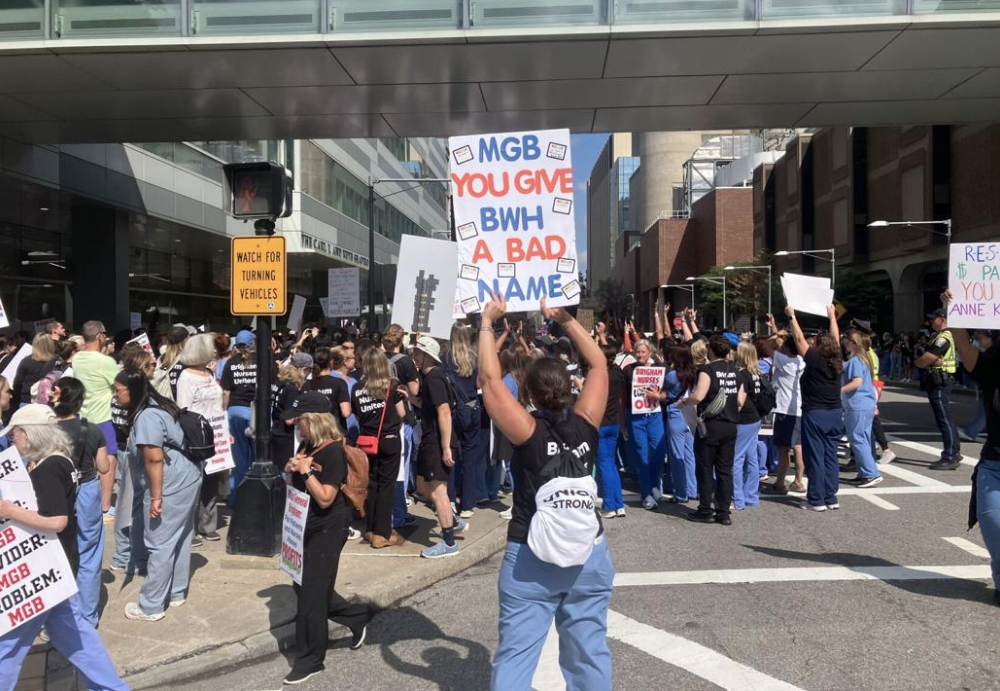
More than 4,000 registered nurses at Brigham and Women’s Hospital went on strike on Wednesday, July 8, 2026. Alison Kuznitz/SHNS photo
On July 15, workers with SEIU Local 509 rallied in Allston to press MAP Community Services for pay raises workers said they need to live in the Boston area.
“Most of us have two jobs and work extra hours,” said Ralph Mwafor, a caregiver who works with disabled adults for MAP Community Services. “Getting by in this industry means working as much overtime as you can.”
Mwafor says he works as much as 70 hours a week. “I’d rather not work that many hours,” he said. “Everybody wants to live with less stress and do their best work. If you have a single job that pays you well, you can be more beneficial to your family and your community.”
The healthcare workers who have struck and picketed in recent weeks are pushing back against broader economic pressures affecting workers around the country as the Trump administration has moved to reduce government regulation of industry, says Darlene Lombos, president of the Greater Boston Labor Council.
“There’s been a change in the economic climate,” she said. “Hedge funds and corporations are feeling emboldened to see what they can get away with. Workers are being tested to see if they’ll actually go on strike. Their estimation is that we won’t, and they’re wrong.”
While Boston Medical Center is a nonprofit, it faces many of the same pressures from increasing prices of drugs and medical devices at the same time health insurance firms are making record profits with the seven largest firms raking in $54 billion in 2025.
The largest insurer, United Healthcare earned more than $30 billion in profits in 2024, the same year its CEO, Brian Thompson, was gunned down by a lone gunman said to be incensed at the insurer’s business practices, including its proclivity for denying claims preemptively.
Healthcare costs are a major driver of the increasing cost of living, accounting for 18 percent of overall US spending.
Ratcheting up the pressure on BMC and other community hospitals was the declaration of bankruptcy by Steward Health Care, a private equity fund-run hospital chain, that resulted in the closing of eight hospitals in Massachusetts in 2024, including the Carney Hospital in Dorchester. BMC and other hospitals in Milton and Jamaica Plain have absorbed some of the emergency room visits from the Carney, increasing the workload for nurses there.
On the BMC picket line July 22, Hannah Didehbani, a teacher at Madison Park High School, said she felt compelled to join the nurses’ picket to push back against the corporate overreach affecting health care workers.
“The system we’re living under is built to maximize profits in every field, including healthcare,” she said. “The bottom line has always been profit, but health care has gotten more expensive and people are doing worse with no raises.”
At BMC, the economic pressures on heathcare workers have nurses at their wits’ end, said Marlon Washington, a vice president at SEIU 1199, which represents BMC employees.
“Nurses are being asked to do more with less,” he said. “We’re seeing workers burning out.”
The BMC nurses are among the lowest paid in Boston and have been in negotiations with management since April.
“We’re close to the end, but wages, safety, and healthcare are what’s holding us up,” Washington said. “Even for our members who are the top earners, their benefits aren’t keeping up with the increasing cost of living.”
As is the case at other hospitals, management at BMC has kept staffing low and relies on traveling nurses to fill shifts. Washington says the traveling nurses are unfamiliar with the patient population at BMC and, therefore, often overlook their unique needs.
“It’s putting patients in unsafe situations,” he said.
Joining the BMC nurses on the July 22 picket line were elected officials, including state senators Liz Miranda and Nick Collins, state Rep. John Moran, and city councillors Ed Flynn, Erin Murphy and John FitzGerald.
“You serve the most critical needs patients in the city,” Murphy told the workers marching by in the picket line. “When our city hospital has an unsafe work environment, we have to stand with you.”
Miranda, who receives health care at BMC, said the struggle the nurses are facing in negotiating with management is common at this moment.
“They’re giving people nothing,” she said of management. “It you’re going to negotiate in good faith you should offer them something real.”
While strikes seem more and more common in recent years, with teachers doing so in towns such as Andover and Malden, Marlon Washington says it’s a good thing workers are willing to stand up to management.
“Because of the time in history we’re in, because of the political environment and the economy, workers are feeling they need to stand up,” Washington said. “Everyday people are struggling while billionaires are getting richer. For so long we’ve been pitted against each other. Now workers are saying, ‘We’re not to blame.’ They saw Steward Health Care closing hospitals while executives walked away with millions of dollars.”
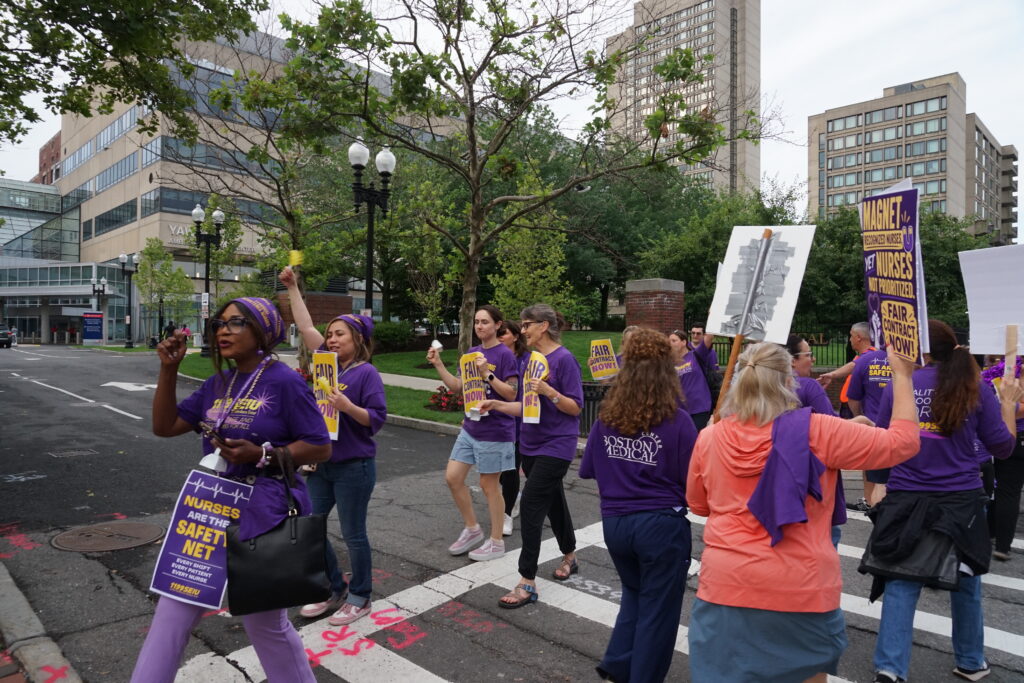
Nurses picketed at the Harrison Avenue entrance to Boston Medical Center on July 22. Yawu Miller photo
