
On a December morning in 1976, Rev. James K. Allen unfurled two pages of the Declaration of Independence on a kitchen table at First Parish Church in Dorchester.
The Unitarian minister of Dorchester’s oldest religious congregation shared his conviction that the fragile likeness of handwritten lines and insertions was an original manuscript, and he hailed its retrieval as a “bicentennial Christmas present.” In a time of division in his city, it was a cleric-historian’s long-shot bid for unity.
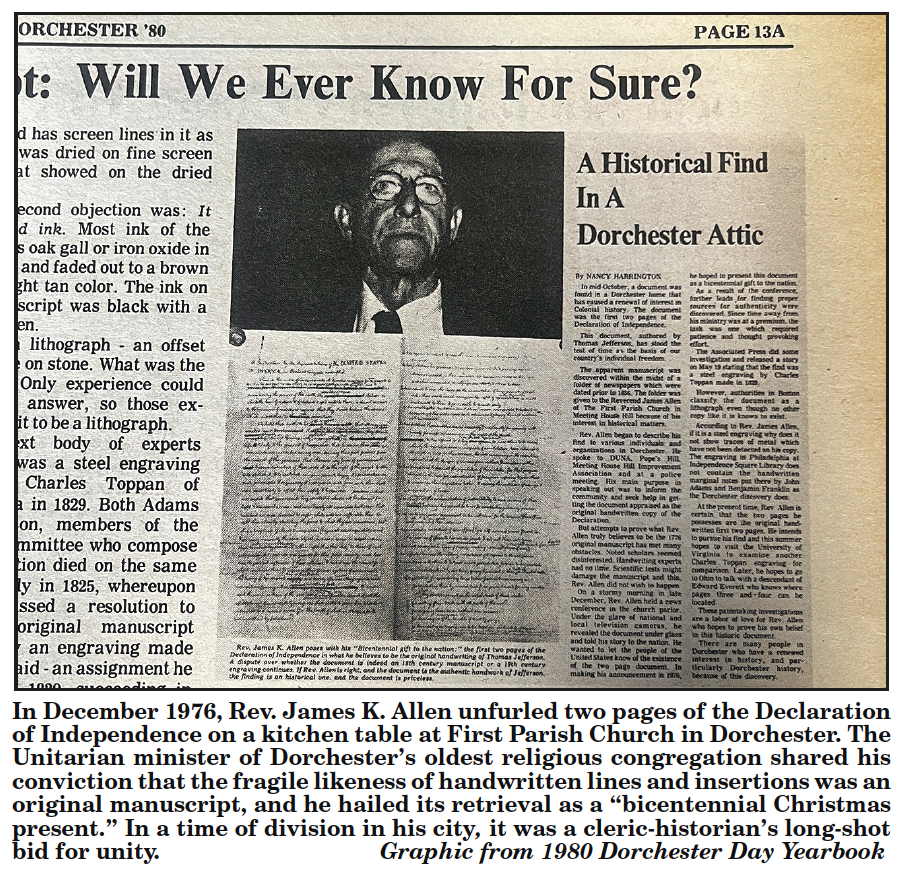
Although his claim would remain unauthenticated, Rev. Allen’s trail of clues and speculation advanced another storyline—about how ideas matter, even when their meaning is fiercely contested, and how a timeline of separate events could be reshaped, with linear history morphing into the cyclical pattern of scripture.
And, if 1976 could evoke 1776, another pivotal moment could serve as a “distant mirror” fifty years later.
Earlier in 1976, Boston observed the nation’s bicentennial with a splendor of historic celebration that was clouded by contemporary troubles, from neighborhood disinvestment and demographic change to flare-ups of racial violence that peaked with the beginning of desegregation of the Boston Public Schools (BPS) two years earlier.
On July 4, while the national milestone was being celebrated at the Charles River Esplanade, all available police cruisers, according to The Boston Globe, were dispatched to Dorchester for a “racial disturbance” on Melbourne Street. It was a skirmish between a group of white youths and a Black family that had been harassed earlier the same year, after moving into the predominantly white neighborhood near Wainwright Park. But neither event could match the durable impression left by a single photograph of a Black lawyer being attacked in April of that year by a white man who weaponized an American flag.
The copy of the Declaration brought to Rev. Allen a few months later was part of an attic hoard that had been hauled from a Dorchester mansion a half century earlier. The two pages were in a pile of old newspapers, right under an issue dated June 11, 1853.
It so happens that the same day’s edition of the city’s patrician newspaper, The Boston Evening Transcript, had a front-page review of a new book on Dorchester history—going back to the town’s founding by English settlers in 1630. That earlier story of migration and pursuit of freedom—and conflict with the native population–would have parallels in the mid-19th century and after.
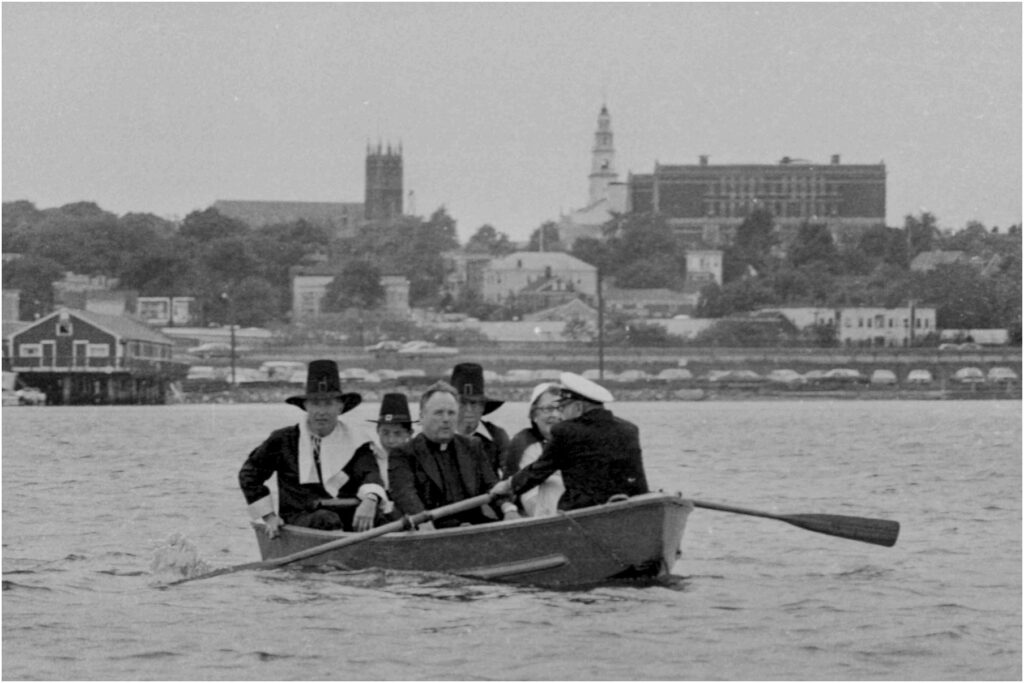
Above: Landing Day in Dorchester, circa 1980. Once part of the annual Dorchester Day observances, Landing Day ceremonies were held each May to commemorate the arrival of English Puritan settlers to this place in 1630. Above, a group that included Dorchester Day organizers like Rev. James K. Allen of First Parish Church, Earl Perkins and Rev. Francis Crowley, then the pastor of St. William’s Church, may be seen with the steeples of First Parish and St. Peter’s and the hulking Mather School in the background. Chris Lovett photo
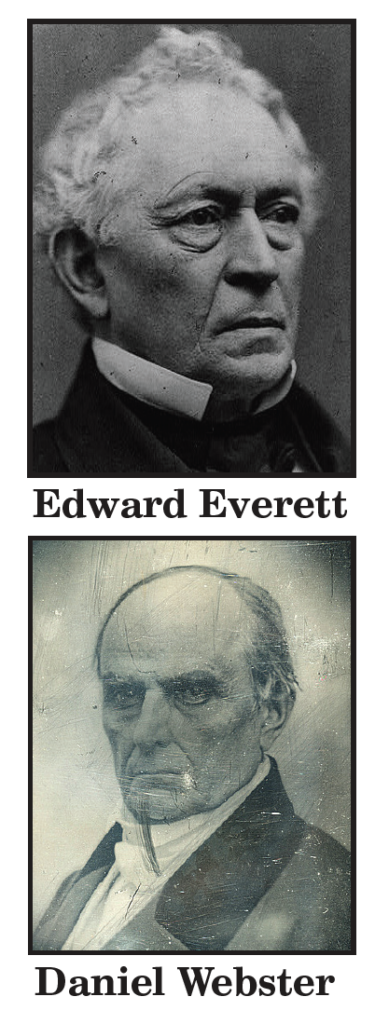
Rev. Allen re-echoed the history through “Landing Day” re-enactments and invocations at community gatherings, which he related to the colonial town meetings that he considered a framework for the US Constitution. In the text of the Declaration, he spotted a phrase that matched some of the wording in a pro-independence resolution that had been approved earlier at a Dorchester town meeting. Based on that clue, he speculated that the pages might have eventually reached a politically prominent Dorchester native, Edward Everett, a scholar, orator, and Unitarian minister who would also hold elected office in the State House and Congress and serve as the nation’s secretary of state.
Everett was elected to the US Senate in 1853, following the death of his fellow-Whig and political mentor, Daniel Webster, who sometimes attended services at Second Church, in Codman Square. Two years earlier, the state’s other Senate seat was captured by Charles Sumner, a Free-Soil candidate who, like Everett, had graduated from Harvard University and studied at Boston Latin School.
The two senators took office during a time of territorial expansion and a surge in the profitability of slavery, partly enabled by the invention of the cotton gin. After territorial expansion from the Mexican War came the California Gold Rush of 1849, with rail expansion later putting Kansas and Nebraska on a track to statehood.
Congress’s response to expansion was the “Compromise of 1850,” an attempt to preserve the union through a political trade-off: in return for more “free” territory, there would be more of a reach for slavery, whether as an on-the-ground practice or in a wider field of enforcement against what Webster conscientiously referred to as “fugitives from service.” This rationing of human rights also affected the balance of power between the two main political parties—the Whigs, more dominant in the north, and the Democrats, more dominant in the south and among urban immigrants.
A seasoned contender for the presidency, Webster was a key member of the bipartisan and trans-regional team that won approval for the compromise in the Senate. His oration advocating the legislative package would be hailed more than a century later by John F. Kennedy, a Catholic, at an appearance in Kentucky during his own run for president in 1960, as “the greatest speech in the history of the United States Senate.”
Despite the South’s historic aversion to Catholics, Kennedy and Texas Sen. Lyndon B. Johnson that year carried seven states that were formerly in the Confederacy, along with about 70 percent of a Black vote that formerly leaned Republican.
Because Webster knew that his appeal for national unity would antagonize much of his base in Massachusetts, Kennedy had saluted it even in his 1956 book, “Profiles in Courage.” Webster acknowledged the moral objections to slavery in the North, yet distinguished between an “abstract question” and day-to-day practice. Webster summed up the practice in the South as “an established relation of society” in which slaveholders were taught to treat “subjects of bondage” with “care and kindness.” According to Webster, the southern view was based on a sense of “natural law” that envisioned little prospect for change.
The most controversial part of the compromise was the “Fugitive Slave Law,” which expanded enforcement powers throughout the country, even in “sanctuary” states such as Massachusetts, where slavery had been abolished in 1783. There were new incentives for capture, but limited legal protections for people accused, correctly or not, of being fugitives.
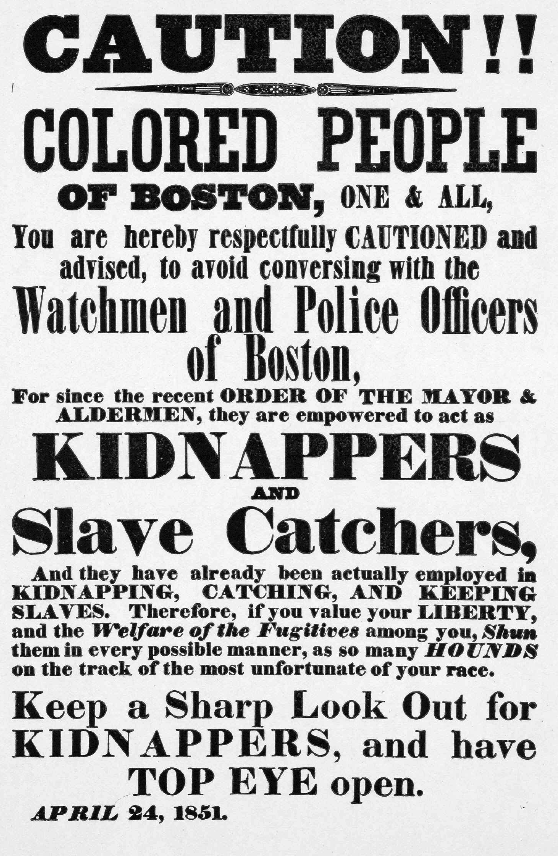
A warning poster circulated in Boston in 1851. Library of Congress
Defending the act in Boston shortly after its adoption, Webster said that slavery opponents would have to put aside “prejudices” for the more urgent obligation to observe the Constitution and preserve the union. But, in a city where the Black population included residents who had fled slavery, enforcement of the law would only make Webster’s “question” less abstract.
In 1851, the law was enforced in Boston against 17-year-old Thomas Sims. After working as an enslaved brick maker on a plantation in Georgia, Sims fled to Boston, where he lived at a boardinghouse in the North End.
According to “Black Bostonians,” by James Oliver and Lois E. Horton, Sims was arrested by two Boston police officers who had been deputized as federal officers, despite local restrictions on cooperation with enforcement of the new law. After initially being told that he was wanted for theft, and then told he was sought as a “fugitive slave,” Sims resisted arrest and wounded one of the officers with a knife.
After a trial and an unsuccessful attempt to free him from the courthouse, Sims was marched, under heavy guard, for shipment back to Georgia, from Long Wharf—Boston’s hub for the offloading and sale of enslaved people in the 1700s. As the Hortons relate, he was also followed by a crowd of supporters. On their way back to the offices of the abolitionist newspaper, The Liberator, they paused at the site of the 1770 “Boston Massacre” and the killing of Crispus Attucks, a man of African descent remembered as the “first casualty of the American Revolution.”
The current events and historic spin made an impression on a city where some fearful Black residents had even decided to self-deport from the United States, while other Black residents were organizing defense measures. “The return of Sims to slavery,” the Hortons wrote, “was a depressing and frustrating event for the black community and for white abolitionists, yet it served as no other single event of its time to dramatize the inhumanity of slavery and to raise local support for the protection of fugitives.”
The Boston area’s “established relation of society” was also being strained by an influx of immigrants from Ireland that spiked with the “Great Hunger” on the island circa 1847. Adding to the surge was the subsidized removal of “paupers” by the British government and Irish landlords. According to Thomas H. O’Connor’s “The Boston Irish,” tensions between the native and immigrant populations had emerged locally as early as the 1820s, coming to a head in the 1834 burning of the Ursuline convent in Charlestown.
The Irish influx was also changing over time, with more recent arrivals more likely to be both Catholics and low-skilled workers. Many of them were clustered in areas with squalid housing, such as the North End and the low-lying South Cove, also known at the time as “Kerry Village.” As Oscar Handlin detailed in “Boston’s Immigrants,” the results in the city were more poverty and health disparities.
The influx intensified competition for jobs and fears of decreasing wages, while native alarm over crime and alcohol abuse led to growing support for temperance laws. In his 1992 history, “Nativism & Slavery,” Tyler Anbinder related that, while Boston’s native population declined by 2 percent from 1845 to 1855, its foreign-born population more than doubled. “When the Catholic population in city neighborhoods became too numerous,” he wrote, “many native-born Protestants moved away because, as one put it, ‘American citizens do not feel safe.’”
Another conflict in the city was over enrollment and curriculum in the Boston Public Schools (BPS). Black enrollment at the time was restricted to a single substandard school, which forced some Black students to bypass schools closer to where they lived. Catholic leaders saw a barrier to freedom and equality in classroom Bible readings, with the Protestant “King James” translation required in the BPS.
For Catholics and Protestants, as well as for Boston’s Black population, the dispute was also about a commonly accepted mission of public schools – to provide “moral instruction” and preparation for citizenship – and how that aligned with community values. Catholic leaders favored two possible options opposed by Protestants: taxpayer support for parochial schools, or a total ban on Bible reading in public schools.
The debate over the Bible in schools was flaring up in other communities, and other states. An 1854 edition of New England Farmer posted a resolution on Winchester schools pledging allegiance to scripture as the “word of God” and “the basis of republican government.” A contributor to the paper from Concord invoked the Puritan settlers of the 17th century to avow that “An open Bible and free schools are the basis upon which New England character and New England prosperity rest.” But readers of some other publications could have been alarmed by stories about Catholic students who were bullied into compliance with Protestant mandates.
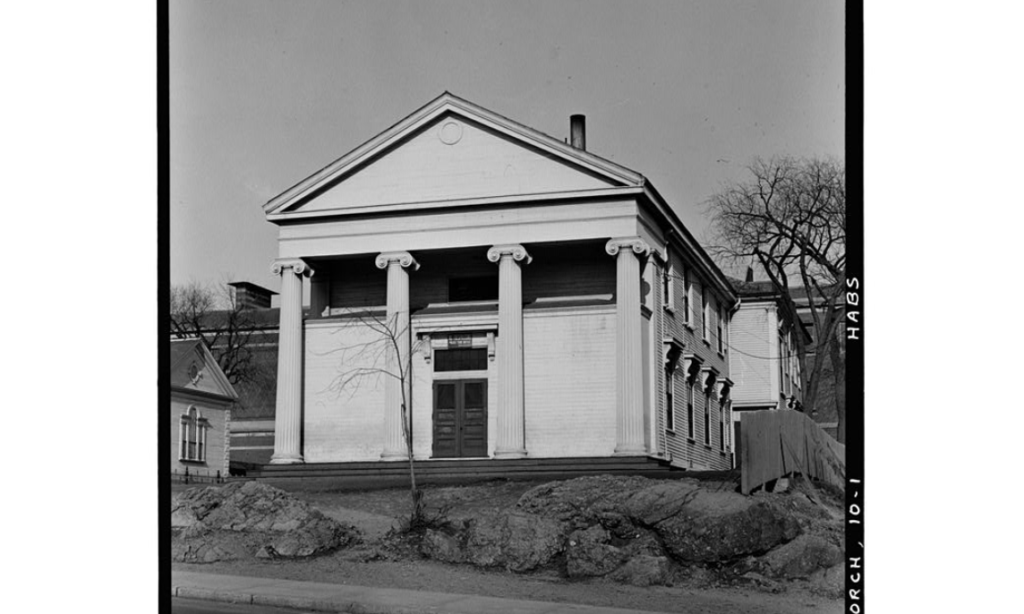
Above: Lyceum Hall on Meeting House Hill in Dorchester, seen here circa 1950, was frequently the venue for debate and lectures on the topics of slavery and abolition in the years after it opened in 1840. William Lloyd Garrison and Theodore Parker both spoke in the hall, which was later used as an enlistment center for those who answered President Lincoln’s call for volunteers to suppress the rebellion by southern slavers in 1861. After annexation in 1870, it was used by the Boston School Department, which neglected the historic building. It was torn down in 1955. Photo courtesy Library of Congress
Even before the end of 1850, the compromise effort in Congress was being fiercely contested locally in packed meetings at Faneuil Hall. A November meeting organized by antislavery leaders was disrupted by a group of “ruffians.” In The Liberator, the “rowdies” were identified, not with “the drunken class,” but with the city’s “cotton aristocracy,” a label signaling the nexus between southern plantations and the northern textile industry. From another camp, the Herald portrayed the event as a gathering of “notorious” abolitionists, who were at times out-hooted by patriotic cheers for Daniel Webster.
In advance of the meeting, the Boston Evening Standard excerpted a pro-Whig defense of the North’s “concessions” to the South as the price for receiving the benefits of the union—and warned that a blanket objection to slavery amounted to a nullification of the Constitution that could escalate to civil war.
A few days later, the same Boston venue was the setting for a “constitution union” meeting to support the compromise—one of several rallies being staged around the country. Among the more than three thousand “leading citizens” supporting the effort—and a related petition—was Boston’s Catholic bishop, John Bernard Fitzpatrick. The first native Bostonian to hold the position, Fitzpatrick was noted for raising money to support famine relief in Ireland, along with serving local needs through new churches, schools, hospitals, orphanages, and cemeteries.
The petition included a denunciation of resistance to the “Fugitive Slave Law”—outside of legal channels—as “mischievous” and “subversive.” A featured speaker at the event was Benjamin R. Curtis, a supporter of the law and, seven years later, as a US Supreme Court justice, of rights to US citizenship for the country’s Black population. At the Faneuil Hall event, as summarized in The Liberator, he reasoned that the natural rights of people who escaped from slavery had no standing in Massachusetts, since they had no right to even be in the state.
“Our peace and safety they have no right to invade,” Curtis declared. “This is our soil,” he insisted, “sacred to our peace—on which we intend to perform our promises, and work out for the benefit of ourselves and our posterity and the world, the destiny which our Creator assigned to us.”
The speech drew a scathing reaction, relayed by The Liberator, from the anti-slavery paper The Boston Republican. Aiming high while striking low, The Republican denounced Curtis as “a narrow, bigoted, and heartless demagogue, ready to pander to the prejudices, and lowest and basest sentiments of the meanest portion of our population.”
Despite being attacked by anti-slavery leaders as a “sham patriot” and a “Tory,” Webster expressed confidence that there was enough public support for the Fugitive Slave Law to be enforced. But, in a “discourse” on Thanksgiving Day, one of the city’s leading abolitionists, Rev. Theodore Parker, contended that the greater threat of disunion was posed by “a serious attempt to execute” the legal right of “the South” to seize human property in the North. “Let her come to take back the fugitives,” Parker threatened, “and, trust me, she will ‘wake up the lion.’”
Observances of Independence Day during the mid-century would be deployed to advance a variety of agendas, including the famous address on July 5, 1852, by the prominent orator and refugee from slavery, Frederick Douglass.
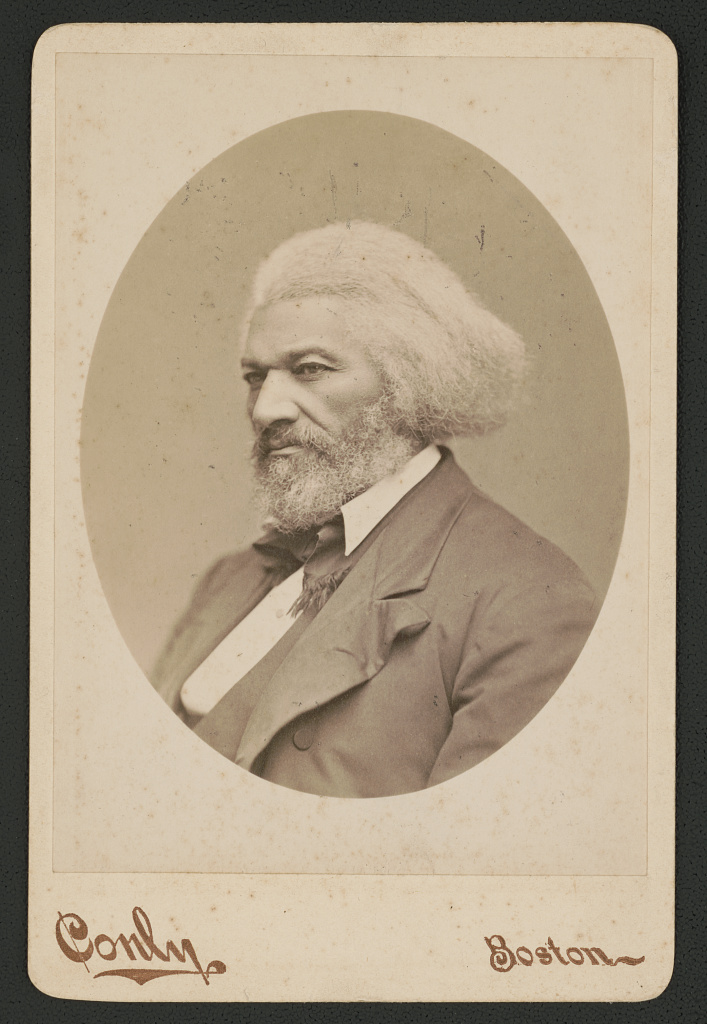
Frederick Douglass. Library of Congress image
Contemporary newspapers report meetings of the Dorchester Anti-Slavery Society as early as 1835, when it held an Independence Day gathering near Codman Square featuring an address by one of the nation’s leading abolitionists, William Lloyd Garrison. In later years, meetings by the group, and by “ladies who are friendly to the abolition cause,” took place near Codman Square and at churches in Lower Mills and Neponset.
There were also signs that Dorchester was intensely divided over slavery. In 1848, some of the members of First Parish broke away to form the Third Unitarian Society, migrating to a church already built at Neponset Avenue and Victory Road. The move was a response to population growth in the “Harrison Square” area, but also to the political climate of First Parish.

Led by a fervent abolitionist, Rev. Nathaniel Hall, First Parish occasionally served as a platform for national leaders of the movement such as Garrison and Parker. And the local Anti-Slavery Society was headed by one of the church’s members, and a descendant of Dorchester’s first English settlers, Richard Clapp.
After Clapp’s passing, in 1862, The Liberator published a tribute by the abolitionist reformer and preacher, Henry Ward Beecher. “The Anti-Slavery cause in Dorchester, as in other places,” Beecher wrote, “had much to contend with, not only the rabble but from a powerful influence in the church. One of the largest religious societies in the town refused the Anti-Slavery Society the use of their vestry for a meeting where the speaker for the evening was a minister of their own denomination, in good and regular standing, and the applicants in behalf of the Anti-Slavery Society were members of the church. Some of us still remember the scorn, contempt, and ridicule heaped upon the Anti-Slavery women of Dorchester, who signed a petition to the Legislature to abolish all laws in the state that made a distinction on account of color…”
As early as “The Great Awakening” around 1740, clerics in Boston’s religious establishment had faced periodic competition from visiting preachers—often less learned, but more charismatic and, sometimes, inflammatory. By the mid-1800s, there were reports around the country of “street preachers” with anti-Catholic speeches drawing large crowds. Among the most notorious was the anti-Catholic firebrand, John Orr. Amplifying his message with a trumpet, he was credited with inciting riots on both sides of the Atlantic Ocean. In 1854, the New England Farmer reported retaliation on Endicott Street, in the immigrant stronghold of the North End: “A gang of Irishmen attacked several men who were returning from Charlestown, where they had been to hear Orr preach, and badly assaulted two of them.”
By the early 1850s, new population growth would lead to the establishment of Dorchester’s first Catholic church, St. Gregory’s. According to a history of the parish by Rev. Michael Parise, “Many immigrants were attracted to the southern part of Dorchester because they could find work in the many mills around the Neponset River, as well as the homes on Milton Hill.”
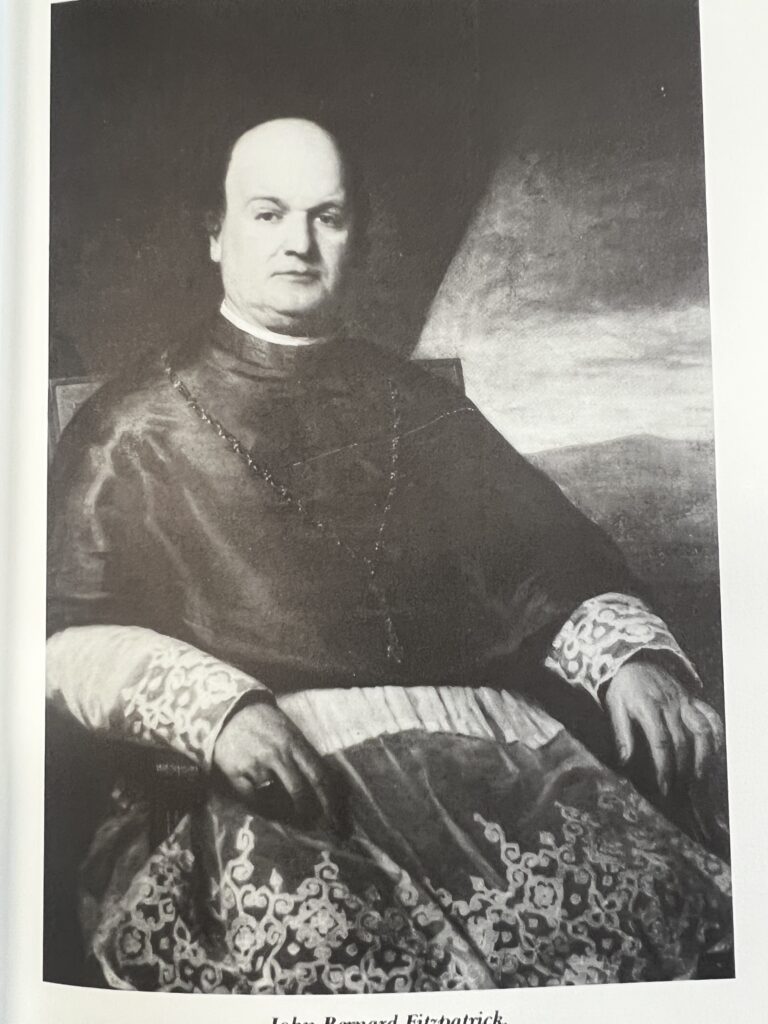
Bishop Fitzpatrick and a Catholic pastor from South Boston explored a possible site for the new church in the Lower Mills area in 1847. Aware of the mounting anti-Catholic sentiment that would soon galvanize the initially secretive “Know-Nothing” order, the church leaders arranged for the St. Gregory’s property to be acquired through a straw purchase. As Parise related, a “group of citizens” tried to head off the new church by offering to buy the property. The offer was refused, but reports that the property would include a Catholic cemetery spurred an attempt to create a new hurdle at the State House. A bill to more tightly regulate cemeteries was approved by the House of Representatives in 1852, but it failed to get approval in the Senate, after vigorous opposition by Bishop Fitzpatrick.
During the same year, the New York legislature debated a measure to place the state’s Catholic church properties under the control of bishops—unlike the properties of other denominations, whose ownership was more decentralized. If intended to consolidate internal control over assets and parishioners, the move was perceived externally as a power grab in the United States by the Vatican, whose leaders were opposed to the pursuit of liberal reforms in the European revolutions of 1848.
Apprehensions about the Vatican were heightened the following year, when parish growth and disputes prompted an extended visit to the United States by the papal nuncio, Gaetano Bedini. In February of 1854, the New England Farmer reported that Bedini had been burnt in effigy during a midnight gathering of “a hundred men and boys” on Boston Common.
In 1854, an even more explosive conflict over land control broke out with the passage of the Kansas-Nebraska Act. An earlier provision would have admitted both territories as “free” states, but the new law allowed their status to be determined by their voters. In Kansas, that set off a stampede of free-state and pro-slavery settlers, escalating to armed conflict, with “illegal” border crossings and armed takeovers of polling places. US troops sent to quell the violence ended up backing the new state’s pro-slavery government.
Though the measure was opposed by the two Massachusetts senators, the 60-year-old Everett did not cast a decisive vote. Before the law was passed, he introduced a “clerical memorial” stating opposition to the measure by local church leaders, with the absence of the Catholic position noted in The Liberator. After being criticized by slavery opponents and supporters, he resigned from the Senate for health reasons on June 1—two days after the law was signed by President Franklin Pierce.
Six days before the act was signed, Anthony Burns, an escaped enslaved man living and working in Boston, was arrested by federal marshals. According to the Hortons, one of them was the police officer who had been stabbed by Sims three years earlier.
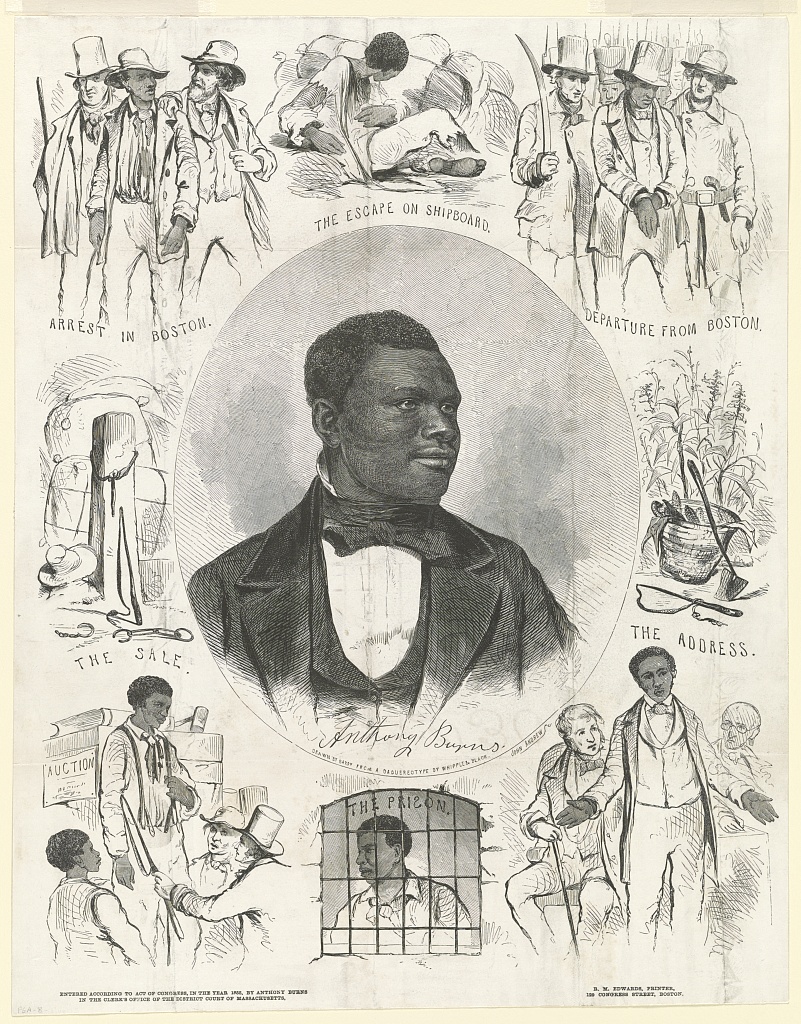
The 1855 print above depicts Anthony Burns surrounded by scenes from his enslavement, escape to the north, his arrest in Boston, and forced return to Virginia under the Fugitive Slave Law that was part of the 1850 Compromise forged by Congress in an attempt to avoid a civil war. Library of Congress
Two days after the 1854 arrest, local protesters equipped with a battering ram tried to free Burns from the Suffolk County Courthouse, an action that resulted in the death of a deputy marshal, James Batchelder, a 24-year-old Irish immigrant. The marshals asked for support from the militia units and, according to Anbinder, most refused, though “a number of Irish units” came to their aid.
“The participation of the Irish militia units in the Burns case,” he wrote, “angered anti-slavery men and reinforced the already prevalent belief that the Irish supported slavery.”
The response to events at the courthouse by a visitor from Louisiana—published in The Liberator—expressed “deepest mortification” over “an infuriated rabble of fanatics hot from the seditious harangues of the Abolition mob-orators,” including Wendell Phillips and Theodore Parker.
In a “lesson for the day” at the Music Hall on May 28, Parker described a courthouse surrounded by ropes and 184 soldiers. “They are, I am told,” he specified, “mostly foreigners—the scum of the earth, none but such enter into armies as common soldiers, in a country such as ours. I say it with pity—they are not to blame for having been born where they were and what they are.”
Though Burns was able to make his case in a trial, a judge ordered his return to slavery on June 1. The next day, he was marched in a procession from the courthouse to Long Wharf. According to the Boston Evening Transcript, the procession along State Street attracted a large crowd of onlookers, greeting the martial quickstep with “groans and hisses.”
The Transcript account began with a description of the scene right outside the courthouse: “A body of 125 individuals, (we cannot call them men,) who had offered themselves to the Marshal for duty, were drawn up in the form of a hollow square. They were armed with pistols and drawn cutlasses. The body-guard was composed of the dregs of society; nearly all were blacklegs and thieves, most of whom have been or ought to be inmates of our prisons.”
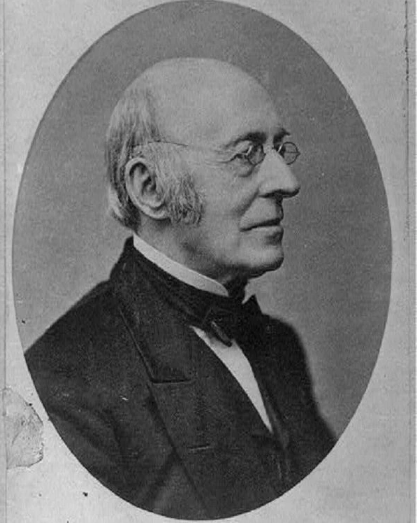
William Lloyd Garrison, publisher of The Liberator. Library of Congress
On June 2, The Liberator drew its own connection between current events and history. “Since the Revolution of 1776,” declared an item in the upper left corner of the front page, “Boston has never witnessed such popular excitement—the Commonwealth has never been so convulsed, through all the ramifications of society—as during the past week—and the end is not yet.”
On a warm, sunny July 4, according to the Transcript, Independence Day was celebrated locally with “marked zest and zeal, and an exuberance of patriotic feeling.” But fresh memory of the Anthony Burns case shadowed the address by Henry David Thoreau at an abolitionist rally the same day in Framingham. “The law will never make men free; it is men who have got to make the law free,” he urged his listeners. “They are the lovers of law and order who observe the law when the government breaks it.”
Thoreau also framed the Burns case as a replay of what happened three years earlier to Thomas Sims. “I have lived,” he reflected, “for the last month – and I think that every man in Massachusetts capable of the sentiment of patriotism must have had a similar experience – with the sense of having suffered a vast and indefinite loss. I did not know at first what ailed me. At last it occurred to me that what I had lost was a country.”
In Dorchester, the same July 4 was marked by a blast around 3 a.m. that had nothing to do with fireworks. According to the Transcript, St. Gregory’s church, still under construction, was “blown up” by someone “placing a keg of gunpowder on the floor of the building.” As the report detailed, “The roof was entirely blown off, and the east and west walls demolished, making a complete wreck of the building.”
Without assigning a motive for the blast, the Transcript headline called it a “gross outrage.” At a Dorchester town meeting three days later, there was a unanimous vote to post a reward of $500 for detection and conviction of whoever was responsible.
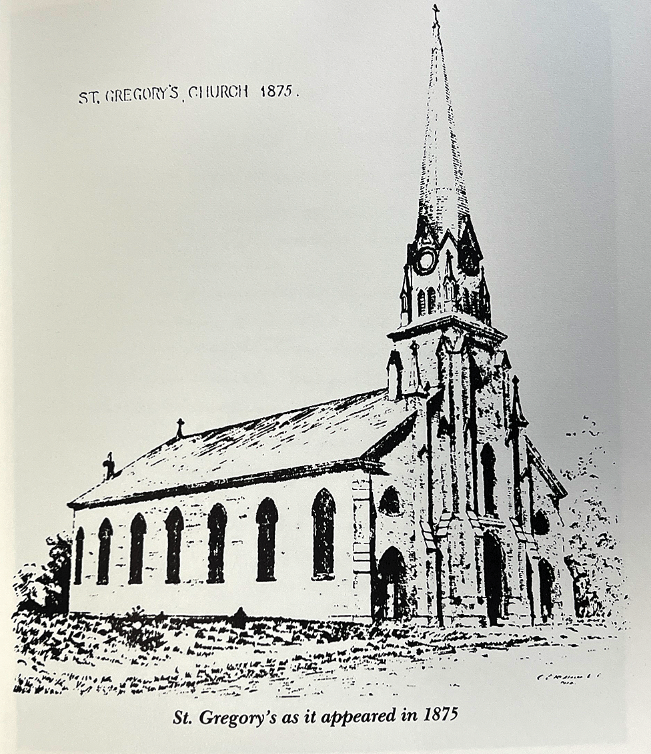
According to Parise, the pastor who was building St. Gregory’s had run out of money, and the property had gone into foreclosure. “Speculation was,” Parise added, “that the church was blown up by the ‘Know-Nothings.’”
On July 9, in a sermon at the “Harrison Square” church, Rev. Stephen Greenleaf Bulfinch denounced the explosion as an act of “sacrilegious violence.” But he also denounced the Catholic Church as “corrupt” in doctrine and practice. His sermon was published two days later in the Transcript, where it covered half the front page.
A son of the architect of the Massachusetts State House, Bulfinch also used his sermon to assert that the area’s Catholic immigrants, the “newly arrived race,” should adapt to their new homeland, instead of seeking “special privileges”—an allusion to attempts by Catholic bishops in Massachusetts and New York to have tax support for parochial schools. “And we are the more entitled to expect this,” Bulfinch reasoned, “because [with] great numbers of them arriving in a condition of poverty, there is a very large annual expenditure on their account in sustaining our various charitable institutions.”
Bulfinch also added to the Know-Nothing call for changing a naturalization process that allowed immigrants to become US citizens in as little as five years. He lamented that “adopted citizens” who had been deprived of rights under harsh British rule “sometimes forget their true politics.” As he explained, “They forget it when they set themselves against our public school system. This system is a part of our institutions which we justly value.”
He warned: “Admitted once to equality in other social rights, a short term of years entitles him to rank fully as a citizen and take a share in electing those by whom we are to be ruled.
“In throwing widely open the door of naturalization, our ancestors certainly had no conception of the immense extent to which emigration would be carried on; and it is probable that had they foreseen this, wisdom would have prompted them to a closer restriction of the right of citizenship.”
The debate over “moral instruction” would be followed 170 years later by the conflict between progressive initiatives and the conservative agenda outlined in “Project 2025,” with its call for “parent control” and freeing classrooms from the teaching of “critical race theory” and “radical gender ideology.”
The nativist “American Party,” widely called the “Know Nothing” movement, with its secret passwords and instructions to its members to say “I know nothing” when asked about what they were up to, also highlighted the political consequences of population change, whether because of rigged elections or an accurate counting of an immigrant voter’s sentiments.
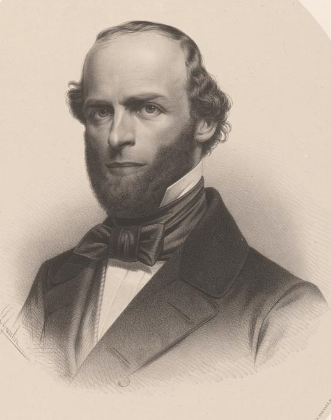
Gov. Henry Gardner. Library of Congress
In the election of 1854 in Massachusetts, a Know Nothing, Henry Gardner, was elected governor, and party members won all state offices, the entire state Senate, and all but three representatives in the House.
While Everett calculated that much of their support came from Whig defectors, Anbinder attributed the results to a mix of sentiments—nativist, anti-slavery, pro-temperance, or concern over “moral instruction” in schools. Whatever the reasons, the Whigs, who had already been dealt a setback in 1850, were finished as a national force.
In its Dec. 30 edition, the Transcript exulted, “In the history of our Commonwealth, we have witnessed the most remarkable political revolution known in our annals, and as we stand between the new and the old we feel a new meaning in the saying ‘The past at least is secure.’”
Though William Lloyd Garrison was impressed by the sweep of the Know-Nothing breakthrough, the contributors to The Liberator were less than fully assured by a national movement that also attracted nativists who were pro-slavery. One skeptical takeaway, from another abolitionist publication, National Era, was posted by The Liberator on November 24.
“Let them be entrapped into no such party,” the National Era advised. “It were well for the anti-slavery party to expose its antagonisms to their principles and policy. At such a crisis as this, when people of the free states are almost ready to unite as one man for the overthrow of the Slave Power, the attempt to get up a miserable issue between native-born and naturalized citizens, Catholics and Protestants, is unpardonable.”
According to Oscar Handlin, the Know-Nothings in Massachusetts would fail in their attempt to enact new literacy requirements for voters and extend the waiting period for naturalization to 21 years. But, once in power, they did bring about some changes. “Foreigners on the police force and in some state agencies were discharged,” Handlin reported, “and a number of cruel deportations displayed an ugly animus against helpless aliens.”
Some of them were in the group of about 35 “paupers” who, in 1855, were sent back to Ireland from Boston. They included Mary Williams and her infant daughter, Bridget, who was born in the United States. It was another departure from Long Wharf, this time on a packet ship named the “Daniel Webster.”
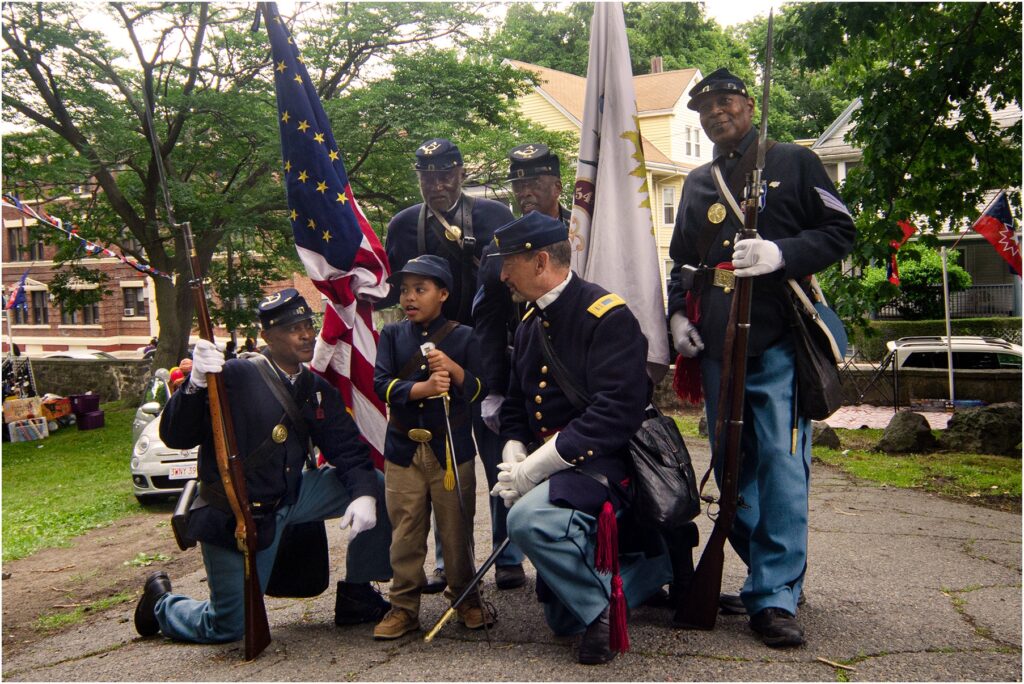
Members of the modern-day 54th Massachusetts Volunteer Infantry regiment Company B during a Juneteenth celebration in Roxbury in 2022. The Boston-based re-enactor group seeks to teach the history of Black Civil War veterans to new generations of Americans. Chris Lovett photo
Chris Lovett is a veteran Boston newspaper and TV reporter who is a regular contributor to The Reporter.
