

By Bill Forry and Seth Daniel
Reporter Editors
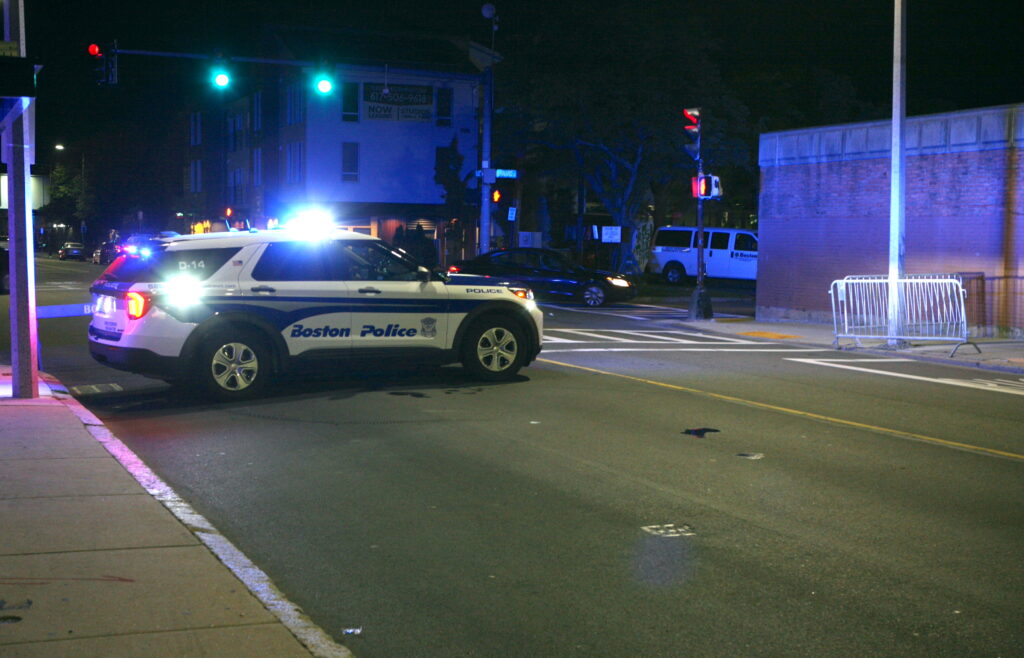
Boston Police officials say nighttime shutdowns of Talbot Avenue and other selected streets near Franklin Park this summer have been successful in curbing late-night gatherings before they overwhelm neighborhoods — and police resources.
The main closure is at Talbot Avenue between Blue Hill Avenue and Bernard Street, near the Lee School and Harambee Park. Police have also restricted access to Old Road near Franklin Field, while officers in neighboring districts have also closed portions of Circuit Drive and Franklin Park Drive within Franklin Park.
The strategy has its roots in the Covid era, when police were constantly called to Talbot Avenue in particular for large gatherings that often featured loud-speaker systems, public drinking, and after-hours partying that sometimes led to violence.
The problem was fueled mainly by out-of-town revelers who police say drove in from communities well outside of the city to congregate by the parks or other open spaces in the summer.
Capt. Sean McCarthy, the commander of the B-3 police district, said Talbot Avenue has become a warm-weather destination for what police describe as “street takeovers” – gatherings that can draw dozens of cars and often more than 100 people for loud music, drinking, parties, scooters, and other activity.
“This plan really is super effective in eliminating those vehicles’ access to Talbot Avenue,” McCarthy told The Reporter during an interview this month.
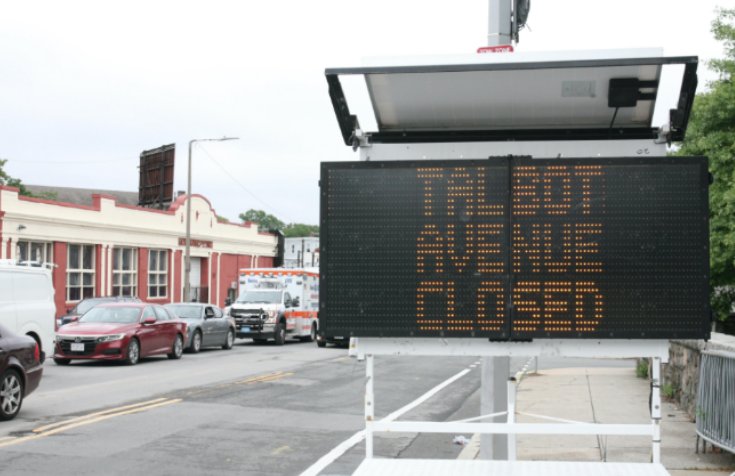
The Reporter viewed the closures this summer, the latest instance being a week ago Sunday night a few hours after the Puerto Rican Festival ended. Talbot Avenue was mostly orderly, except for one smaller group that had set up on the corner of Wales Street with speakers and some dirt bike groups gathered in Harambee.
The same was true for Old Road, which was empty aside from police cruisers. Both sites were staffed with officers, who pro-actively turned vehicles away.
The situation away from the barriers was a bit more chaotic. Blue Hill Avenue was congested with cars, loud music, and revelers and a parking lot at Talbot and Millet Street featured a large number of people and loud music. Harvard Street seemed to be absorbing overflow traffic and was at a stand-still for many blocks moving east of Blue Hill. But nothing had popped up like the gatherings that kept residents in the area up through the night in past summers, according to previous observations and neighbors in the area.
Police initially announced that the selected streets would be closed from 10 p.m. to 6 a.m. Thursday through Sunday during the summer. But McCarthy said the Talbot Avenue shutdown is generally put into effect on Friday, Saturday, and Sunday nights, and it may begin as early as 8 p.m., depending on weather, traffic, and what officers observe through cameras and patrols.
“If it’s really quiet, sometimes we’ll hold it off until maybe 8:30, until 9 o’clock,” he said. “But 8 p.m. is usually the earliest we’ll do it, and it’s based on volume.”

Boston Police Capt. Sean McCarthy. Seth Daniel photo
He said that police have seen vehicles arrive from elsewhere in Boston, the North and South shores, New Hampshire, Rhode Island, and Connecticut for gatherings that are promoted through social media.
“They stack up along Talbot Avenue,” he said. “They create parking issues, loud music, parties, drinking.”
The barriers require two officers at fixed posts instead of answering calls elsewhere in the busy B-3 district. McCarthy said assigning two officers to prevent a gathering is preferable to later sending an entire shift to disperse dozens of vehicles and a large crowd.
“It’s the lesser of two evils,” he said. “Having those two officers there — it’s worth its weight in gold.”
Once a gathering has formed, McCarthy said, officers may find themselves outnumbered as they respond to noise complaints, fights, illegal parking, reckless scooter activity, or other incidents.
“Now we’re going in there and it’s almost too little, too late,” he said. “It’s going to be a massive strain on our resources to clear Talbot out.”
McCarthy said quality-of-life complaints and reported crime in the targeted areas have dropped since the closures began. He described the restricted section of Talbot Avenue as becoming “almost like a ghost town,” but said that result restores the street to residents rather than allowing it to serve as a regional gathering point.
In fact, he said, one consequence is that scooter activity has also decreased on Talbot because riders like to “perform” for the crowds, and with nobody there, they tend not to come.
Police officials acknowledge that the strategy does not eliminate the wider problem. Gatherings can and do move to stretches of American Legion Highway, Canterbury Street, or other parts of the city.
“Shutting down Talbot Ave. is not solving the entire problem citywide, but it definitely solves the problem in that community,” he said.
The Reporter first detailed the summer restrictions in a 2022 story. Similar traffic controls have been used near Franklin Park since 2020, when late-night and wee-hours gatherings, racing, mopeds, and other noise, generated complaints from residents.
Previous closures have drawn mixed reactions, with some neighbors describing them as a welcome relief and others raising concerns about access, communication, and disruptions to travel.
One phenomenon some abutters describe is that people living farther away from Roxbury, Mattapan, and other parts of Dorchester are the ones who often are upset about the closures and the idea of a public street being shut down.
But it is a welcome inconvenience for the abutters and their neighbors.
Last August, Jemison Johnson, of Kerwin Street next to Talbot, reached out to The Reporter after a large crowd had disrupted his street’s peace and quiet into the early morning hours following the weekend Dominican Festival. The gathering didn’t break up until 6 a.m. on Monday and ended with a shooting incident that he documented. It was just one of many out-of-control situations he witnessed last summer.
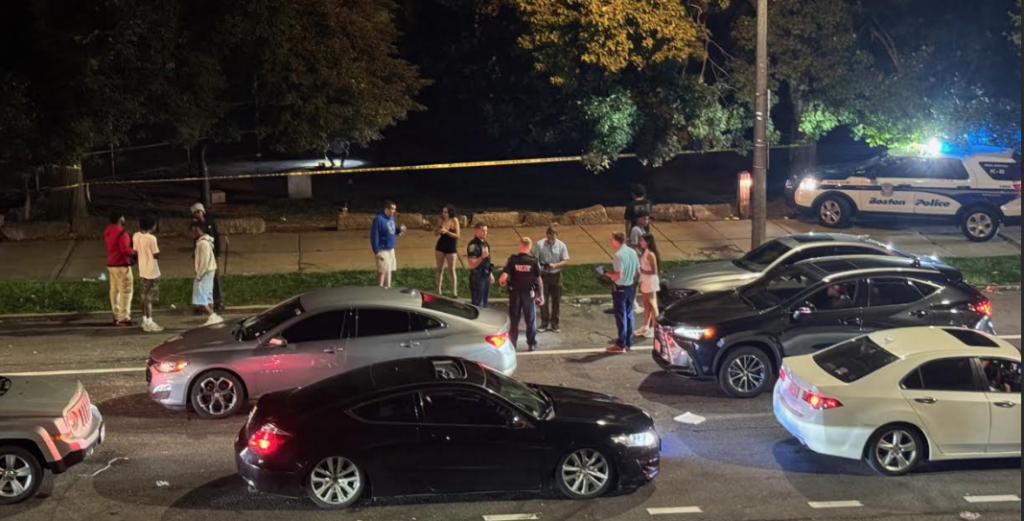
A scene captured following a disruptive night in summer 2025 along Talbot Avenue.
This year has been different and Johnson credits the Boston Police and the temporary street closures.
“This summer has shown that the road closures are working on Talbot Avenue,” he said. “I can’t speak for what has happened in other neighborhoods with road closures but on Talbot Avenue the results have been a success story compared to last summer. The difference has been noticeable to those of us who live here, and I appreciate the efforts that have gone into making these changes.
“I also want to point out that I drive and have had to detour around the road closures many times this summer,” he added. “It has been perfectly fine. Any minor traffic inconvenience is well worth the improvements in public safety, quality of life, and neighborhood peace that residents have experienced.”
Johnson said the verdict is still out on whether order will remain during the upcoming Dominican (Aug. 16) and Caribbean (Aug. 29/30) festivals, but he noted that he felt things went well following the Puerto Rican festival July 24-26.
“I believe residents will continue to see the positive progress we’ve experienced so far this summer,” he said.
But not everyone is okay with the current situation.
One business directly impacted is the Carver Den and Russell Auditorium, an event facility operated by the Most Worshipful George Washington Carver Grand Lodge. The organization has hosted events at its Talbot Avenue property since 1976 and has a large off-street parking lot.
It also has an entrance on Wales Street, but lodge president Glenn Williams said that alternate route is difficult for visitors unfamiliar with the neighborhood to find.
“We have a lot of people not familiar with Roxbury and Dorchester come to events here from out of town,” Williams said. “Since these closures, our revenues have taken a little hit. A lot of people coming here aren’t 100 percent sure how to get here and how to navigate the back streets to get to our back gate. It’s a challenge.”
Williams said he supports efforts to prevent disruptive gatherings, but questions whether closing the entire Talbot stretch is the best long-term solution.
“I agree with a lot of people that there should be a better way than shutting the whole street down,” he said. “I think having a little more police presence would deter people. It’s one or two knuckleheads that decide they will come and cause so much trouble and everyone has to suffer for it.”
McCarthy said police had previously spoken with Carver Den officials about using the Wales Street entrance, but he was concerned to hear that the closures might be hurting the organization’s business.
“We don’t want any local businesses to be negatively impacted by this,” he said. “They have a long history of partnership here in the City of Boston, in B-3 — Carver Den. So, we need to work with them.”
McCarthy said he would ask the district’s community-service officers to follow up with Williams.
Councillor Brian Worrell is also hesitant to frame closures as a fix-all. He said he’d like to see more enforcement. He said neighbors report relief from the revelers, but he’d like more.
“This is only a temporary solution,” he said. “We cannot close our way out of this problem. We need to enforce the laws already on the books, hold people accountable for dangerous and disruptive behavior, and invest in programs and services that give our residents, especially our young people, positive ways to stay connected and engaged.”
For now, McCarthy said, BPD plans to continue using the barriers because the tactic has produced results. “As far as a new tactic,” he said, “we’re kind of going with what works.”
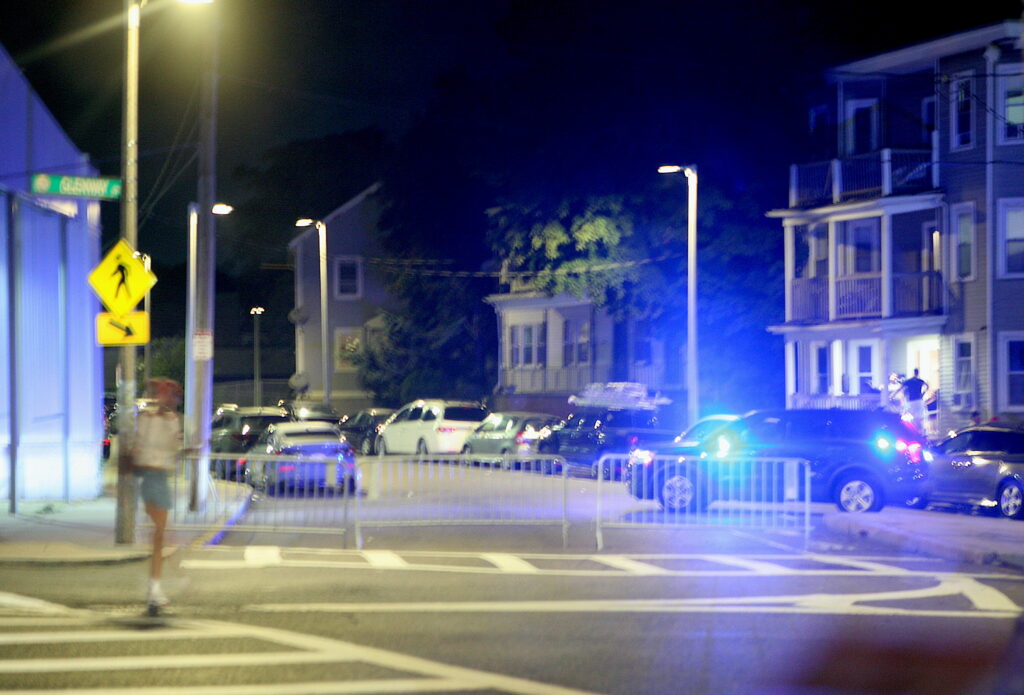
A barricaded Old Road near the corner of Glenway Street in Dorchester in July 2026. Seth Daniel photo
Neighbors who live close to Old Road – a two-block road behind the Harvard Street Neighborhood Health Center that had become a gathering spot for “revelers” in 2020, also have praise for the closure tactic.
The small block near Franklin Park had become a “hot-spot” for speaker cars, public drinking, fighting, and people smoking Hookah pipes. In September 2023, a 22-year-old man was shot and killed at the location during a large and chaotic gathering. Sleepy neighbors described emerging on Monday mornings to find heaps of trash, urine, feces and liquor bottles strewn in their yards and streets.
Marilyn Forman, president of the Erie Ellington Brinsley Neighborhood Association, said the concept of closing off Old Road came up last spring when revelers in huge numbers once again began to gather there. McCarthy said residents started pressing him for a plan in April.
“Well, what I have heard was the residents are pleased [with the closures] and they are happy, especially the ones that attend the association meeting,” Forman wrote.
One of the fiercest advocates is state Rep. Chris Worrell, who lives only 150 yards from Old Road and describes the situation as “very hard,” and noted that on some nights “my windows were rattling and so this is a true problem.”
Worrell said the barricades have helped to alleviate the problem, but have not solved it.
“Last Sunday [after the Puerto Rican Festiva]) was over, my family and I were coming home from a BBQ and pulled into the driveway and found two young girls urinating right on the driveway in front of us,” he said. “I called them out and I tried to teach them that they can’t do that around here – and this kind of thing could be dangerous for them too. They left and went toward Old Road.”
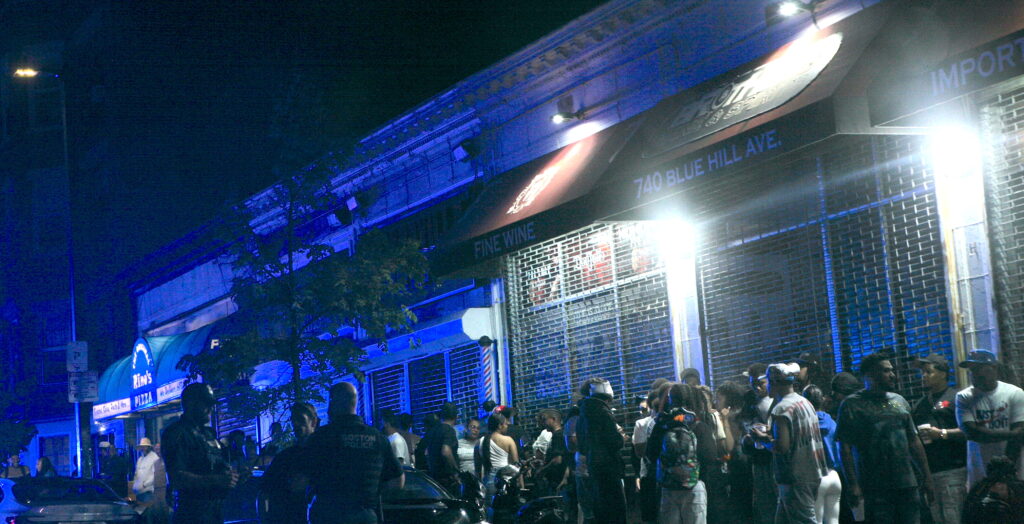
A crowded Blue Hill Avenue block in late July 2026. Seth Daniel photo
Worrell said he favors the closures and has been helping the BPD legislatively to keep them around, securing a $100,000 earmark for walking beats just for Old Road. He also said they are working on License Plate Reader (LPR) Camera-enabling legislation at the request of police.
“Closing the street is definitely something we need to do,” he said. “I think closing it down is the best option just in terms of getting a peaceful night’s rest for the neighbors. As a resident I hate it – the gatherings. It’s become bad enough that we’re getting emails at my office from residents asking for us to call in the National Guard.”
State Rep. Russell Holmes was one of the original architects of the closure policy with BPD back in 2020. He still supports it, but said he has to “strike a balance.” He has also gotten calls from constituents about calling out the National Guard to quell the gatherings, and at the same time he gets angry calls from people who feel pushed out of late-night gathering places.
“I am trying to balance someone who wants to bring in the National Guard with someone who says they should be able to stay out there all night long and do whatever they want because that’s what they’ve always done,” he said.

Above: Rep. Russell Holmes.
“I’m achieving that balance with this solution and working with this plan and this summer it seems to be a good middle ground.”
For all involved in the discussion, the key question keeps popping up: Is this forever?
McCarthy and Holmes both said they aren’t worrying about the future, but only the present. For the moment, they say, the closures send a clear message that these streets are off-limits to out-of-town partiers who would disrupt quality-of-life for residents.
“I had a business partner who used to say there’s nothing more permanent than a temporary solution,” said Holmes. “That means this is a solution that’s working. Until we find something better, there’s no way we’re going to move it. It solves the problem.”
The restrictions are intended to be seasonal and will be reviewed after Labor Day. McCarthy said the department does not want to commit personnel to the barricades any longer than necessary.
“We always revisit everything we do here, every strategy we have, to see if it’s working,” he said. “Even the shutdown takes manpower. It’s something that we wouldn’t want to do if we didn’t need to do it.”
