

City and state leaders gathered at UMass Boston last week to highlight a year-long study to evaluate how thermal energy sourced from local bodies of water— like Dorchester Bay— can be harnessed for large-scale urban heating and cooling.
UMass Boston has already proven to be a leader in the field: The campus has used a seawater pump system to help cool its buildings since 1974. The pump has since been upgraded to provide heat and the study will test how a similar system could be adopted at other sites across the region.
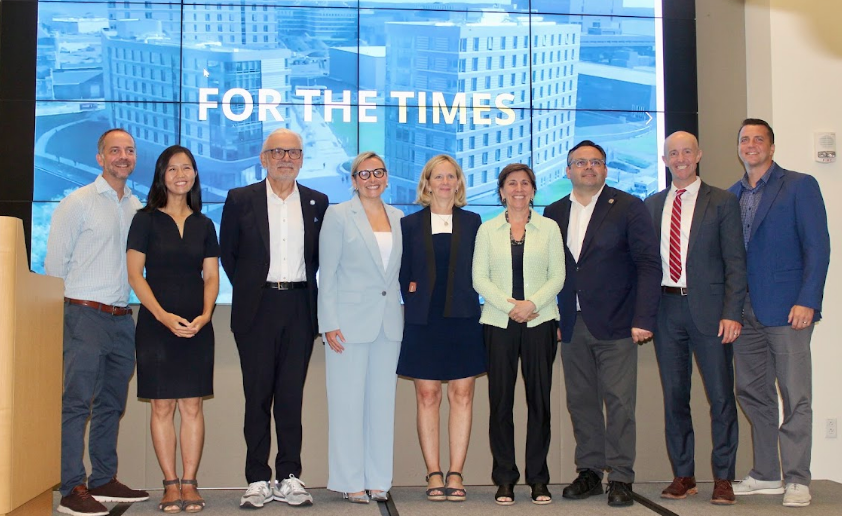
Dubbed the Boston Area Thermal Energy Network feasibility project, it will focus on Boston Harbor, Fort Point Channel, the Charles River, and the Mystic River. Reservoirs in the bedrock below the Charles and Mystic Rivers will also be assessed as part of the study, led by the Boston Green Ribbon Commission. It was launched in April in partnership with the City of Boston and the Massachusetts Clean Energy Center with its goal to transition large energy users, such as universities and hospitals, away from natural gas combustion.
“Over the next year, the project team will evaluate the technical, economic, and regulatory feasibility of developing district-scale, clean thermal infrastructure that utilizes our harbor, rivers, and subsurface geology to provide heating and cooling to major institutional energy users, and ultimately surrounding communities,” said Dr. Lindsey Butler, the executive director of the commission.
If all goes according to plan, other large energy users throughout the city can transfer energy without directly drawing water from the environment through a closed-loop system.
“Our work on the saltwater pump house shows how strategic investments in energy infrastructure can reduce reliance on fossil fuels and generate economic development,” said Marcelo Suárez-Orozco, UMass Boston’s Chancellor. “It is a reminder that the Commonwealth of Massachusetts, and the iconic city of Boston, are the gold standard in enacting climate resilience planning, leading with an ethic of care and responsibility. UMass Boston is proud to be doing its part in shaping a clean energy future right here.”
Mayor Wu called the project “a major pillar of our action plan,” with the potential to “make Boston one of the first cities in the country to transition to a clean, resilient, and portable energy system.”
She added: “Our rivers and harbor have long been the spirit of our city. That’s where we swim with our kids, kayak with our friends, and gather with our neighbors. And now we’re off to find out if the thermal energy there can power our homes and businesses more efficiently and more affordably than ever before. “
The final report of the project, funded by a $500,000 grant from MassCEC, in partnership with the City of Boston, is expected to be delivered by June 2027.
