


Fare-free bus service on three of Boston’s busiest routes is being held up as a national model in a new report by US Rep. Ayanna Pressley and Sen. Edward Markey, the lead Congressional sponsors of the “Freedom to Move Act,” which they reintroduced in July 2025.
The legislation — which faces long odds in the current Republican-controlled Congress—would provide $25 billion over five years for transit agencies nationwide to eliminate fares, improve service, or pursue both.
Their report, “Making Transit Free, Frequent, and Reliable,” examines Boston’s fare-free bus program alongside similar efforts in Worcester, the Merrimack Valley, and other communities.
Boston’s fare-free routes include the 23 bus from Ashmont to Ruggles, the 28 from Mattapan Square to Ruggles, and the 29 from Mattapan Square to Jackson Square. The pilot program, which had been scheduled to expire in June, was extended through the end of this year, thanks to an agreement between Mayor Wu and the MBTA, but it has not yet been made permanent.
Pressley and Markey argue that the Massachusetts experience illustrates how eliminating fares can reduce household expenses, bring riders back to public transportation, and make transit simpler to use and operate.
“The data doesn’t lie and this report makes plain what we’ve long known: Fare-free transit is essential to building connected communities, improving mobility, and making life more affordable for our families,” said Pressley, whose Seventh Congressional District includes most of Dorchester, Mattapan, and Roxbury.
The co-chair of the Future of Transportation Caucus, she called transit equity “an economic, racial, and climate justice issue” and said Congress should treat public transportation as a public good.
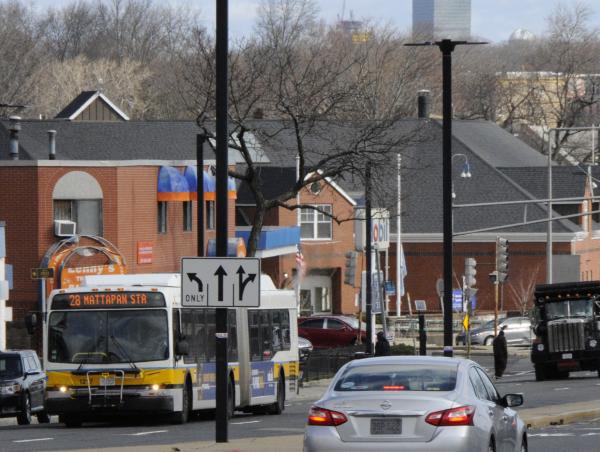
The 28 bus from Mattapan Square to Ruggles on Blue Hill Avenue. File photo
Between March 2022 and March 2025, the elimination of fares saved riders in Massachusetts an estimated $52 million. More than one-quarter of surveyed passengers reported saving more than $20 per month — money that the report says families could instead use for groceries, rent, utilities, child care, or other essential expenses.
“From Worcester to Boston to the Merrimack Valley, Massachusetts is showing the nation what is possible when transit goes fare-free,” Markey said. “Our report shows that fare-free transit saves families money, increases ridership, and helps make transit easier and simpler for passengers.”
Transit ridership in Massachusetts last year was 14 percent higher than in 2019, according to the Markey-Pressley report, which they say is far better than the national average, which is 19 percent below pre-pandemic levels. The strongest recoveries occurred among transit systems that adopted and maintained fare-free service, they claim.
“More transit riders can mean less congestion, cleaner air, and safer streets,” Markey said. “Congress should pass the Freedom to Move Act and help any community go fare free.”
Similar bills introduced by Pressley and Markey in 2020 and 2021 never received committee votes and expired without reaching either chamber’s floor. The latest version, filed in July 2025, has also remained in committee for more than a year.
Both Markey and Pressley are up for re-election in 2026.
