


Above, Mayor Wu with Marabou Cafe co-owner Paulette Innocent. City of Boston photo by John Wilcox
Copyright © 2026 Boston Neighborhood News, Inc. This content may not be re-published or re-used without written permission.
Mayor Michelle Wu visited a Haitian restaurant in Mattapan Square on Tuesday (Oct. 27) to announce a series of proposed zoning and licensing reforms intended to make it easier, faster, and less expensive to open or take over an existing restaurant in Boston.
Speaking at Marabou Cafe on Blue Hill Avenue, Wu said the city intends to eliminate redundant zoning reviews and simplify the transfer of restaurant ownership. The changes could reduce the time needed to reopen an existing restaurant under new ownership from four months to less than two weeks, potentially saving owners $20,000 or more.
“The last thing an entrepreneur needs, after raising money, finding a location, picking the perfect menu, and building the ambiance, is to get tripped up by permitting,” Wu said in remarks in Marabou Cafe. “We are taking what has historically been more confusing, longer, and more expensive than it needed to be, and making our rules simpler and clearer for everyone.”
The announcement came as Marabou Café was celebrating its selection as Mattapan’s 2026 Business of the Year by Mattapan Square Main Streets.
Paulette Innocent, a co-owner of Marabou, said opening the restaurant was a labor of love fueled by a determination to invest in the neighborhood despite discouragement from others.
“There were people who told me not to invest in Mattapan,” she told the gathering. “I am so glad I did not listen, because this community has given me far more than I could ever imagine.”
“Marabou Cafe is not only a place to enjoy the flavors of Haiti. It is a place where every neighbor, every culture, and every generation has a seat at the table.”
Wu praised the restaurant’s owners for creating a gathering place while contributing to Mattapan’s economic vitality.
“So many restaurants give our residents one more reason to love where they live,” Wu said. “At the city, we are doing everything we can to make it easier for local businesses to grow and thrive in Boston.”
The first proposed reform would revise the city’s zoning definition of a restaurant to eliminate a separate review currently triggered by take-out service. Under existing regulations, even a business purchasing an established restaurant can be required to seek approval from the Zoning Board of Appeal for activities already permitted under the previous owner.
Wu noted that take-out has become commonplace, making the distinction increasingly obsolete.
“There is hardly a restaurant operating today that does not offer takeout orders,” she said during a question-and-answer session. “The rules reflect a different day and age, when delivery and takeout were not a given.”
The proposal will go first to the Boston Planning and Development Agency board and then to the Zoning Commission for consideration.
A second initiative would modernize zoning in commercial and mixed-use districts throughout Boston, allowing more restaurants to open as-of-right without seeking zoning variances. That effort will build on previous changes in Mattapan Square, Roslindale Square, East Boston, and downtown.
The city also plans to update its online restaurant-opening guidance, consolidating instructions for obtaining Common Victualler licenses, food-service permits, and entertainment licenses.
The mayor said the changes would not eliminate Licensing Board oversight or opportunities for neighborhood input.
The event also served as a leadership transition for the Boston Licensing Board. Wu announced that Kathleen Joyce, who has chaired the board for eight years, will step down next week.
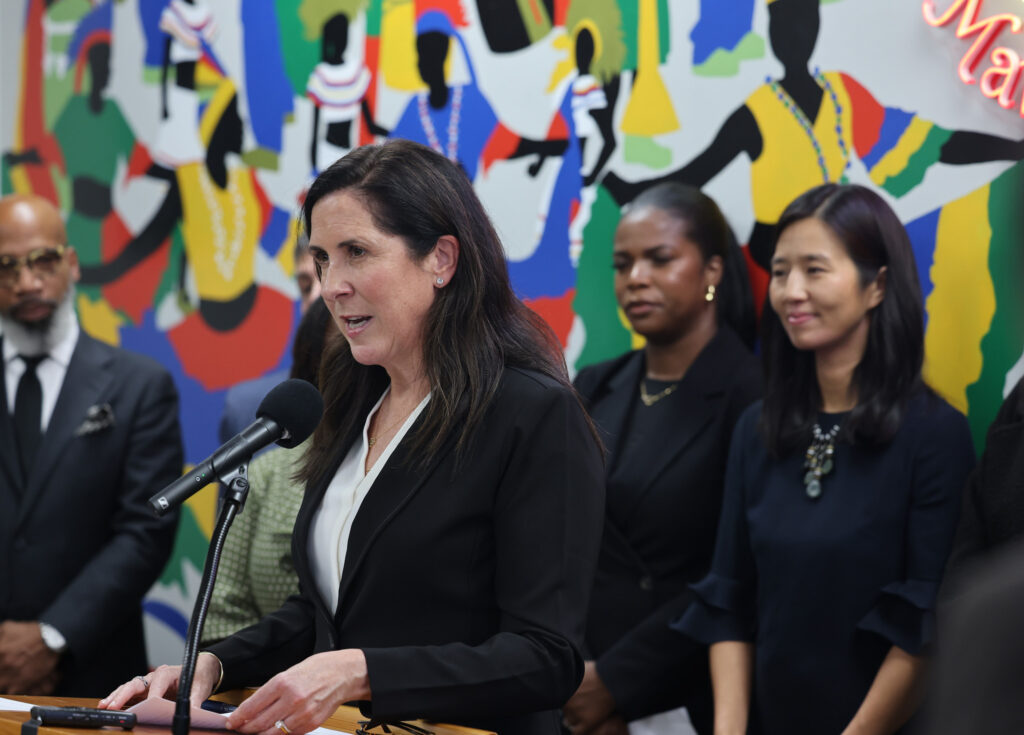
Outgoing Licensing Board chairperson Katlhleen Joyce spoke at Tuesday’s event. John Wilcox/City of Boston photo
Joyce reflected on the pandemic, when indoor dining was suspended for 97 days, and the city’s efforts to help restaurants survive through outdoor dining and other accommodations.
“A decision we make at a hearing can help someone open a restaurant they have spent years working toward and saving for,” Joyce said. “It can also affect the person who lives upstairs and has to get up for work the next morning. Both deserve to be heard.”
Her successor, Ava Callendar Concepcion, a Mattapan native and granddaughter of former state Rep. Willie Mae Allen, pledged to make equitable access to restaurant opportunities her priority. She pointed to disparities in the distribution of Boston’s 225 newly authorized liquor licenses, including 195 restricted to designated zip codes.
“Here in Mattapan, only two of seven all-alcohol licenses have been distributed, and none of the six beer-and-wine licenses have been distributed,” she said.
“It is not a mere coincidence that a neighborhood that has historically been disinvested in sees this trend.”
City Councillor Ruthzee Louijeune, who helped advance the liquor-license legislation, said the city must continue addressing barriers facing entrepreneurs, particularly Black- and brown-owned businesses that lack access to capital.
Wu said the latest proposals will advance over the coming months, with some changes requiring formal zoning approval.
The Reporter’s John P. Forry contributed to this report.
Copyright © 2026 Boston Neighborhood News, Inc. This content may not be re-published or re-used without written permission.
