


Surveillance tech funding is one issue
Copyright © 2026 Boston Neighborhood News, Inc. This content may not be re-published or re-used without written permission.
Boston Police Commissioner Michael Cox testified before the City Council during a Nov. 10 hearing.
Yawu Miller photos
Police officials who appeared before the City Council in a pair of hearings last week urged the body to approve a $13 million grant from the Trump administration that would fund surveillance technologies and emergency management response for Boston and neighboring communities.
Civil rights advocates urged the Council to reject the funding, citing the Trump administration’s insistence that the funds be used to coordinate enforcement by federal immigration officials and the Boston Police Department’s record of failing to comply with a city ordinance that requires them to seek Council approval for the acquisition and use of new surveillance technologies.
“The City of Boston has long prided itself on being a leader in progressive values, a defender of civil rights and a place where all residents — regardless of immigration status, race or socio-economic background — are treated with dignity and respect,” said Astrid Hernandez, representing the group Citizens for Juvenile Justice.
He added: “We are concerned that in the context of federal overreach, accepting Department of Homeland Security funding would betray those very values we hold dear.”
As the Trump administration has ramped up arrests and detentions of immigrants — those here legally and those not — advocates worry that the surveillance technologies being deployed by local police departments are aiding the federal Department of Customs and Immigration Enforcement (ICE) in identifying and tracking immigrants.
The Trump administration’s grant would fund the Boston Regional Intelligence Center (BRIC), a so-called fusion center where Boston police officers share office space with federal agents, including representatives of the Department of Homeland Security — under which ICE operates — and the FBI, which in recent years has increasingly coordinated with ICE.
Housed at the Boston Police Department headquarters on Columbus Avenue in Roxbury, the BRIC facilitates cooperation between the federal agents, state police and the police departments in Boston, Brookline, Cambridge, Chelsea, Everett, Quincy, Revere, Somerville, and Winthrop.
The grant, which comes under federal Urban Areas Security Initiative (UASI), pays for surveillance technologies that advocates say facilitate civil liberties violations such as automated license plate readers (ALPRs), social media surveillance tools and the Boston Police Department’s controversial gang database.
During a Nov. 10 hearing, councillors grilled police brass on why they deployed social media surveillance software without the body’s approval, as required by an ordinance that took effect in 2022.
“What makes you think you are not required to report to us something like Life Raft before you start in order to get approval?” District 7 Councillor Miniard Culpepper asked BPD Commissioner Michael Cox.
Under questioning, Cox repeatedly cited a clause in the ordinance that allows police to acquire surveillance tools under “exigent circumstances,” meaning circumstances that require immediate action. Police brass testifying in the Council hearing cited recurring events such as the presidential election and the Caribbean Carnival as well as one-off events including the World Cup games and celebrations as constituting “exigent circumstances.”
Cox cited the Nov. 10 hearing as an example of the process the department undergoes to seek approval from the Council.
“I would say this process… us coming before you and being transparent, telling you everything we used, how we used it and when we used it — it works,” he said. “That’s what we’re doing right now.”
In addition to seeking Council approval prior to acquiring and using surveillance technologies, under the 2022 ordinance city officials are required to file a report on their use of surveillance technologies in May of each year. Yet in each year, city officials have released the report much later in the year. The 2025 report was released in September.
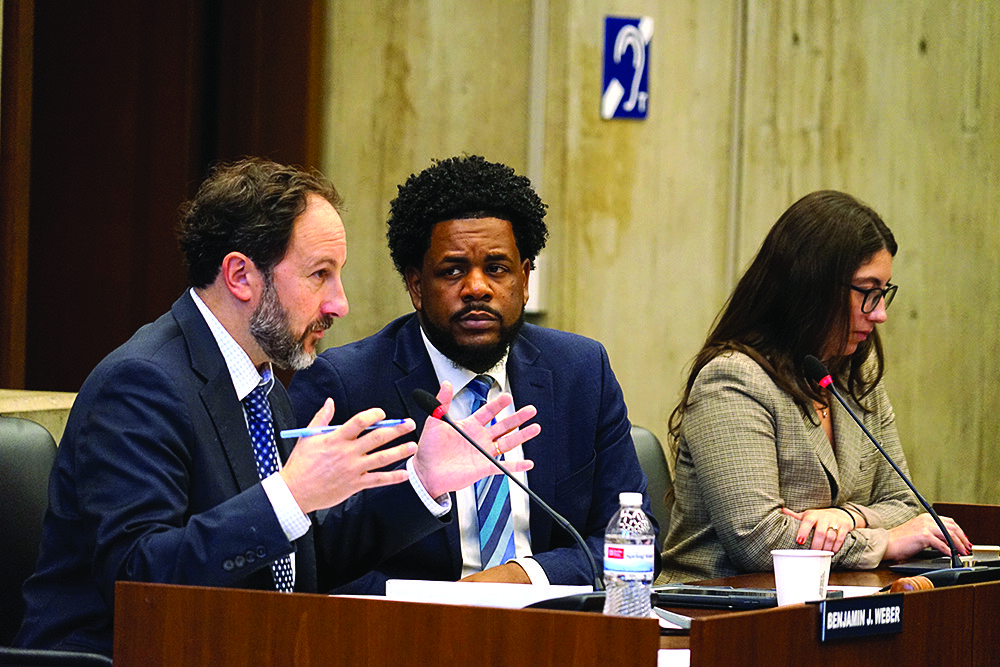
District 6 City Councillor Ben Weber questioned police officials during a Nov. 10 City Council hearing as at-large Councillor Henry Santana and District 1 Councillor Gabriella Coletta Zapata listened.
“Adhering to the surveillance oversight ordinance requires a significant amount of work, which we are happy to do,” said Shin-pei Tsay, chief information officer for the city. “But it’s months of work. We take it very seriously.”
The report covers the use of security cameras, ALPRs, cell site simulators, drones and other technologies deployed by BPD, the Boston Public Schools, and Boston Municipal Protective Services.
The BPD portion, which makes up the vast majority of the report, appears to contain information that is in many ways identical to reports in previous years, as much of the technology used hasn’t changed. The BPD report also appears to contain passages cut-and-pasted from one section to another.
Under the heading “Impact on communities,” which asks for the civil rights implications of the technologies BPD deploys, each section of the report reads, “The Boston Police Department strives to maintain the highest standards of honesty and integrity and is committed to building and strengthening trust with all members of the community.”
Under a section which asks for an accounting of public complaints or concerns about each technology, police officials in each instance note that their official mechanism for complaints is through the Internal Affairs office and state, “The Department has not located any specific complaint concerning this technology responsive to this request.”
The reports make no mention of specific complaints and concerns raised by civil rights groups in the yearly department hearings on surveillance technology.
Testifying before a mostly empty chamber on Nov. 13, Jamaica Plain activist Susan Moir told District 6 Councillor Ben Weber — the only official left in the chamber at that point — that police officials always testify first, before public comment, and leave the chamber immediately after.
“This is no way to hear the public,” she said.
Moir also noted that a letter from the city’s corporation counsel on the UASI grant was dated Nov. 12, the day before the hearing on UASI funding. Moir was critical of the letter, which asserts that the city does not need to comply with provisions in the UASI grant which funds the BRIC that would require local police to work on immigration enforcement with ICE, stating that the letter was “designed to give the City Council an excuse to do what the mayor wants them to do.
“We know we’re a sanctuary city and what it’s asking us to do is against our own laws,” she said. “Do we ever want to have a strong City Council? Then be strong. It doesn’t have to be done this way.”
Moir and others who testified in last week’s hearings urged the Council to reject the grant.
Julie Bernstein, a co-chair of the civil liberties advocacy group Digital 4th, noted that while police say they don’t share data from automatic license plate readers with federal authorities, there’s no guarantee that the companies it contracts with — Motorola and Axon — are keeping Boston drivers’ data safe.
“While the Boston Police Department purges its searches, the vendors may be sharing them or even selling them to federal agencies,” she said.
Bernstein and others noted that the UASI funding is used in part to support federal anti-terrorism initiatives.
Under the Trump administration, anti-capitalist, anti-fascist and Black Lives Matter protestors can be classified as terrorists.
Fatema Ahmed, executive director of the Muslim Justice League, noted that although BPD officials testified they are not monitoring her nonprofit, the BRIC released records in which it did just that.
“Twice a day BRIC put out reports — so not just surveilling but actually publishing information and sending it out — that included our events, events from Jewish Voice for Peace and anti-war organizations,” she said. “Any events related to Palestine — film screenings, vigils, all sorts of events.”
The BRIC reports, which are shared with local law enforcement and federal officials, have in the past included Black Lives Matter protests, Occupy Boston demonstrations, and other such groups.
Ahmad noted that Brookline Town Meeting members are considering a proposal to pull the town out of BRIC. The Quincy City Council and said activists in Quincy are pushing for a similar move.
“Other cities are not desperate for this BRIC money at this point,” she said. “They are looking for ways out because the recognize with this surveillance is doing.”
While Council sources say the Wu administration officials have pushed councillors to vote on the UASI funding by Nov. 18, Weber said the body will discuss the funding.
“I’m not sure if this is coming up for a vote on the 18th,” he said. “My sense is it could be in December.”
Copyright © 2026 Boston Neighborhood News, Inc. This content may not be re-published or re-used without written permission.
