
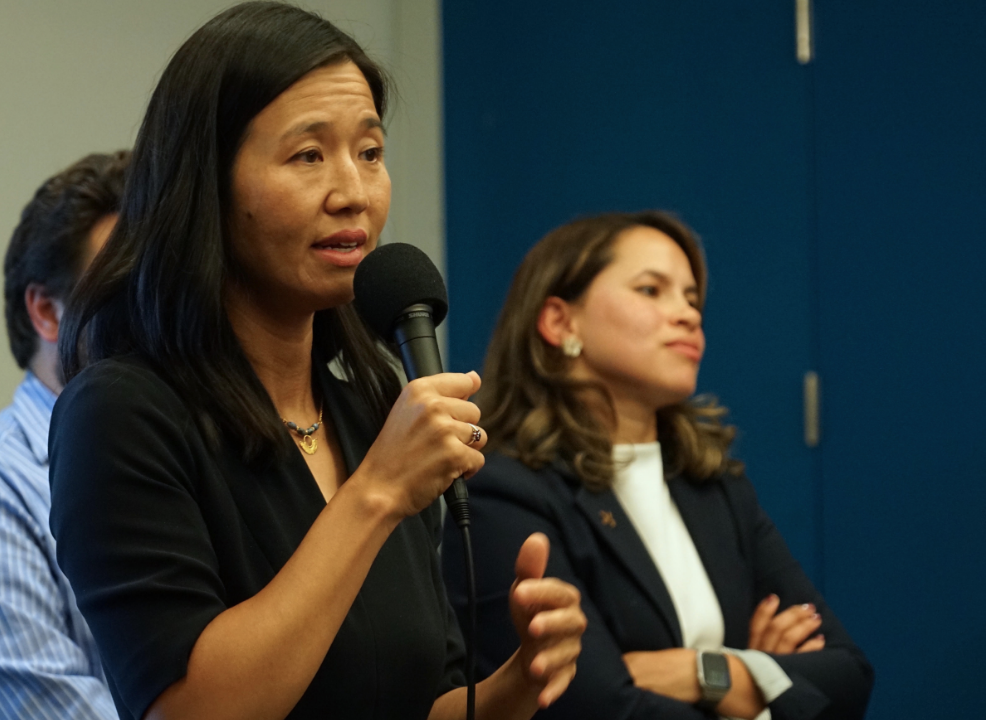
In April, mayoral hopeful Josh Kraft pitched his candidacy to the members of the Pope’s Hill Neighborhood Association.
Last week, it was Mayor Wu’s turn with the group and she used the opportunity to reflect on her first term and explain why she should get another four years in office.
Accompanied by her infant daughter Mira, Wu spoke for over an hour during the May 28 gathering inside the Richard J. Murphy School cafeteria, then answered questions from a crowd of about 70 people.
“This part of the city has some of the oldest neighborhood associations in the country,” she said. “Neighbors coming out, taking responsibility for the parts of our home that we share, the community that we love, is what gets things done. That’s what we’re trying to do citywide.”
After her presentation, the mayor was asked a series of prepared questions posed by Bob Dunford, president of the neighboring Cedar Grove Civic Association. Other attendees were also invited to ask the mayor direct questions.
One major topic was very local – safety and staffing concerns at the Murphy K-8 School. Wu, a BPS parent herself, told the group she is “not satisfied where we are with BPS,” and added that it’s her “priority to make sure we’re moving as quickly as we can.”
There are plenty of amazing things happening in city schools, she said. But she also acknowledged that none of that matters if students and staff are not secure.
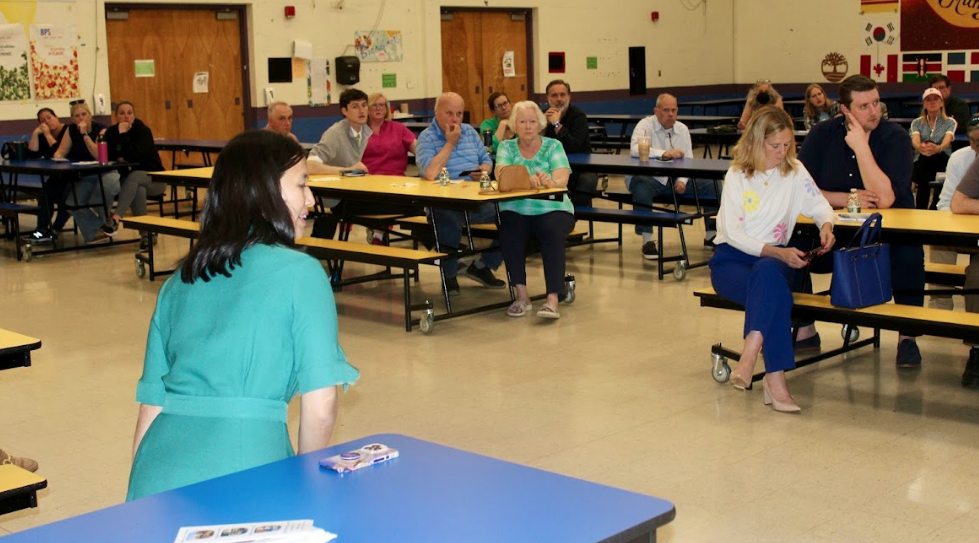
Mayor Wu takes up questions from members of the Pope’s Hill Civic Association. Cassidy McNeeley photo
“We can’t get anywhere if safety is the concern,” Wu said while holding Mira with one arm and a microphone with the other. “I want to understand what’s happening here with that. We have increased the level of staffing when it comes to adults who are in schools focused on safety, and we have weekly safety meetings focused on young people with a team that includes all of the public safety agencies.”
The mayor promised to speak with educators and school leaders at the Murphy to figure out what exactly the school needs from her and Superintendent Mary Skipper.
Problems persist at other BPS facilities, too. Last Wednesday morning, a pair of altercations in the Henderson Upper School prompted a large police response and left two employees injured.
Wu was asked about these incidents — and related security matters in the school system— at the meeting.
“Some of the things that you mentioned happened before I got to where I am,” she said. “I take responsibility that they have continued, and everything that’s happening now is under my watch and my name’s on the ballot. Some of these issues are big and are going to take even more time to get where we need to go.”
Wu added: “Our kids can’t wait for a new term of four years. This is what keeps me up at night, the urgency of making sure we’re getting things done for our students.”
She said that rather than shuffling students between schools, her administration is working on getting to the root cause of various problems in BPS.
“That is why we have been doing things like making hard decisions to merge or close schools,” she said. “We need to be creating the strengthening of programs where they are working, putting resources where they are working, and then making the hard decisions to consolidate, merge, and close where we have to.”
The mayor also touched on exam schools, saying a review of the admissions process is now underway.
Like Kraft, Wu was asked about housing issues, and specifically about an ongoing project at 900 Morrissey Blvd.
Formerly a Comfort Inn hotel, the property is now owned by The Community Builders in partnership with Pine Street Inn, which is renovating the building to accommodate formerly homeless seniors.
The project has been — and remains— a source of controversy in Pope’s Hill, where many neighbors spoke out against the conversion.
“We have to have places for people to go, not just when they’re in the depths of addiction, but at every part of needing,” Wu said.
But, she added: “Boston can’t do it on our own. We’ve been overperforming when it comes to housing in terms of reaching our goals ahead of time.”
Traffic issues, particularly the installation of dedicated bike and bus lanes, were also raised during the session.
“Anytime something is proposed, we have to think about traffic. We’re trying to do everything we can to get traffic better,” Wu said.
One example she gave was the city’s recent collaboration with Google Maps. With this data, Wu said, she and her team have been identifying problematic traffic lights. So far, with that data, more than 100 intersections have seen improvement, she said. She also said she will continue to push for improved service on the MBTA.
Several PHNA members who spoke voiced frustration about the city’s planning process, saying that they felt they were not adequately engaged in decisions.
A few referenced the Article 80 process— which governs large projects through the city’s Planning Department.
Wu said she agreed that Article 80 planning could be more effective and noted that she would like to move away from having Impact Advisory Groups— or IAGs— created for just one project and instead establish a group to review multiple projects at once.
“They would be there to see whatever projects get proposed for a whole area so that they can kind of make sure that everything makes sense relative to each other as well,” said the mayor.
Just before the meeting came to a close at 9 p.m., Wu asked everyone present for their votes in this year’s election.
“We have a lot more work to do, and I’m proud of the work, the progress that we’ve made,” she said. “There are still a lot of challenges at a very difficult moment in the world, but I love the city. Boston has given me everything I love in my life. It’s been an honor to be in this role.”
