

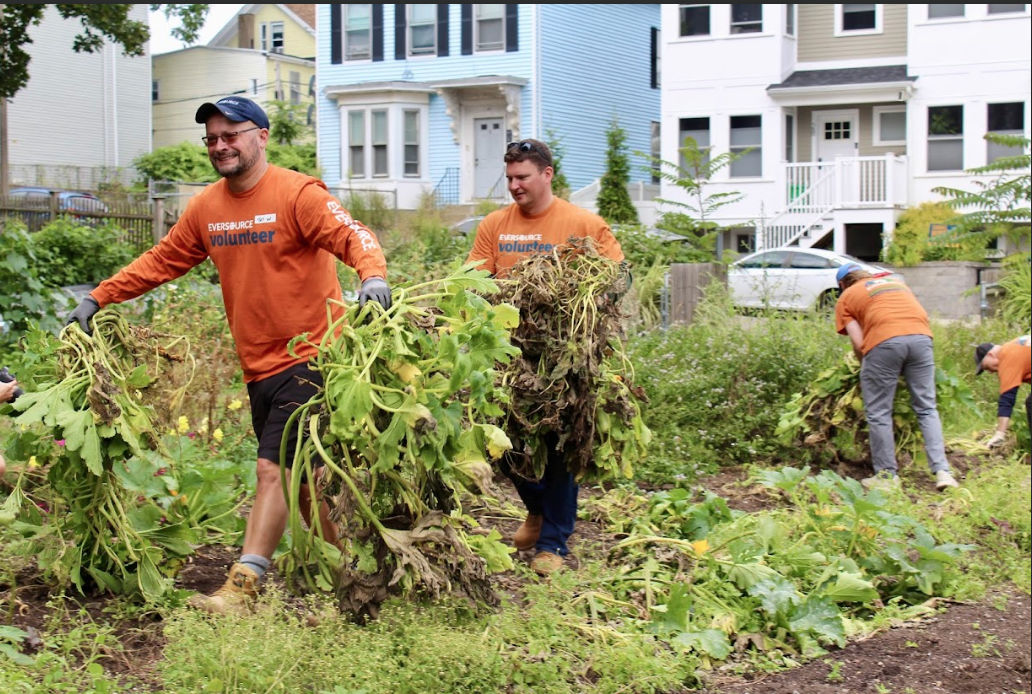
A group of about 30 Eversource employees left their daily business tasks behind to get down and dirty last Tuesday (Aug.19) as volunteers at The Food Project’s West Cottage St. farm, fanning out around Uphams Corner to clean up the Dudley Street Greenhouse, fill raised garden beds on North Ave, and harvest squash and dragon tongue beans at the Langdon Street site.
The team was led by James W. Hunt III, a lifelong Dorchester resident and executive vice-president at Eversource, who, while being interviewed, was anxious to get to work plucking tomato vines from the greenhouse.
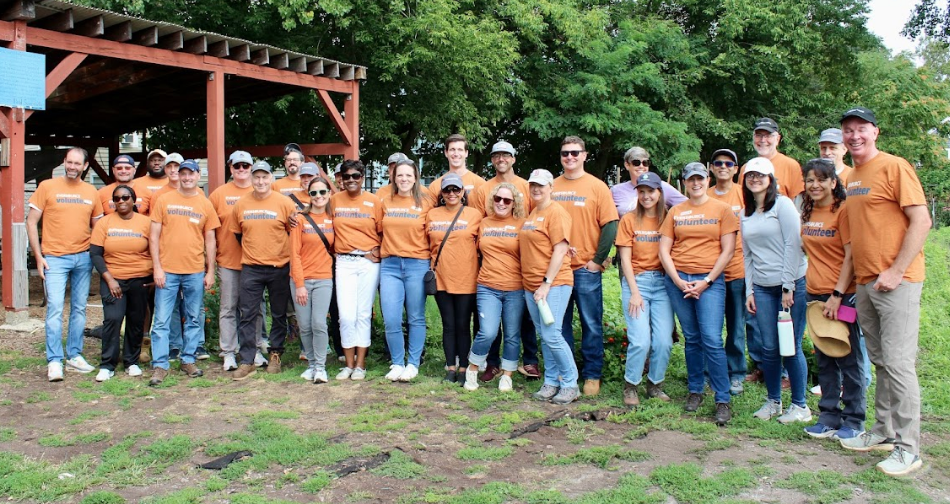
“We are in 520 communities across our service territory, we have 4.4 million customers in Massachusetts, Connecticut, and New Hampshire, but we started here in Boston,” he said. “Our service center is on Mass. Ave. in Dorchester, so we never lost sight of our roots, and today we are planting roots here with The Food Project.”
The non-profit The Food Project, founded in 1991, works at the intersection of youth, food, and community with the belief that everyone deserves access to fresh, healthy, and affordable food. And the community greenhouse is one way that residents of the neighborhood can get just that.
“The front empty beds are managed by residents of the neighborhood, so they grow food in there, and then we grow food in the back half,” said Danielle Andrews, the Boston Farms and Greenhouse manager. “The greenhouse is basically like a three-season greenhouse. We close down for about a month from the middle of August through the middle of September, and then we plant again.”
She added: “It’s an opportunity to clean the greenhouse and to deal with any issues. The community cleared their plots over the weekend, and now we are lucky to have [Eversource] volunteers to help us take down the tomatoes today.”
By cleaning the facility, Hunt and his team of volunteers are not only prepping it for when the community returns in September, but they are also allowing The Food Project staff to focus on providing food and opportunities to nearby residents.
“We do a lot of different things,” Andrews explained. “Last Friday, I hosted a foster care girls’ camp on the farm. Which is so fun. But we also do have to do things like this. The more we have volunteers who can help us with these big labor jobs, the more time I have to put together creative learning opportunities, whether that’s for outside camps or our own young people or events on the farms.”
Hunt noted that his group benefits from the collaboration, too.
“It’s a great team-building opportunity, getting our hands dirty, bringing us together in a different setting outside the office. There is an important employee engagement aspect to this as well,” he said. “Eversource likes to give back to the communities we serve, and this is a great organization that matches our commitment to community, to sustainability, to addressing climate issues, and to empowering youth through clean jobs. This was a perfect match.”
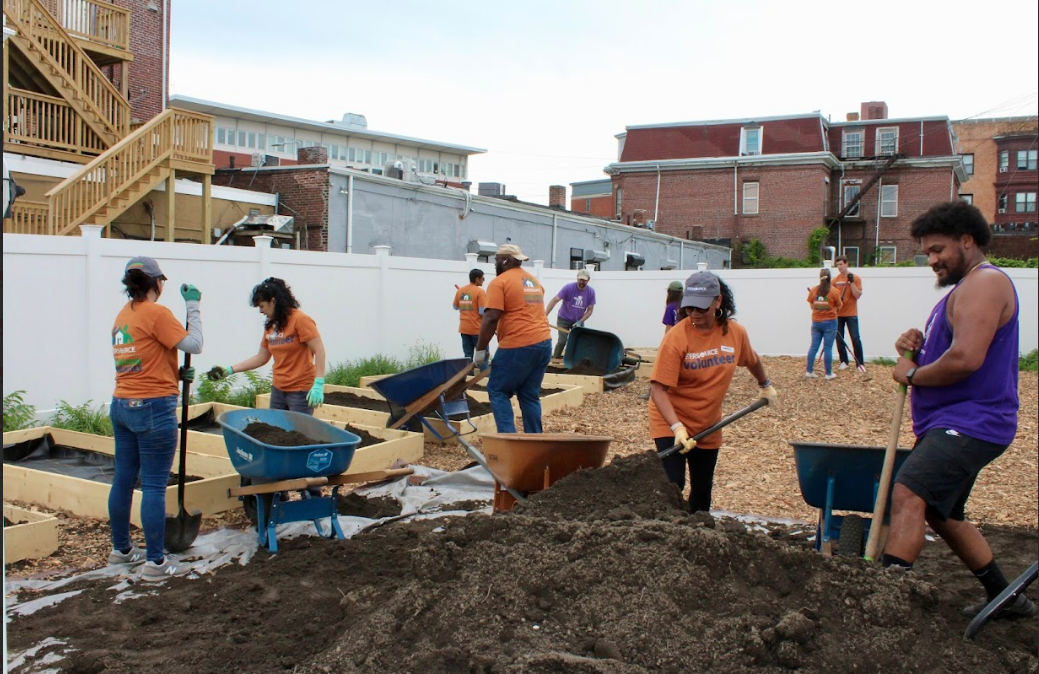
Just a short walk away from the greenhouse, The Food Project’s Greater Boston community programs manager, Evan O’Neal, was putting another group of about 10 Eversource volunteers to work on North Ave., where they filled eight raised garden beds with soil in what was previously an abandoned lot.
“Each raised bed will go to a local community gardener,” said O’Neal. “Typically, a lot of members in this community grow corn, shell beans, Portuguese kale, collards, and tomatoes.”
O’Neal described the volunteers as a “well-oiled machine,” adding, “We’ve only been out here about 40 minutes, and we’re almost done.”
Amanda Heinsen Morales, Eversource’s Massachusetts manager of Corporate Citizenship, wasn’t surprised by the group’s diligence.
“I think it’s because we are a utility team, we’re like no other corporate group,” she said. “Even though we’re the more community, communications role, we’re not the folks on the line. I always warn our nonprofit partners that we come hard.”
She noted that “everybody at Eversource is given two paid days to volunteer. Our business comes first, our customers come first, but at the end of the day, volunteerism is at the core of who we are as a company.”
While volunteers on North Ave shoveled soil, those at the Langdon Street Farm gathered crops.
“I hope that today our help with the food project fulfills their mission in bringing healthy, local, sustainable food to the residents of Dorchester,” said Morales, “and I hope that it builds upon our commitment to being a good corporate citizen here in Dorchester.”
She added, “We have so much work going on, we know our work can be disruptive, we know it’s essential to provide that reliable energy, but at the end of the day, we’re here every single day. Whether bad weather, project, or no project, we’re here every day, and we want our customers here in Dorchester to be able to know that we’re reliable.”
