


By Madyline Swearing
Special to the Reporter
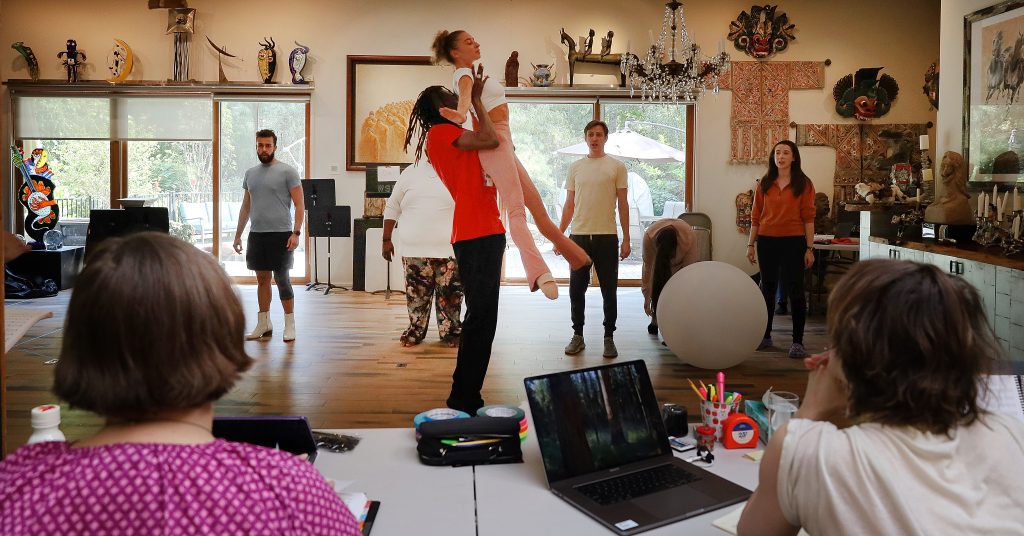
Inside a sprawling Brookline home, where koi swim in an in-ground living room pond and a pet pig named Mazipan can be seen through sliding glass doors, a troupe of performers flit around a makeshift stage, rehearsing a battle of futuristic proportions.
The scene is set in the years after the Sixth Extinction — a human-made climate crisis that has left the planet Earth a dystopian wasteland —and a new opera, “White Raven, Black Dove,” which is scheduled for a three-day run at the Strand Theater this weekend (Sept. 26-28), tells the story of the segregated Silvers and Onyx, who are faced with building a new world.
Steeped in international mythology, the opera combines live performance with computer-generated animation to explore themes of race and climate change.
As a self-proclaimed “activist” performance company, White Snake Projects produces only original operas by living creators as a way to “authentically” explore societal issues, says Cerise Lim Jacobs, the company’s artistic director and founder.
“Art can be used as an instrument of change,” Lim Jacobs said. “It doesn’t have to be didactic and burdensome, but fun and immersive.”
The company was founded in 2018 following the success of Lim Jacobs’ first opera, “Madame White Snake” — a retelling of an East Asian folktale — which won a 2011 Pulitzer Prize for its composer, Zhou Long.
An immigrant and woman of color, Lim Jacobs says her values “totally permeate” the company and its work.
As rehearsals continue inside her Brookline home, haunting vocals detail the discord between the identity-bound light-skinned Silvers and dark-skinned Onyx, and reveal how a scarcity of resources has driven the two groups apart. Amid the devastation, characters Raven and Dove serve as proponents of change.
Shows are produced thematically each year. With last year’s general election, the company’s theme was voting rights. This year the environment has taken center stage. Lim Jacobs says recent federal funding cuts to organizations like the National Weather Service and the National Oceanic and Atmospheric Administration helped influence that decision.
“What could be more timely?” Lim Jacobs said. “It cannot be more urgent. The whole thing is frightening.”
Beyond advocacy, Lim Jacobs says, a main objective of White Snake Projects is to modernize opera and make it appealing to younger generations. One way is through the integration of cutting-edge technology in operatic settings.
For the company’s director of innovation and computer-generated imagery (CGI, Curvin Huber, this means applying gaming technology to live performances. A professor at the Lesley University College of Art and Design, Huber has worked in the 3D industry as a generalist for about 30 years. His expertise with Unreal Engine, a game development creation tool, has optimized White Snake Projects’ scene designs.
With Unreal Engine, photorealistic graphics can be created and modified in real-time, creating a speedier design process. Once the 3D imagery is generated, it can be projected on stage in any format.
“The advantages are that it can build content quickly and we can make changes as needed,” Huber said. “It allowed for a more efficient pipeline.”
While Huber has logged almost 100 hours working on “White Raven, Black Dove,” the base work was done by Lesley design students, who spent three semesters working with the creative team to produce the 2D animations and 3D illusions that make up the set.
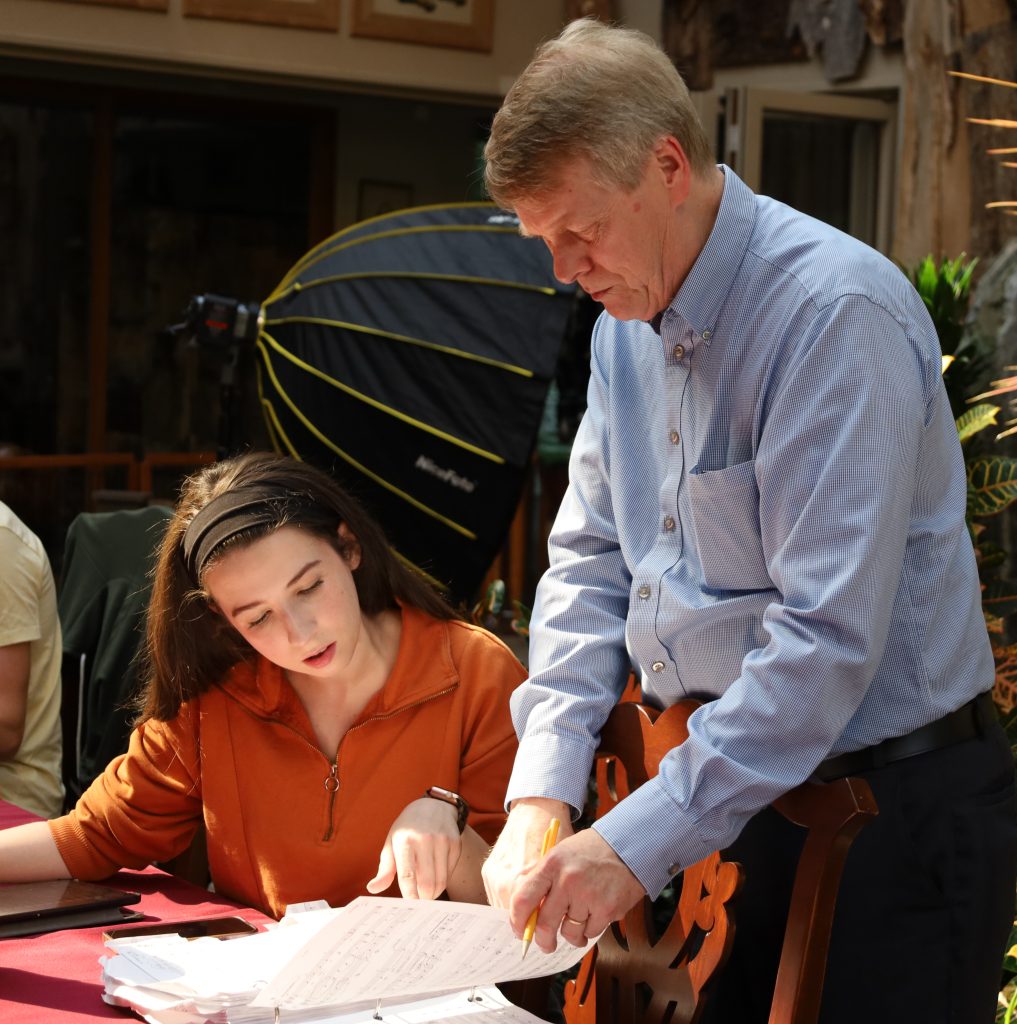
As part of Lesley University’s internal internship program, which matches students with local clients, students are assigned to specific teams, depending on their skill levels and interests. Derek Hoffend, professor of game design and immersive technology at Lesley University, serves as the students’ project manager.
“They could be doing drawings and concept studies for character and environment designs,” Hoffend said. “Some do game engine work, where they’re building 3D environments in Unreal Engine.”
Huber says he then acts like a cinematographer, polishing and refining students’ work to make it production-ready. “It’s a great experience for them — they get to see how it works,” he said. “We force ourselves to take a step back and ask what we want visually and what’s the best way to tell a story.”
Hoffend says the opportunity for students to see the physical manifestations of their work has been beneficial for them both creatively and intellectually.
“They really appreciate having a client,” Hoffend said. “They’re used to doing things in the classroom, but to see something that gets out into the world that’s also politically interesting is important.”
In times of increased political divisiveness, Lim Jacobs says, the company has to consider the implications of its work more than ever before. And while funding may have been cut, production levels haven’t.
“People have to feel hope, otherwise they’ll give up,” Lim Jacobs said. “We make work for our community. I hope they come and feel inspired to do a little something.”
See “White Raven, Black Dove” at the Strand on Sept. 26 at 8 p.m., Sept. 27 at 7:30 p.m., and Sept. 28 at 2 p.m. A talkback with a member of the creative team will follow each performance. Tickets are “pay what you can.”
This story is part of a partnership between the Dorchester Reporter and the Boston University Department of Journalism.
