Even before he read the story, Tom Mulvoy got the news.
After a drive with his mother to a bakery in Quincy, the 15-year-old son heard over the counter that the business might be losing customers because of the new highway going up back across the Neponset River.
Knowing that much, Mulvoy wanted to know more. He walked from his home in Dorchester to the branch library on Adams Street and asked for information about the project in print. A staff member promised to round up a selection of news clippings and told him to come back the next day, early enough to get through all the reading.
As a reader, Mulvoy learned more about how a project endorsed by so many elected officials had also been opposed by local residents and businesses. From a local perspective, the gains from getting somewhere else more quickly were outweighed by the loss for the people left behind, in places like Dorchester.
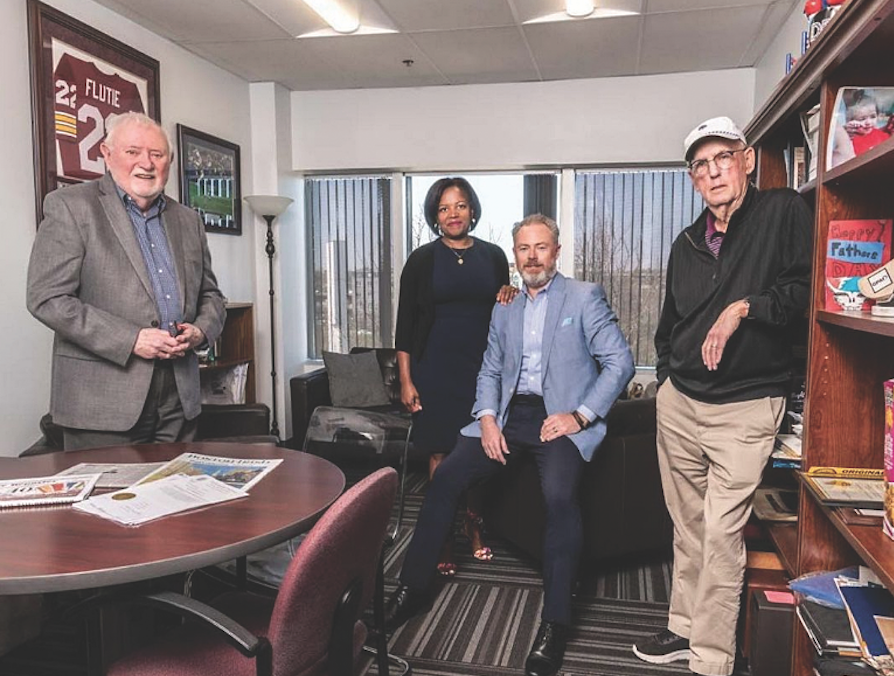
In the Dorchester Reporter offices in 2024, from left: Founder Ed Forry, co-Publishers Linda Dorcena Forry and Bill Forry, and Associate Editor Tom Mulvoy. Photo by Lee Pellegrini, courtesy Boston College Magazine.
“From that time on,” Mulvoy recalled in an essay for The Dorchester Reporter. “I was sure that I was meant to be a newspaperman on a team with a mission to tell stories about my city and my neighborhood that readers would day after day find useful and informative.”
Across some seven decades as a journalist, Mulvoy would go on to work almost entirely for two publications, both headquartered within three miles of his childhood home in St. Mark’s Parish. His path to The Boston Globe led through Boston College High and Boston College and, before that, the Wollaston Golf Club in Milton and North Quincy, where his caddying helped him win a scholarship. But the allure of storytelling, like the craving for news, began earlier and closer to home, where it would always be grounded.
•••
Mulvoy was one of five children (of an original six) raised by Thomas F. and Julia (Harrington) Mulvoy, who married in 1940 and lived until 1975 as renters in a two-family house on Lonsdale Street. An immigrant from Galway, Mulvoy’s father worked for the US Postal Service, while serving St. Mark’s parish as an usher at Sunday services and as a leader of its Holy Name Society. He was also a sportswriter for a weekly paper sent to parishioners serving in the military during wartime.
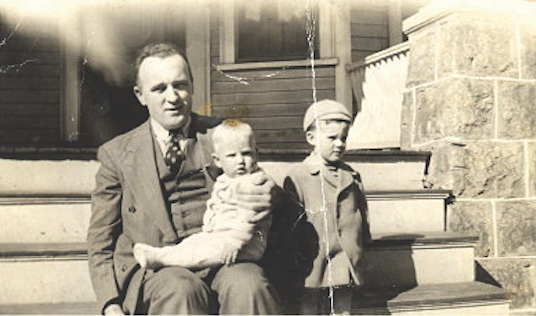
Thomas F. Mulvoy, Thomas F. Mulvoy Jr., lap-sitter, and Mark (Skippy Mulvoy), circa 1944
Mulvoy’s parents met when they were both working at Sears and Roebuck in Cambridge. After their children were all in school full-time, Julia landed a job as a bank teller and went on to become the assistant treasurer of the Granite Cooperative Bank in North Quincy.
As Mulvoy would later recount in The Globe, St. Mark’s was“an insular world of black and white, and precious little gray, and proud of it.” Within three blocks on the other side of Dorchester Avenue, the world was dominated by a Catholic church, a parish school, and a “centerpiece of life for St. Mark’s kids” locally known at the time as Wainwright Park.
As a journalist looking back, Mulvoy would associate the park with two adult figures. One was Margaret MacQuarrie, the mother of a large family who was often outside her house, right across the street, “checking in with neighbors.” The other was Charlie Paget, a local man who survived childhood polio and became the park’s tireless caretaker.
Both figures qualified as “eyes on the street,” but Paget did more than look after the grounds and the kids who suffered cuts or scrapes. When Mulvoy was a teenager, he was among the “regulars” who would hang out on the steps of a park building at the end of a summer day and listen to Charlie Paget, the village explainer.
“He was full of information about the neighborhood and its people going back to his childhood days when he was a schoolmate of my mother’s at the Emily Fifield School in Codman Square,” Mulvoy reminisced in an article for the Dorchester Reporter. “He had detailed stories, and opinions, about the politicians who had helped govern the neighborhood since the high-gloss times of James Michael Curley and Honey Fitz.” As Mulvoy put it, the “maestro” of Wainwright Park “was the perfect mentor for a boy who told him early on that he wanted to become a newspaperman.”
Mulvoy also followed the lead of his older brother, Mark, the guide and protector of the younger “acolyte,” glove-carrier, and batboy at Wainwright Park. After being groomed at a caddie camp on Cape Cod, Mark went to carry golfers’ bags at Wollaston, blazing a trail for his three younger brothers. Tom was next in line, hitting the links in 1958, at age 15.
“It was there that I learned about hard work and following the rules of golf while abiding the cultural etiquette that went along with the golf while I was on the private club’s property,” Mulvoy wrote in an email.
Eventually, the caddie from Dorchester and student at Boston College High School was toiling for two golfers on a four-hour round through 18 holes, with a bag of clubs slung on each shoulder. On a Saturday or Sunday, there could even be two rounds. Among the clients were people he was unlikely to encounter in St. Mark’s parish: doctors, lawyers, executives, and politicians, including Boston’s mayor at the time, John B. Hynes.
“The best of these members were on a first-name basis with their regular caddies and talked to us as partners in the success of their golf games,” Mulvoy wrote. “It was an uplifting experience when they showed interest in what we were up to in school and at home.”
His takeaway: “Hard work, done by spending a great deal of time outside in spring, summer, and fall not only with my caddie peers but also with successful club members, raised my emotional expectations beyond Lonsdale Street as to what life had to offer into the mid-1960s, just before Vietnam and social tumult changed so much.”
Another boost came in 1960, when Mulvoy was one of the winners of a scholarship established by the Massachusetts Golf Association for caddies and other teens working at courses. The scholarship was named in honor of Francis Ouimet, whose 1913 US Golf Association triumph helped spark a surge of enthusiasm for golf. What had previously been viewed mainly as an elite pastime in other countries was becoming more like a competitive sport and an American path to higher circles.
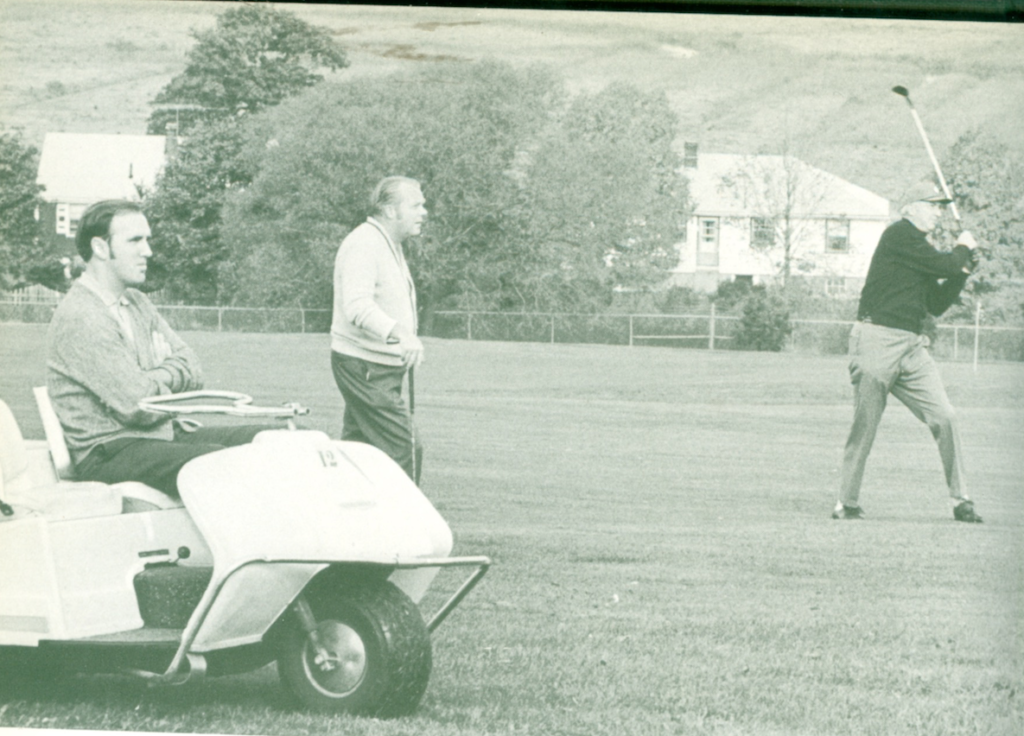
Tom Mulvoy, left, observes the action at Wollaston Golf Course, circa 1970. Mulvoy family files
In a spread that took up more than half of The Globe’s front page above the fold, Ouimet’s victory at The Country Club in Brookline over a pair of top-ranked professionals from the UK was dramatized as a trans-Atlantic blockbuster. The story also had deep local roots, since the twenty-year-old champion had grown up across the street from the 17th hole, as the son of immigrants from Canada and Ireland. Mulvoy would meet the golfing legend in person at a scholarship event and handicap him 66 years later as “just a real gentleman, a young kid who had no money, caddied at the Country Club for that set, and made a life of golf himself.”
Also following the lead of an older brother, Ouimet went from caddie to student of the game and scavenger for golf balls. In accounts of the rain-soaked 1913 playoff round, Ouimet was acclaimed for consistently placing his drives in a better position for the next shot, in a course described at the time as “a perfect network of traps and hazards.” More than a century later, Mulvoy concurred that Ouimet won mainly because he was the best player on the course.
“In order to play his best he had to hit every shot to a point on the course that would give him the best route to the green or the pin with his next shot,” Mulvoy concluded. “That was his advantage. He knew the answer from daily experience. And he probably kept notes along the way for the next day if he saw something new on the playing ground, like swampy grass where it shouldn’t be wet.”
In his own account, Ouimet gave the most credit to his caddie, Eddie Lowery, a ten-year-old son of Irish immigrants. In a legendary group photo taken right after the competition, Ouimet stands at the apex, beaming over a huddle of supporters. But the visual centerpiece is the noticeably shorter caddie, with his right hand splayed over the hooded clubs in the bag hanging from his left shoulder. His neck is still draped with a towel, his eyes still poised for the reaches of a fairway. He wears a jacket with a patriotic ribbon, a dislocated tie, and a soggy bucket hat.
Between $500 a year from the Ouimet scholarship and another $500 from seasonal caddying and occasional off-season jobs in the clubhouse, Mulvoy had more than enough to cover the annual tuition at BC. As a student, he focused mostly on history and political science, though the Jesuit curriculum also required courses in theology and philosophy, including epistemology. Students were schooled in the power of faith, the limits of knowledge, as well as the imperative for accuracy and clarity.
In the decades to follow, Mulvoy said, he would apply the same principles: “Just before you get going, before you get too deep into anything, define what it is you’re dealing with and talking about and what’s your intent and thought. And if I take one lesson out of all my eight years with the Jesuits, it’s that. And I still think that way.”
Mulvoy graduated from BC in 1964, in the same class with Mark, a feat that scored a “graph” in The Globe’s commencement coverage. With experience covering BC sports and working part-time for The Globe, it took only one month for Mark to join the paper’s sports staff. Five months later, he was recruited by Sports Illustrated, where he would eventually become the managing editor and publisher until his retirement in 1996.
The younger classmate tried to follow suit, but he made it to The Globe only after a series of surgeries two months after graduation to repair internal damage from perforated ulcer and four months of convalescence followed by 20 months as the news director for the Plymouth radio station WPLM. The first story he covered was about a water leak that would spill out in finger-pointing at a “combative” public safety meeting.
The radio job required learning how to write copy suitable for reading on-air. There were also the occasional office encounters with visitors, including the state’s first-term US Senator, Ted Kennedy, who nodded to Mulvoy simply as “Plymouth.”
“We weren’t friends or anything,” Mulvoy explained. “But he recognized me, and occasionally, I would say less than ten times if more than five, I called his office just to get a bit of information to help me – not working on a deadline story, but just to get some information. And I’d get it just from that.”
For Mulvoy, Kennedy was one more contact to be stockpiled by a reporter, even in addition to quotable sources. But the combination of public figure and celebrity status also tested a reporter’s need for distancing.
“It was simply part of doing business,” Mulvoy reflected, “and how you get to the point where you’re comfortable with that is a challenge, I think, because there are all sorts of examples of people being enraptured by the presence of a luminary and your ability to call them and let them know who you are and they know your name and all of that. But it’s part of the process to navigate that.”
After joining The Globe in 1966 as a copy editor, Mulvoy shifted to the sports desk and after seven years of working the midnight shift, he became the assistant sports editor, which included designing the section’s front page. In 1976, he became the morning Globe’s night editor and, two years later, an assistant managing editor. In 1982, he would take a year off for a National Endowment Fellowship at Stanford University in California.
A former colleague of both Mulvoys, at The Globe and Sports Illustrated, was the writer, columnist, and author Leigh Montville, who started at the paper in 1968. In an email summing up his experience with Tom Mulvoy, Monville wrote, “He was helping to run the sports department, a young guy, serious, with a solid head on his shoulders, accompanied by a nice sense of humor. We talked about a billion things those days, I’m sure, but the one quote that sticks in my mind is he said something like, ‘I don’t care about making a lot of money, I’d just like to make enough to buy a hardcover book without feeling guilty.’”
Along with vetting copy, Mulvoy learned about other components, such as typography, headlines, captions, page layout, and graphics. He also learned about the construction of a story and when not to fuss with a reporter’s style.
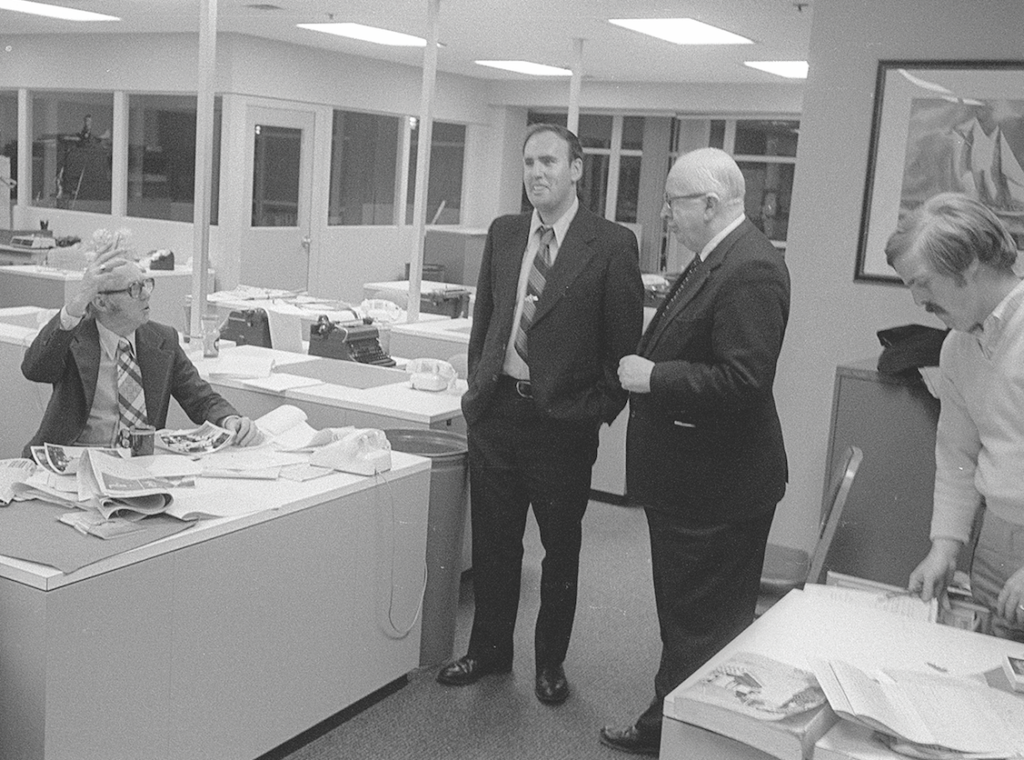
Tom Mulvoy in the Boston Globe newsroom on Election Night, 1976. Boston Globe photo
During this time, The Globe’s editor was Tom Winship, a third-generation journalist and Harvard graduate who raised the paper’s national profile and greatly boosted circulation between 1965 and 1984. Working a news desk shift from 2 p.m. to 1 a.m., Mulvoy sometimes found himself raising time-sensitive concerns about a crucial story with the paper’s national editor or Winship himself.
“And I found out that I had a voice,” said Mulvoy, “that people listened, and didn’t always agree, and I didn’t expect that. But at least when I came and asked the question, I got an answer.”
In Mulvoy’s time, Boston had as many as seven daily papers. TV news was still gaining ground as a trend-setter, while the dailies were still crammed with an abundance of local material, from crime and politics to school sports, weddings, obituaries, movie listings, classified ads, and racing results.
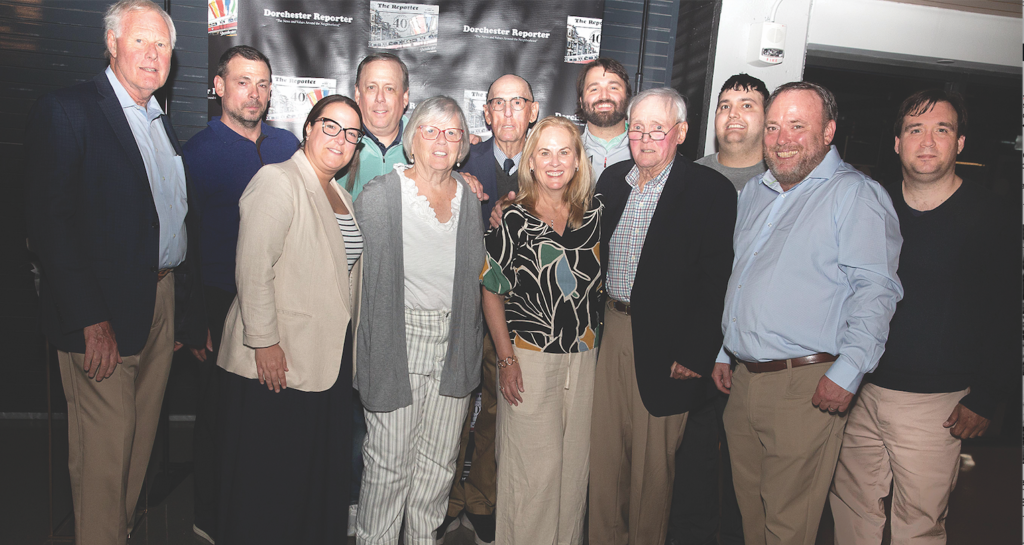
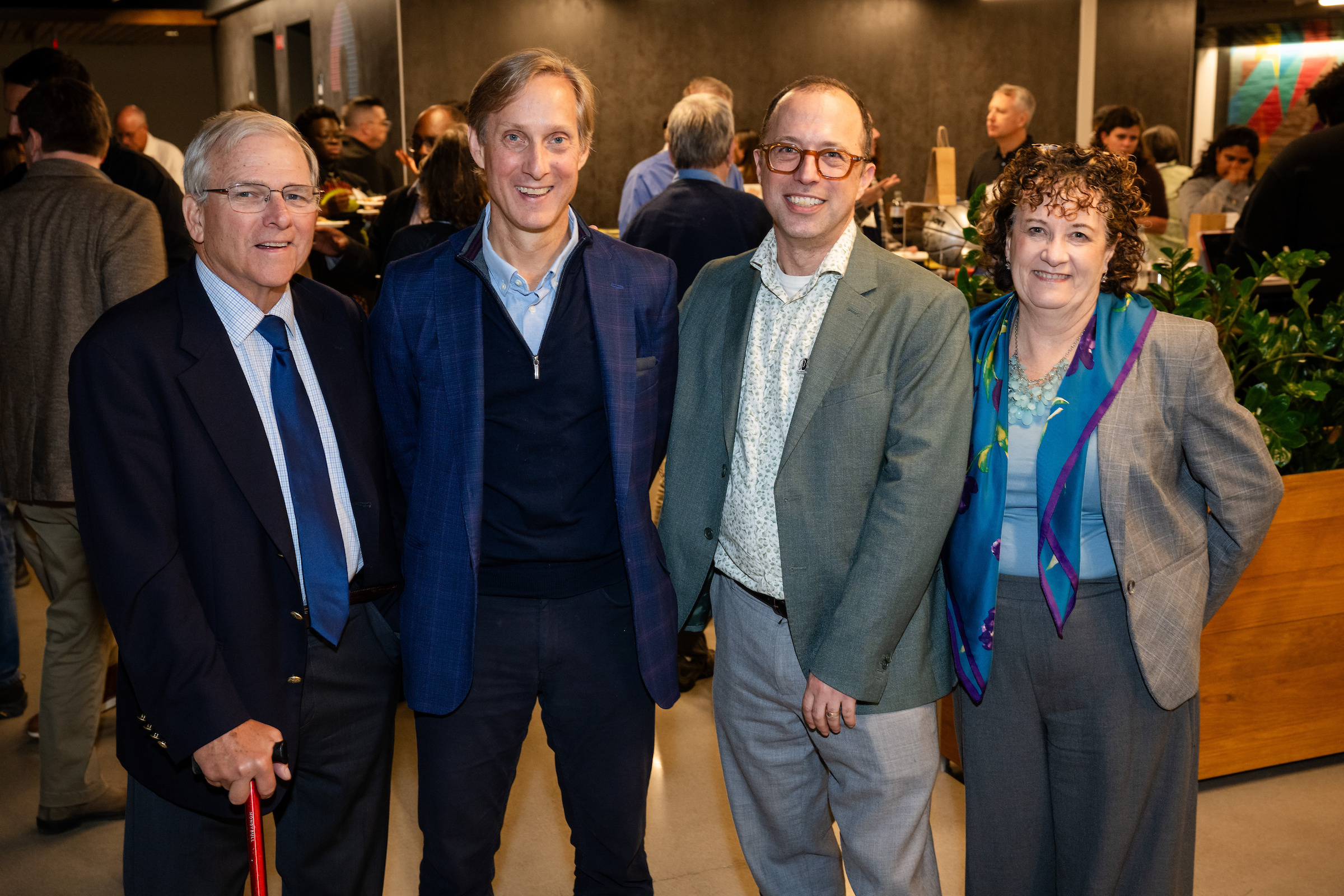
The above photograph, taken by the photographer Bill Brett at the Reporter’s Local News Initiative launch on May 28, shows a number of Mulvoy family members: From left, Donald Lofty, Ryan Mulvoy, Lauren Mulvoy, Robert Mulvoy Jr., Mary (Mulvoy) Lofty, the honoree, Jennifer Watson, Nicholas Mulvoy, Robert Mulvoy St., and Benjamin, Kevin, and Stephen Mulvoy.
“Newspapers were huge,” Montville recalled. “Everybody got the paper. Most everybody. You’d go to the suburbs and there would be those little Boston Globe breadboxes on a pole at every driveway. You’d go into convenience stores and there would be high stacks of newspapers, twice as high on Sunday. Everybody was a reader instead of an iPhone clicker. The stories were an important part of daily life…and Tom was an important part of this important part.”
Though Winship expanded The Globe’s function as a portal to national and world news, he insisted on a clear stamp of local origin – understood by Mulvoy as “commandment number one.”
“One of the things he said to me early on when we were putting the paper together at night,” Mulvoy recalled, “was we kind of go out dressed like a TV show, a TV news show. He said, ‘We always remember it’s Boston, and we’re going out undressed if we don’t have a significant Boston story on the front page.’”
On his return from Stanford in 1983, Mulvoy became The Globe’s deputy managing editor, helping the managing editor, Matthew V. Storin, in day-to-day direction of news operations. One part of the job was recruiting a team to work on special coverage of the 40th anniversary of World War II. Among the recruits was a Columbus, Ohio, native who came to The Globe from the Pittsburgh Post-Gazette, Wil Haygood.
“From that began a decades-long alliance of reporter and editor,” Haygood related by email. “Tom became the big city editor who turned me loose across the nation. He mentored me. He edited my stories with calmness and precision. Every story became better. And I actually learned something from every story he edited.”
Haygood would go on to write eleven books, including one dedicated to Mulvoy, about the pastor and former Congressman from Harlem, Adam Clayton Powell, Jr. Another book, “The Butler,” was about Eugene Allen, a Black man from Virginia who worked for 34 years at the White House, serving under eight presidents. Starting when Black employees at the White House were almost entirely restricted to the role of domestics, Allen went from “pantry man” to maître d’ and would live to vote for the country’s first Black president.
The first version of Haygood’s story appeared as a Washington Post profile in 2008, shortly after Obama’s election and the death of Allen’s wife, one day earlier, before she could cast a historic vote. It was a national story, suitable for any metro daily. For the Post, it was also a story about a local resident and a local workplace.
In 1991, Mulvoy became the “managing editor for news operations,” with his oversight expanded to include photography, design, copy desk operations, sports, and newsroom technology. As The Globe announced, he would also have “primary responsibility for Page One.”
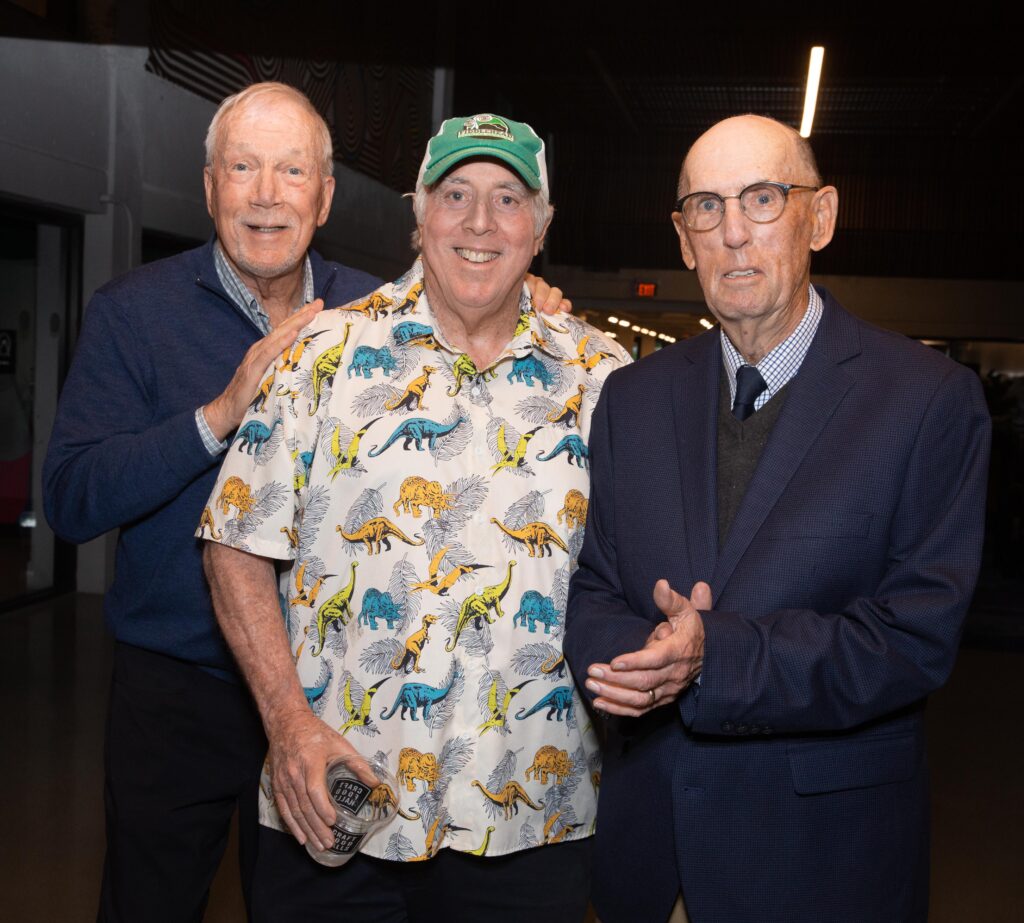
Three Globe legends: Walter ‘Robby’ Robinson, Stan Grossfeld, Tom Mulvoy reunited at the Reporter’s Local News event on May 28, 2026 at Southline Boston, the old Boston Globe headquarters on Morrissey Blvd. Photo by Bill Brett
By this time, Mulvoy had already developed working relations with staff photographers, including Stan Grossfeld, who became The Globe’s chief photographer in 1983. Grossfeld would later win the Pulitzer Prize for covering sports, famine in Ethiopia, and immigrants crossing the Mexican border. Though he had an undergraduate degree in photography—eventually followed by a master’s from Boston University, Grossfeld would often accompany his images with writing that went beyond the range of captions. That began with his first assignment, capturing the aftermath of a violent crime, but it would continue, with support from Mulvoy.
“In those days, you know, photographers were thought of a lot of times as second-class citizens,” said Grossfeld in a remote interview. “And Tom never treated me like that. He always encouraged me on the writing side.”
Grossfeld’s 1984 front-page photo of immigrants wading precariously across the Rio Grande resurfaced in May on The Globe’s website. Pictured are five mostly invisible men, up to their chins in muddled water. To be more precise: faces, hats, arms, hands, even a single wary eye looking askance, seemingly within inches of a lens that’s all but submerged. The photographer, when asked 42 years later, confirmed by placement of his forearm that he, too, was in the water – up to his chest. It’s literally in-depth reporting, and it affirms the dictum of the legendary photojournalist, Robert Capa: “If your pictures aren’t good enough, you aren’t close enough.”
The photo doesn’t editorialize, but a difference in range and perspective can allow a polarized topic to be viewed differently, almost eye-to-eye. In the dislocating jolt of the moment, there’s a suspension of bias that, even short of egalitarian sympathy, alters perception by shifting focus.
“Tom realized that we don’t want to be the same as every other, we don’t want to be clichés,” Grossfeld reflected. “We don’t want check-cashing pictures – presentation pictures – because they don’t really do anything except feed the egos of the people in the pictures. And that’s not going to change society or mankind.
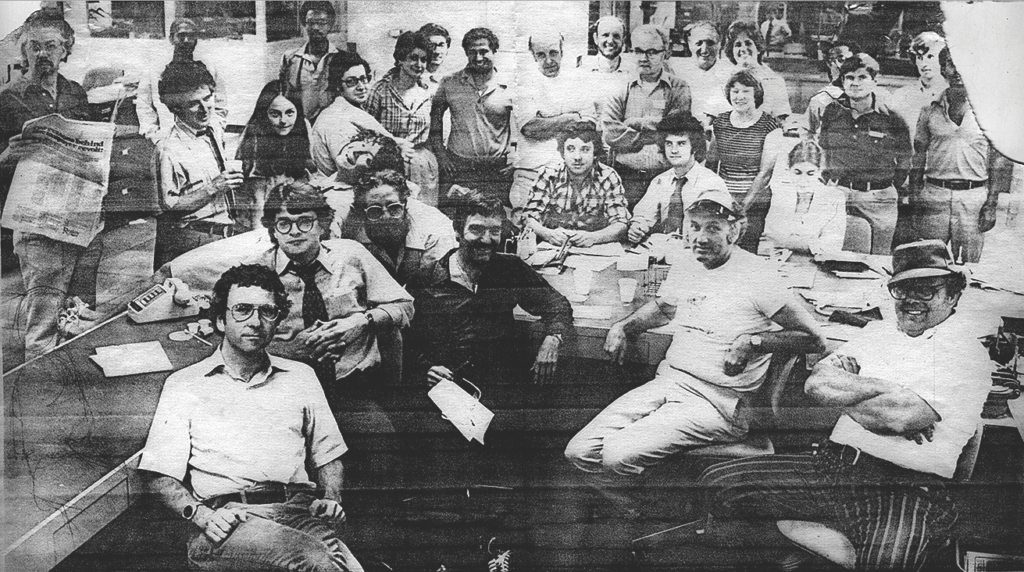
Night Editor Tom Mulvoy worked with the editors, artists, and editorial assistants who sat for the picture above in 1977.
“I think Tom is an everyman,” he went on to say. “He knew what the people were like who were living under the bridge by the Neponset River, at the circle there. He could get along with them, and he could get along with Prince Charles at the same time.”
According to Grossfeld, Mulvoy was a hoard of knowledge, territorial and historical, and a cool head under deadline or amid the city’s turmoil fifty years ago. “But Mulvoy, to his credit,” Grossfeld emphasized, “he always would hit ‘em down the middle of the fairway.”
Mulvoy acknowledged that, as early as 1979, he explored using his storytelling skills by taking a weekly assignment as a reporter. But the idea faced resistance from important colleagues, though in a way that affirmed his pivotal role as the “last pencil” on editions that went beyond corrections and an ear for local idiom to being a steward of perspective.
“And you have to start by bringing in perspective yourself, and see if they accept it,” Mulvoy said. “And I think the main thing that you find over years, at least in my little corner of the world, that that perspective plays out when you don’t do it that way, when all of a sudden the readers are jerked about– this isn’t how the Globe does things, what’s this story doing here?”
Over the years, Mulvoy’s name appeared in a Globe byline only intermittently. But, aside from the paper’s staff listings, it appeared frequently in the published ruminations dissecting internal decisions about coverage that were posted by the Globe’s designated “ombudsman.” Mulvoy was often cited as the authority on why unsettling details had to be included in a violent crime story, when there was a need for restraint in an obituary, or when it was time to stop calling a police vehicle a “paddy wagon.”
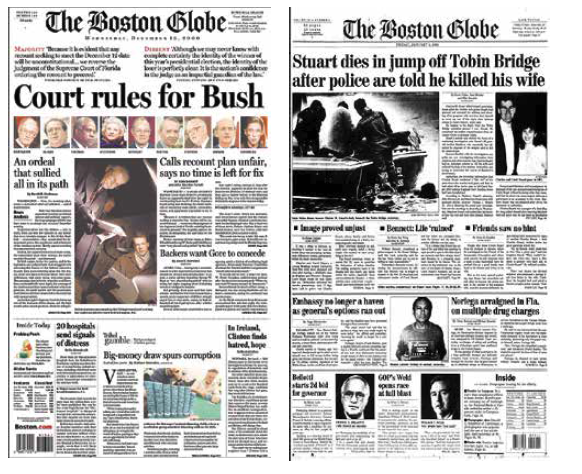
Above, two of the roughly 5,500 Boston Globe front pages that he supervised during some 35 years working at the paper.
In the extended coverage of the racially fraught “Stuart Case” of 1989, it was Mulvoy who noted to the ombudsman The Globe’s policy against mentioning the race of a crime suspect on the loose when other characteristics were lacking. That policy didn’t come into play in this instance: It was the wounded murderer Stuart who said from his hospital bed that a black man in a track suit had shot into his car, setting off a police chase that victimized the area’s Black residents.
Mulvoy’s first Globe byline dates from 1971, over an article about the theft of more than 25 “Hummels” from his family’s home. The folksy figurines, gifts to his mother, became popular after World War II, when many of them were brought back to the US by GIs who had served in Germany. Excused as irresistible kitsch, or prized as vintage collectibles, Hummels were often amassed over time, becoming a staple of décor in many of Boston’s Catholic households.
As Mulvoy detailed, each figure came with a personal story of its acquisition, even how one piece was meant to fit with the others, turning an inventory of objects into a chain of reminiscences. Though his piece adopted the tone of a routine police report, the first sentence makes it clear that what counted in the property crime was 30 years’ worth of memory loss and an aftertaste of bitterness.
He wrote about the same house again in 1980, four years after the last of his family had moved to Boston’s suburbs. Their departure took place after the death of the woman who had owned the house for most of the past century. Mulvoy recalled her care for the house and its grounds, along with kind words for her tenants. He also described how, by 1980, her lawn had been converted by a new owner into a driveway for a “wretched old car.”
What happened to the property on Lonsdale Street was hardly the most jarring example of neighborhood change, but it was an indicator of how the texture of the city was changing. Downturns in population and household size came with a growing number of cars, many of them awkwardly crowding Dorchester’s pre-automotive street grid. Once again, Mulvoy registered the “local,” not as a nostalgic fixation, but as something that could change and hit home as a loss.
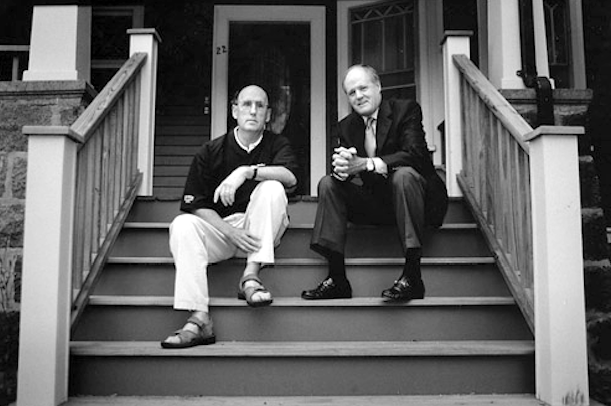
Brothers Tom, left, and Mark Mulvoy on the porch of their childhood home on Lonsdale Street. Photo by Bill Brett
In 2001, when St. Mark’s Parish was faced with possible consolidation, Mulvoy assessed the possible loss as declining numbers of worshipers and students, but also a diminished social fabric. The reporter’s inventory was local, yet it reflected similar changes in other parishes, even among other religious denominations.
Mulvoy had written earlier about other losses. In 1973, it was Rev. Walter F. Donahue, a priest who served St. Mark’s “unobtrusively” for 22 years. In 1974, it was Charlie Paget. Mulvoy had kept in touch with him, even treating him to a trip to Martha’s Vineyard and, for their last excursion, to a field of dreams that the “maestro” cherished even more than Fenway Park—the Arnold Arboretum.
In 2002, the sense of loss hit much closer to home when Mulvoy wrote about the fade-out of memory and personality when his mother was diagnosed with “dementia of the Alzheimer type.” The article described her struggle with illness, but also the frustration of family members trying to keep in touch with her through the slow progression of mental, then physical, decline.
Lying outside his central responsibilities at the time, Mulvoy’s bylined work usually appeared as “op-ed” commentary or, elsewhere, as the odd splash of local color. What made it less formulaic was that it addressed the public more squarely than either the generic detachment of a reporter or the angular persona of a columnist. Mulvoy said the “op-ed” about his mother got “quite a bit of reaction,” and there was a similar response to the writing about Charlie Paget and the worsening signs of neglect at Wainwright Park.
“I got notes from all sorts of people who didn’t know Charlie,” he said, “but they knew a person who did that sort of thing, out of Framingham or Cohasset. I said, ‘Boy, you put it in The Globe and people read it.’”
Another op-ed that stirred readers was about the approaching death of Mulvoy’s 82-year-old father, in 1991. The piece begins with Mulvoy kneeling to help his two-year-old son put on his pants, while the boy is propped up by his right hand on his father’s left shoulder. Just hours later, Mulvoy’s on his knees again, helping his father get dressed, the same shoulder touched, this time, by a hand that’s shaking.
Mulvoy immediately registers the touch of resemblance and shares the connection with his father, who responds with a show of stoicism for himself and empathy for his middle-aged son. The father’s dispensation allows Mulvoy, in the middle of life’s road, to confess that “it is painful to ponder my little boy’s future and my father’s death in the same mind-frame.”
The dispensation is paid forward to Mulvoy’s readers. “The mind doesn’t need scruples at times like this; deep down,” he admits, “you think only about how a loved one’s death is affecting you. There’ll be time to consider everyone else later.”
Mulvoy met his wife, Anastasia Coulianos in 1983, soon after he returned from his fellowship. At the time, Mulvoy was 40 years old, and Coulianos was a 23-year-old Northeastern University co-op student. Starting with nightside work on The Globe, she became an intrepid research assistant for The Globe’s Spotlight Team.
After their engagement, Coulianos moved from the newsroom to the paper’s front office, in the promotion department, finally leaving The Globe after marriage. “She hated leaving the newsroom,” Mulvoy added, “and felt awkward in the promotion position.”
The couple had four sons, born between 1986 and 1999. Two of them were diagnosed with autism: the oldest, Stephen, who works as a paraprofessional in special education for the Holliston Public Schools, and the youngest, Ben, as a medical delivery courier. Michael, the second oldest, is a staff sergeant/medic serving in the US Army. The next oldest, Nicholas, works with technology for a company specializing in payroll systems.
Anastasia passed at age 46 in 2006, after a long struggle with liver disease caused by the hepatitis C virus, which Mulvoy believes may have been contracted through a blood transfusion related to a pregnancy. Just a few months earlier, before her condition seriously deteriorated, she had been scheduled to undergo a transplant, with her 19-year-old son Stephen as the donor. According to The Globe’s obituary, she devoted time and effort to her children even during her illness, which included acting as a “fierce advocate” for her youngest son’s needs in special education.
The boys, Mulvoy related, “watched their mother die in slow stages until the last six months when things seemed to rush to a conclusion delivered in late 1999 – namely that she would live for only another five years. “That was devastating to all of us,” he wrote.
At that stage of his wife’s illness, Mulvoy and The Globe, which had already been acquired by the New York Times Co., had agreed to a buyout plan that allowed him to spend more time with his family. He retired at age 58, when his youngest child was 19 months old.
Mulvoy’s name would still appear sometimes in the paper, including a stint of a few years writing and editing Globe Santa stories as fund-raising appeals. He also continued as a journalist for another locally based outlet, the Dorchester Reporter. Starting in 2002, he was back to shepherding copy and crafting the front page, recycling his skills in news page design and a flair for headlines and captions.
“The Globe’s ‘loss’ was the Reporter’s immeasurable gain. He taught us, among many things, that ‘there’s always room on page one for a page-one story,’” wrote the Reporter’s publisher, Bill Forry.
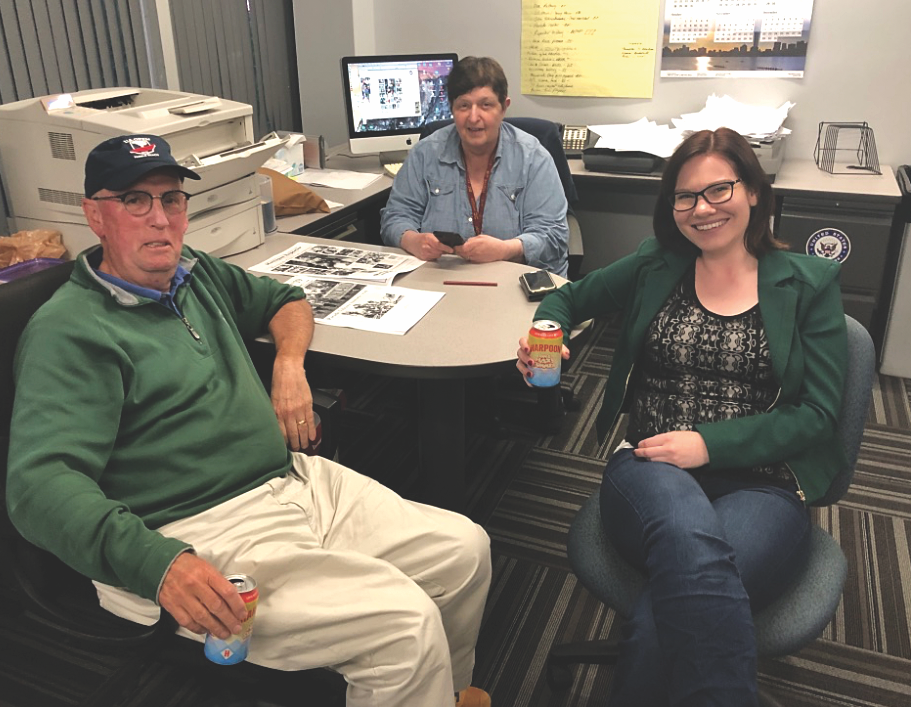
Tom, left, with Reporter production manager Barbie Langis (center) and news editor Jennifer Smith in the Reporter newsroom after shipping a Dot Day double edition in 2018. Reporter file photo
“Tom has a quiet, sometimes reserved manner at the copy and production desk,” said Forry. “He’s meticulous in his scrutiny of every detail of the Reporter’s news flow, from the simplest caption in the People section to the most complicated deep-dive investigative story. At 83, he’s blessed with a steel-trap mind and a lightning-quick recall of Boston’s modern history, much of which he’s witnessed and chronicled. He’s added immeasurably to the depth and caliber of the Reporter’s coverage for the last two decades.”
From one news cycle to the next, things change. Ouimet and Lowery remain lifetime friends, and the caddie becomes a multimillionaire auto dealer in San Francisco. St. Mark’s merges administratively with a neighboring parish, then reverts to earlier status, with masses in English and Spanish. In 2011, The Globe begins online subscriptions. In 2017, after its sale to the current publisher, John W. Henry, the organization departs from Morrissey Boulevard in Dorchester, with print operations relocated to Taunton and the editorial component to Boston’s Financial District.
In 2026, Mulvoy still plays golf three days a week. For fifty years, he’s been a member of the Thorny Lea Golf Club in Brockton, which he joined as “a working man’s private golf club,” and “where there’s always a game to be had.”
Looking back over more the decades, he wrote, “I operate today with the same personal drive I had as a nine-year-old boy in a very busy household: I needed to look over the newspaper every day so I would know what was going on beyond my street. As I grew up, I was certain that I belonged in a newsroom, to be with the people who reported and presented the news every day, whose predecessors educated me by telling me stories away from the classroom. And I’m just as certain today that with The Dorchester Reporter, I’m where I belong.”
In a move last year to support local journalism in the decades ahead, The Reporter established the Edward W. Forry and Mary Casey Forry Foundation for Community Journalism. The first fundraiser for the initiative took place last week at Southline Boston, the former site of The Globe on Morrissey Blvd.
The event was also the launch for an effort to support aspiring journalists from Boston’s neighborhoods, through the Thomas F. Mulvoy Jr. Scholarship: a tribute to a caddied who became a straight-shooting master of local news.
Chris Lovett is a veteran Boston television and newspaper journalist and a regular contributor to The Reporter.
For more information about the Forry Foundation or to donate to the Mulvoy Scholarship, please click here.