
Above, Councillor Culpepper, left, and Councillor Worrell explain their idea today at a press conference. Gage Vieno photo
An ambitious proposal to extend the Orange Line subway underground from Ruggles Station to Mattapan Square via Warren Street and Blue Hill Avenue got a private airing with Interim MassDOT Secretary Phil Eng Tuesday in the Back Bay’s State Transportation Building on Tuesday.
Councillors Brian Worrell and Miniard Culpepper offered the idea as a long-term replacement for the controversial center-running bus lane project now slated for the corridor, with any bus service only serving as a near-term bridge to full rail service.
WBUR: Transit advocates, key lawmakers criticize ‘unserious’ Orange Line proposal
The idea of an Orange Line extension branching off at Ruggles has come into conversation lately as opposition to the center-lane bus route has grown. Both councillors said on Tuesday that they’ve taken a good first step in a renewed process and that their idea is the equitable solution for the area, and not the center-running bus lane.
“There was the commitment to make us part of the Program for Mass Transportation (PMT) that will include our proposal in the larger scheme of the planning they do for the T around the state,” said Culpepper. “That’s critical because it involves the Orange Line underground…We thought it was a good meeting and we agreed to meet again.”
Added Worrell: “The conversations were around making sure we are not only finding the most efficient way of getting transit riders up and down Blue Hill but also a long term solution for transit riders. That solution is the extension of the Orange Line. We believe there should be a subway in that area and the data calls for it.”
The PMT is the MBTA’s long-range planning document that looks at changes and additions in service for future needs. Eng did not immediately return a request for comment on the meeting, nor did Mayor Michelle Wu, who backs the center-running bus lane plan.
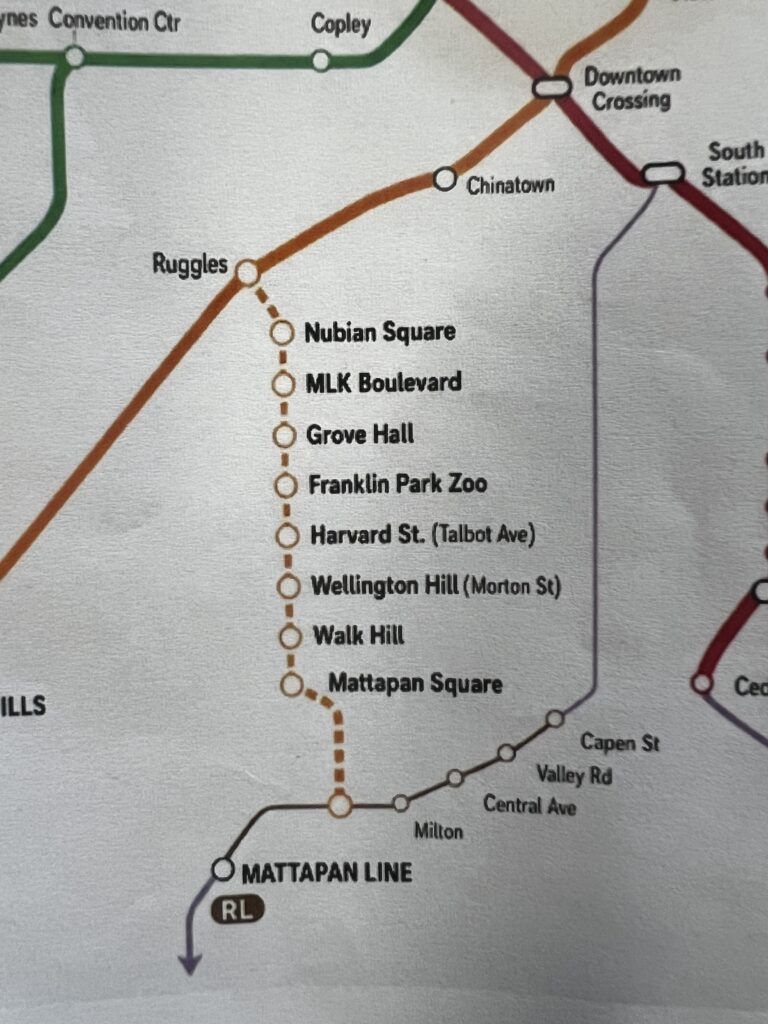
A map handed out by Councillor Culpepper’s office to illustrate the councillors’ proposal.
Culpepper and Worrell said their strategy includes going to the Legislature and speaking formally with Wu, Gov. Maura Healey and other stakeholders in due time.
“When you look at the map, you can see every part of Boston has rail, has a subway, or light rail,” said Worrell. “The only area that does not have it is the area that has the most bus riders in the state…How can we solve for that in the moment? This subway is that plan.”
Culpepper called the area from Ruggles to Mattapan Square a “train desert” and said buses are not the remedy for Blue Hill Avenue. A handout map distributed to the media showed an Orange Line branch splitting off from Ruggles and having stops at Nubian Square, MLK Boulevard, Grove Hall, Franklin Park Zoo, Harvard Street at Talbot, Wellington Hill at Morton, Walk Hill, and Mattapan Square. The idea would be underground stations with exits to the sidewalks.
Both pointed to stops that would connect the Zoo, and schools like Boston Latin Academy, Madison Park Technical Vocational School, John O’Bryant High School, and Young Achievers School to the new subway.
“There is no train that goes through the Black community from Mattapan to Grove Hall to Nubian to Ruggles,” Culpepper said. “What we are proposing is to remedy this train desert so we can enjoy the same kind of transportation that everyone else in the state enjoys. We believe we’ve been excluded on Blue Hill Avenue. Everyone keeps saying buses and I’m saying no buses.”
He noted that the Fairmount commuter rail line, which runs from South Station to Mattapan Square near the duo’s proposed subway extension, is a welcome amenity, but a “different line.”
“If you look at the transportation and train desert we’re talking about, it goes in a different direction and that’s not what we’re talking about,” he said.
There were no cost estimates discussed, both said, as they expect the PMT study would provide numbers for extending an underground subway of some six miles. However, they cautioned, cost comes up too often to thwart major projects in the Black community.
“When they did the Big Dig, the most expensive transportation project in the country, nobody said anything about it sounding like a lot of money,” he said. “When they did the extended [Green] Line [in Somerville], nobody said anything about a lot of money. In this case, we want to be treated like everyone else. They find the money when they need it.”
In response to a request for comment from Mayor Wu about the Culpepper-Worrell idea, a spokesperson for the mayor said: “The City is always looking to expand public transit access for our residents in partnership with the MBTA. However, digging new miles of subway tunnel under City streets would take many years of evaluation and likely well over a billion dollars in federal investment.
“Today, Boston has an opportunity to deliver more immediate improvements and beautification of the Blue Hill Ave corridor with nearly $150 million secured in state and federal funds. As we continue to work with community members to incorporate feedback into the proposed project design, we are focused on ensuring improvements to speed up commutes, expand opportunities for small businesses along the corridor, and boost quality of life for families in our neighborhoods.”
State Rep. Russell Holmes, who represents part of the corridor, has been a staunch supporter of the center-running bus lane, but he said he welcomed discussion of more transit.
“I am very thankful the councillors have moved the conversation to one about public transit and not a conversation about keeping things the same on Blue Hill Avenue,” he said. “People ask why I’m so adamant about the bus lane and it’s because I think there has been a true injustice done to the community when they turned our business district into a three-lane highway.
“I am happy we’re talking about public transit and how to improve it and I welcome everyone to that conversation I’ve been having for 20 years.”
Rep. Chris Worrell, the brother of Councillor Worrell, said: “If we are serious about relieving traffic congestion, connecting our neighborhoods with Boston’s economic engine, and making the city more accessible, we need to be bold in supporting proposals like the Orange Line extension — that would be a game-changer for Boston.”
In contrast, state Sen. Liz Miranda, who represents the entire corridor, said the city and MBTA need to go back to the community and work to find broad support for a plan within the funding limits that likely doesn’t include an Orange Line extension or a center-running bus lane.
“The proposed Orange Line extension should not be presented as an alternative to that work,” she said. “While it’s an exciting long-term vision, it has never gone through a community planning process, has no identified funding source, and has not earned broad community buy-in.
“I believe the MBTA and the City should work with residents to exhaust every option within the scope of the available funding to determine whether there’s a solution the community can support…Without a new redesign process that earns broad community buy-in, I don’t believe we should move forward with any proposal,” she concluded.
The genesis of the Orange Line extension conversation goes back to the removal in 1987 of the elevated Orange Line that ran for decades from the South End to Dudley Square and ended in Egleston Square. Culpepper, Worrell, and other community leaders have recently been unearthing the promises made to return equal or better transit service to those areas.
Part of Tuesday’s meeting, Culpepper said, was to push the MBTA to honor those past promises.
“Let me be clear, 40 years ago there was a promise to the Black community that when we take down Egleston, Dudley, Northampton and Dover (Orange Line Stations), we would get comparable transportation and we never got it,” he said. “We want them to live up to their commitments so we can have transportation like everyone else.”
