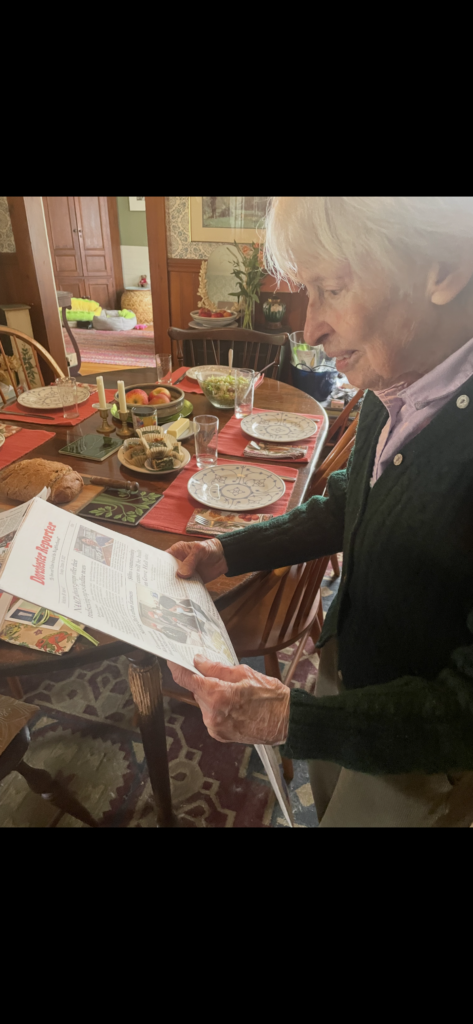

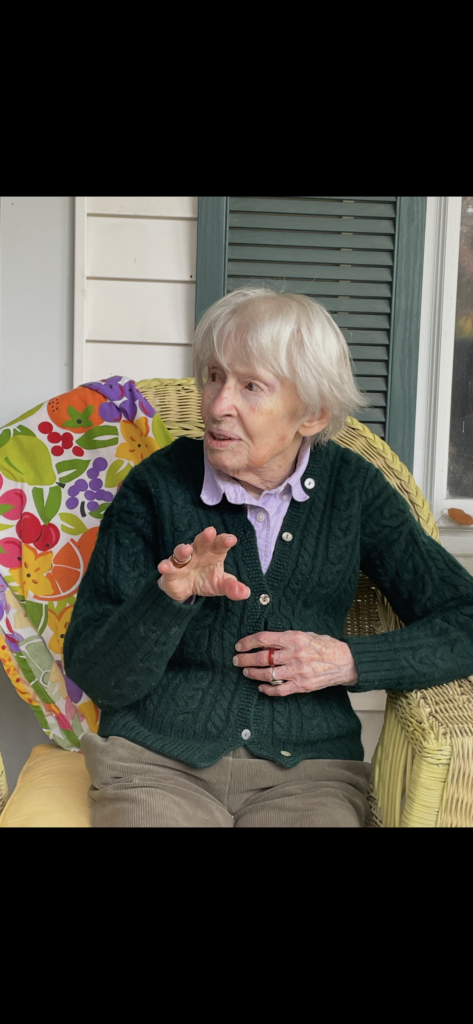
Bill Walczak photos
Fifty years ago, as a young student at UMass Boston, I enrolled in Professor Connie Veenendaal’s course on American poetry. I had no talent for poetry but thoroughly enjoyed and remember how she guided us through an exploration of American poetry and encouraged us to pursue our own poetics.
I didn’t see the professor for many years until we reconnected several years ago through my wife, Meg Campbell, who is a member with Connie of Dot 4, a writing group of Dorchester women poets that has been meeting for 25 years.
Connie continues to write poetry, an experience that culminated with the publication of her fifth volume, “Sky of Sudden Chances” (Blaze VOX books), on her 100th birthday. The poems explore people and places, and several of them are about Dorchester, a tribute to her many years living on Wellesley Park.
I recently interviewed the professor in advance of her 102nd birthday this month. She has a remarkable memory of a very full life.
She recalled growing up the granddaughter of Irish immigrants in Springfield, Massachusetts, as the eldest of six children. She remembered listening to Presidents Calvin Coolidge and Herbert Hoover on the radio, but much preferred the Fireside Chats of her hero, Franklin Delano Roosevelt.
Her father was a draftsman in the 1930s, a time of little construction, so the Great Depression years were a time of struggle. Her parents eventually purchased a house in Springfield at a bargain price from former bootleggers from New York, whose fortunes had plummeted with the end of Prohibition.
Connie was in high school when Pearl Harbor was bombed, and she heard FDR’s speech declaring war broadcast in her classroom. In 1942, she entered Massachusetts State College, now known as UMass Amherst, just as most of the men at the school were being drafted to serve in the war. She said that UMass turned into a “girls’ school” until the end of the war.
Connie came to Boston as a founding member of the UMass Boston faculty in 1965. The university’s first decade was spent in downtown Boston, including buildings in the so-called “Combat Zone,” where pornographic theaters and bookstores were flourishing. I took a chorus class singing Mozart that was located across from a theater called the “Naked Eye.” Her office was in the former Boston Gas building on Arlington Street, which was still being built when she moved in. All professors were issued hard hats as a safety precaution.
In addition to teaching and writing poetry, Connie was a founder of the groundbreaking Alice James Press, a cooperative launched to create opportunities for women to publish poetry. She loved living on Wellesley Park, but later relocated to Franconia, New Hampshire, to live with her daughter. She said she misses her Melville Park neighborhood.
Reflecting on being 102, the professor said that some things haven’t changed – getting things done has always been hard. Asked which decade was her favorite, she said “the ‘60s. It was a time of optimism.” On the worst, “When we got into the ‘80s, I remember thinking, ‘I don’t like this decade very much.’”
What concerns Connie the most today?
“The awful things and bad attitudes toward immigrants. Immigration was such a story in all of our lives. Our families adapted and they didn’t have police coming after them in their homes. My husband was an immigrant and lived here without becoming a citizen for most of that time and nobody bothered him about it.”
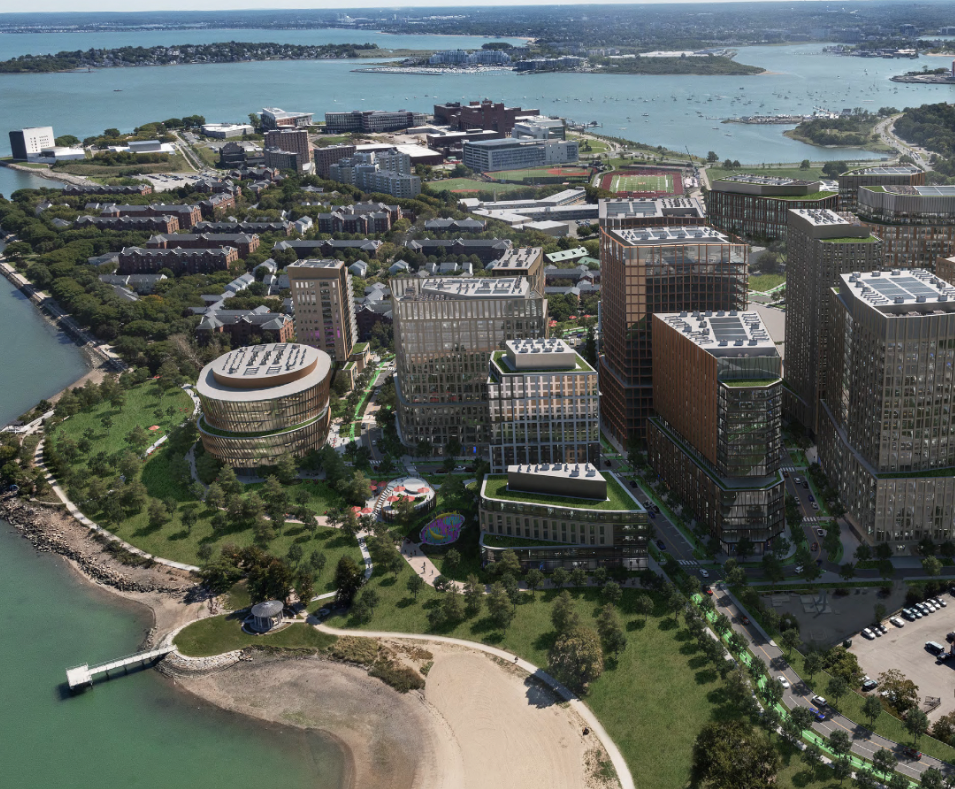
In her recent volume, Connie revisits UMass Boston in the poem “Columbia Point”:
We were an estimable community,
together, our original, shared gifts.
At the outset in improvised rooms
then building here at the harbor.
From my desk I looked out to the islands,
cargo ships moving into the docks,
flight lanes over our sealed windows,
then back to the anxious page.
If only I had realized then
that teaching is leading out to the sun.
Happy 102nd birthday, Dorchester poet Connie Veenendaal!
SAVIN HILL
Sunday afternoon, soft weather,
Russian Sage and Hydrangeas
on stone walls.
I walk the nearly perpendicular
Street of 19th century houses,
Foundations quarried from the hill.
You are already up the grassy bank,
and I follow to the summit, walking
on outcrops of puddingstone.
Look down – there is the sheltered bay,
just as when the Neponsets looked down
from their summer campground
and watched the John and Mary sail in.
A man in a white shirt is playing ball
With two little kids. He tells us
he’s the new city councilor. He says
we’ll find a Savin tree on the way down.
COLUMBIA POINT
(excerpted above)
Finally, I dare to go back,
with camera, walking the outer edge;
the sailboat landing, the clean salt smell,
daisies, goldenrod, briar roses among rocks.
An unexpected feeling of belonging –
Grounded as my shadow –
brings into focus the whole enterprise.
The campus seems at ease now –
sky, water, and dark horizontal walls.
I knew their fluorescent interiors well,
discomfort of the halls, discipline
of an academic day. Out of the rushing,
Remember me? I’m still working with words!
We were an estimable community,
together, our original, shared gifts.
At the outset in improvised rooms
then building here at the harbor.
From my desk I looked out to the islands,
cargo ships moving into the docks,
flight lanes over our sealed windows,
then back to the anxious page.
If only I had realized then
that teaching is leading out to the sun.
One last picture now: a reader on a bench,
too far away to notice me and my camera.
In the darkroom I will see more things
than I have dreamed,
even on my seventieth birthday.
Copyright © 2026 Boston Neighborhood News, Inc. This content may not be re-published or re-used without written permission.