
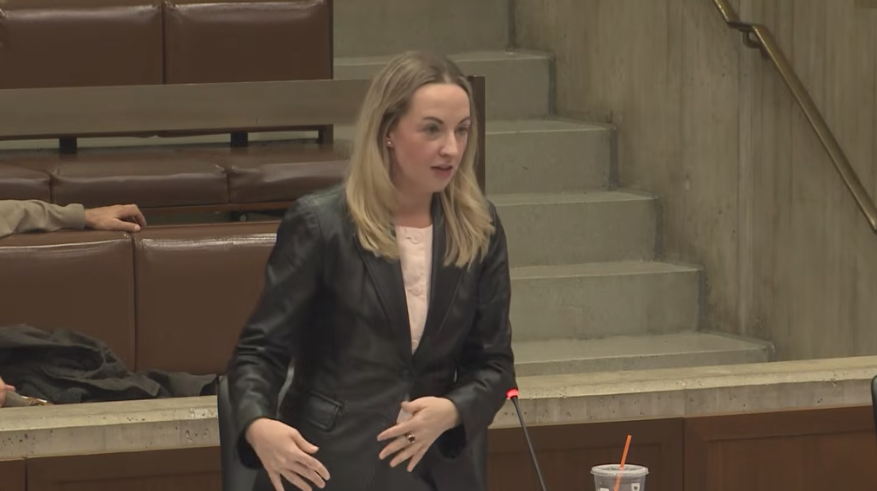
Above, Councillor Sharon Durkan. Screenshot
By Eve Zuckoff, WBUR
In an effort to bring down housing costs, the Boston City Council has taken the first major step towards eliminating its off-street parking requirement for new housing.
The closely watched council vote in favor of the change to current rules would allow developers to decide how many spaces are needed, instead of mandating the number of spots per unit in many new developments.
Liz Breadon, Gigi Coletta Zapata, Sharon Durkan, Ruthzee Louijeune, Miniard Culpepper, Enrique Pepén, Henry Santana, and Ben Weber supported it. Councilors John FitzGerald, Ed Flynn, Erin Murphy, and Brian Worrell voted against it after most advocated for carveouts in their own districts. Councilor Julia Mejia was marked present, but later changed her vote to support ending the minimums.
The proposal must now go before the city zoning commission for final approval.
Depending on the neighborhood, the current mandate ranges from 0.5 to 2 spots per unit. Advocates say eliminating the minimums could lower housing prices for renters and buyers who often feel the costs passed down to them.
According to the city, it can cost up to $50,000 to include a single garage space on a project. And according to a separate UCLA study, garage parking adds 17% to a housing unit’s rent – a massive tack-on in a city where median rents exceed $3,000 per month and median home prices are north of $700,000, city officials said.
The change doesn’t prevent a developer from including parking in plans; rather, they can decide based on an assessment of demand, financing and accessibility, rather than a zoning minimum. But critics say the change doesn’t guarantee lower housing costs.
It was championed by Durkan, whose district encapsulates Back Bay, Beacon Hill, and Fenway, laid out a case for eliminating parking minimums. She pointed to studies from the Metropolitan Area Planning Council that show roughly one-third of residential parking spaces in the Boston area sit empty overnight.
She also said that mandated off-street parking encourages higher rates of car ownership, which stands in opposition to the city’s public transit, traffic congestion and climate goals. But mainly, Durkan and other councilors in support of the change said the parking minimum harms housing production in a city where a shortage of housing stock and skyrocketing rents persist.
“Removing parking mandates increases the financial viability of smaller, ‘missing middle’ housing projects on constrained parcels, which are currently often denied financing because the cost of required parking exceeds the potential rental income of the units,” according to the proposal.
The proposal has gotten support from groups like the Greater Boston Real Estate Board, CREDA Massachusetts, The Builder Coalition, the Black Economic Council of Massachusetts and the Environmental League Of Massachusetts.
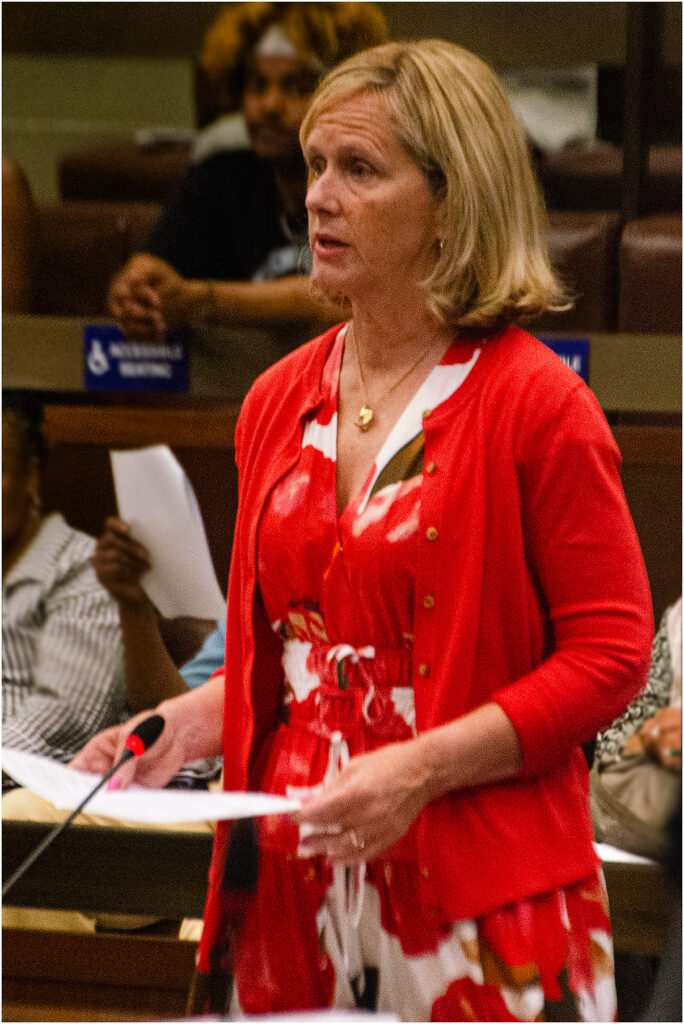
Councillor Erin Murphy at a June 2026 council meeting. Chris Lovett photo
Murphy said her opposition to the proposal centered around the individual needs of residents.
“ How does a family of five bring home a week’s worth of groceries on a bicycle? How does a parent transport children, hockey bags and sports equipment? What about the growing number of adults raising children while also caring for aging parents?” she posed. “What about women who leave for work before sunrise or return home late from work?”
“Owning a car is already a financial burden,” she said, “But for many residents, driving remains a necessity, not a luxury.”
Councilors also voiced concerns about the impact on their individual neighborhoods, each of which has different parking needs. They said they worry about whether the change could indirectly limit the production of affordable housing, whether it could force spillover onto the street, which could lead to quality of life issues for residents, and whether it might impact accessibility for people with disabilities who rely on personal vehicles.
Overall, the hours-long discussion was tense. At one point, while council was still in session, Mejia threw up her hands, walked away from her chair, and sat away from her desk for a few minutes.
According to some City Hall staffers, a working session on Monday designed for councilors to hash out final details didn’t live up to the hopes of electeds who were on the fence about the ordinance.
“Boston City Council working sessions are designed for city councilors to discuss the merits of a proposal in an environment that encourages debate and discussion without the formality of a hearing,” Flynn wrote in a Tuesday Facebook post. “At yesterday’s working session, city councilors were specifically told by the chair [Durkan] that debate would not be allowed and a difference of opinion would not be even entertained.”
After that session, following pushback from Coletta Zapata, Durkan included a carve out for that councilor’s districts: East Boston and Charleston. Those two neighborhoods underwent their own planning overhaul with neighborhood-specific parking minimums in 2024. Mattapan will also get a carveout.
The last minute change following two years-worth-of-work for Durkan, means those neighborhoods wouldn’t eliminate parking minimums until at least Jan. 1, 2029.
On the floor Wednesday, Flynn, FitzGerald, Culpepper and Worrell introduced unsuccessful amendments that would have exempted their own districts from eliminating the parking minimums.
Other cities, like Cambridge and Somerville have completely abolished minimum parking requirements. In 2021, Boston eliminated parking minimums for housing developments where at least 60% of the units are deemed affordable, meaning they were priced for residents at 100% or below the area’s median income. The amendment would strike that language.
The city also has a maximum parking ratio; parking requirements for housing developments exceeding 50,000 square feet are site specific, with officials considering proximity to T stops and grocery stores, among other things.
The proposal by Durkan, who’s usually in lock-step with Wu, got a lukewarm reception for the passage of the rule change from a city spokesperson who said Boston has already eliminated parking minimums Downtown and in neighborhoods that have completed a planning and rezoning process.
“Our neighborhood by neighborhood approach has enabled zoning changes that fit each community’s needs while reducing barriers to development. We will evaluate the implications of eliminating parking minimums citywide.”
This article was originally published by on November 18, 2026. WBUR and The Reporter share content through a media partnership.
