

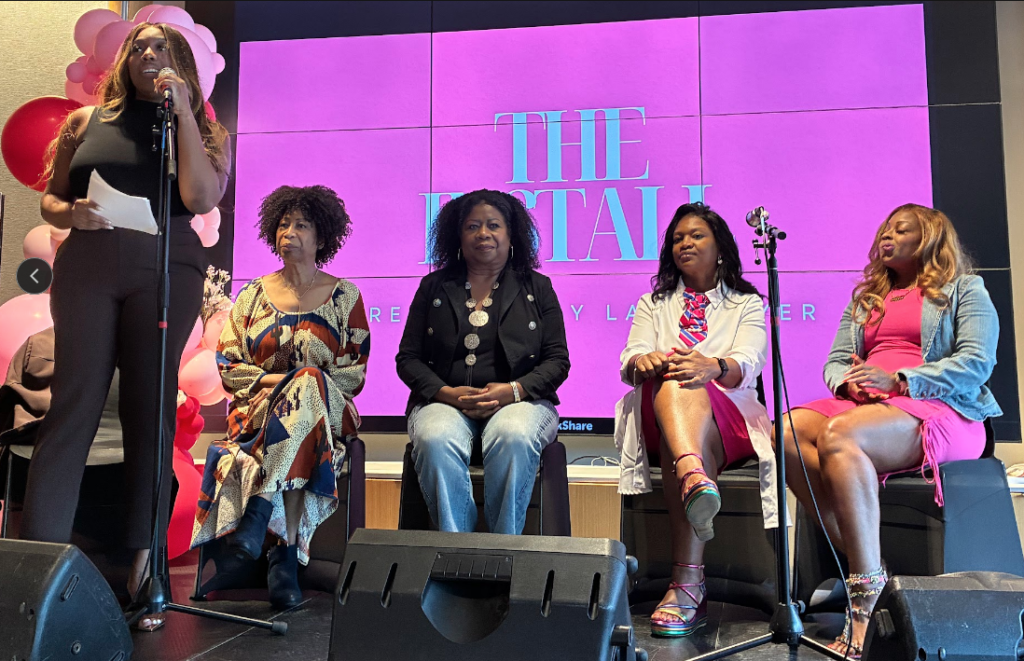
Panel discussion featuring Arlene Baldwin, Dianne Austin and Pamela Shaddock, Wonder R. Hollingsworth and Danielle “Ms. HotSauce” Johnson. Photo by Daniela Ginsburg
By Daniela Ginsburg
Special to the Reporter
Sitting at the foot of her mother’s bed, Dorchester native Arlene Baldwin would hold a pile of rubber bands while her mother would section off parts of her style to style her hair, a memory that she said resonates with many Black women.
At 17 years old, Baldwin developed alopecia – an autoimmune disease that causes hair loss – and had to relearn to feel “normal” while having to “grieve” her hair. She couldn’t go to the beach or hang out with friends without constantly worrying about her wig slipping or drawing unwanted comments.
“You’re trying to figure out who you are, you want to feel pretty, you want to fit in, you want to do everything that most teenagers do, and suddenly I was really trying to understand why I was losing my hair,” Baldwin said.
Baldwin used her experience with alopecia to create Lace Layer, a company that would educate women about medical hair loss and offer products for underrepresented communities. She hosted an event last Saturday (Sept. 19) at City Hall where Black women talked about their experiences with alopecia, hair loss, and wigs.
While attending UMass Dartmouth, Baldwin would drive 50 miles each way every weekend to find beauty products tailored to her and get her hair done by her mother. She described Boston as a “resource desert for beauty,” pointing out that Black-owned, female-operated businesses in the industry remain out of the spotlight.
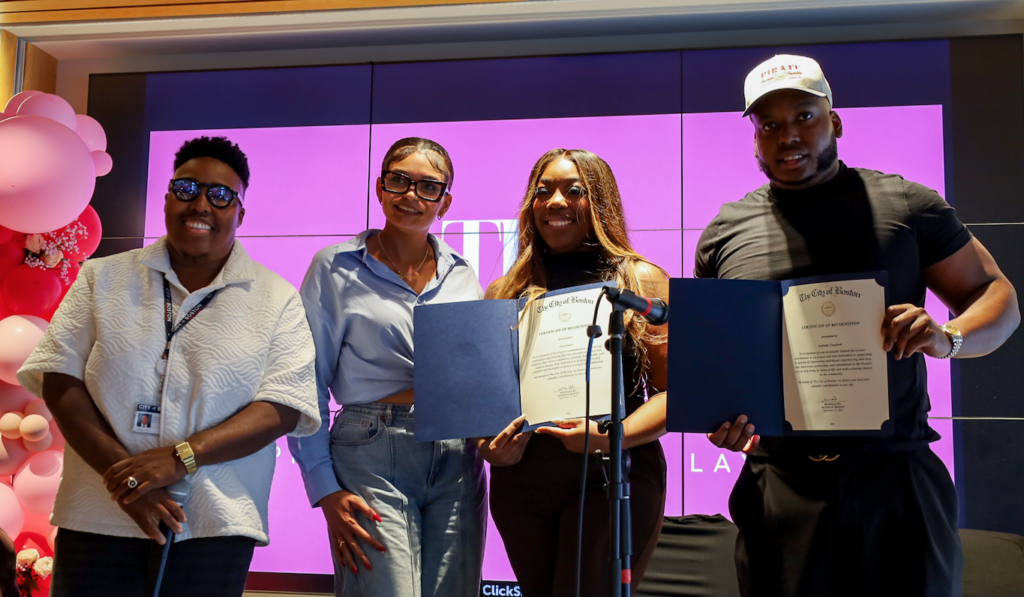
Arlene Baldwin and Andrade Crawford accept a Certificate of Recognition from the City of Boston for their company, Lace Layer. Photo by Irene Yimmongkol.
Baldwin, now 33, remembers medical professionals telling her to wear a hat or scarf if wig products weren’t sufficient, something she said ignited her to search for a solution.
After the death of her mother in 2016, Baldwin had lost not only her “hairstylist” but the person who created a space for her to be confident with her alopecia.
“She was pouring the confidence in me that really laid the foundation. It’s why I’m able to stand here today,” Baldwin said. “She never allowed me to believe that losing my hair meant that I was losing myself.”
She co-founded Lace Layer in 2020 to provide confidence to other people, as her mother had done for her, making products not only for herself but for an overlooked community.
“When I think about being a Black-woman-owned business, I think about really using our story to connect and make sure that women see themselves within our business,” Baldwin said.
The company aims to raise awareness of alopecia to help destigmatize wig use, Lace Layer co-founder Andrade Crawford explained.
Crawford said he’s seen how stigmas of wigs as “unprofessional” and “ghetto” have created a culture where Black women are questioned for wearing a wig rather than allowing it to just be another style.
“I think styles are expressions of you, of culture, of environments, of just like a natural preference,” Crawford said. “You don’t want to have to feel like you need to conform to somebody’s standards.”
Baldwin sees the company as a continuation of her early activism, which began with Dorchester youth poetry and nonprofit work at Teen Empowerment, to now removing stigmas for women wearing wigs, serving the diverse needs of women who wear them.
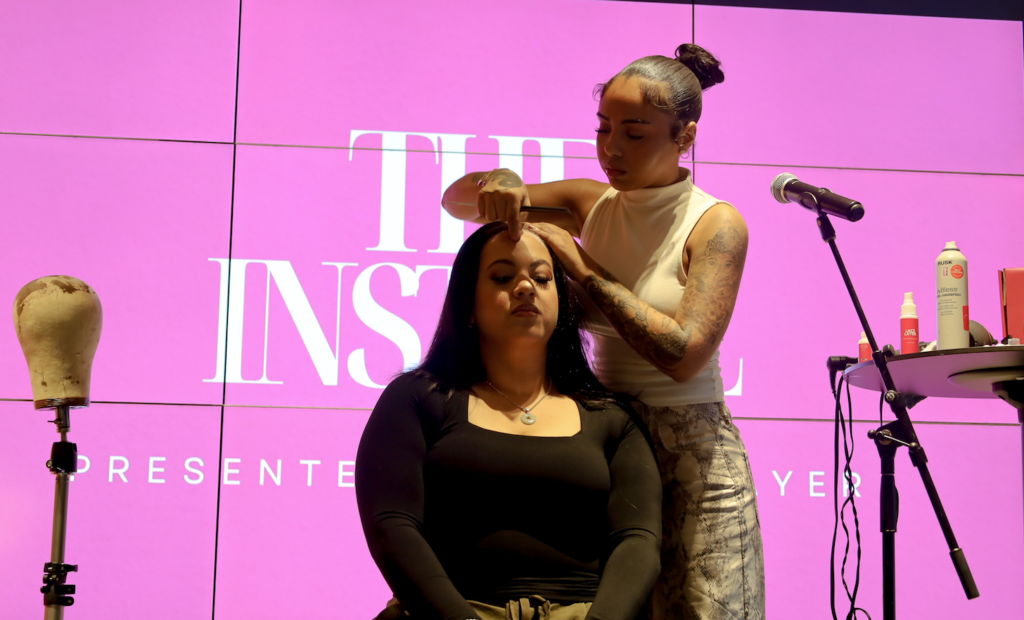
Samantha Camilo (Sammie Marie of Thehairrpluggg) curls her client Michelle Garcia-Vargas’s hair during a live wig installation. Photo by Irene Yimmongkol.
The exhibition Baldwin hosted Saturday at the Civic Pavilion at Boston City Hall, called “The Install,” was designed to raise awareness for Alopecia Awareness Month. It challenged negative stereotypes by redefining wigs as powerful tools for self-expression and empowerment.
The focus of the event was a panel discussion featuring Dianne Austin and Pamela Shaddock, co-founders of Coils to Locs, a company that sells a diverse line of wigs; Wonder R. Hollingsworth, executive director of Awareness Project Network, a nonprofit that helps people with alopecia and sickle cell disease; and Danielle “Ms. HotSauce” Johnson, founder of Spark FM Online, Boston’s first Black female-owned digital radio station.
Coils to Locs launched in 2019, when Austin discovered during her cancer treatments that Boston hospitals only had Eurocentric hair textures available, leaving Black women and women with textured hair to look outside insurance-provided options.
“It was devastating, the thought, because I had tied so much of my self-esteem to my hair, which is not uncommon,” Austin said. “I wanted something that looked like me.”
The company aims to address a systemic gap in medical hair loss resources by partnering with hospitals to provide a diverse line of wigs for women, helping maintain a “sense of self and dignity” for a larger demographic. Coils to Locs operates in over 30 hospitals nationwide, including three in Massachusetts: Dana-Farber Cancer Institute, Beth Israel Deaconess Medical Center, and Massachusetts General Hospital.
Hospitals should ask patients what they need, Austin said. “Don’t assume that everyone wants a straight-haired wig…one size fits all is not the case,” she said.
Mayor Michelle Wu’s office honored Lace Layer Saturday for its commitment to empowering individuals experiencing hair loss.
Theonide Pierre, a general manager and community change-maker at Ben & Jerry’s, attended the event to find a community that understood the struggles of wearing wigs in the workplace.
Two years ago, Pierre shared that she experienced hair loss and is still learning how to transition into wearing wigs properly.
Attendees at the “Install” event got a step-by-step wig demonstration to show them how to use Lace Layer products – which Pierre said helped women like her learn the process firsthand.
“We’re still here too, you know, like there are options for us, and there are people that advocate for it instead of hiding and being ashamed of what you have,” Pierre said. “You have people that are in the same community that are gonna be outspoken and fight for your journey as well.”
This story is part of a partnership between the Dorchester Reporter and the Boston University Department of Journalism’s Newsroom program.
Copyright © 2026 Boston Neighborhood News, Inc. This content may not be re-published or re-used without written permission.
