

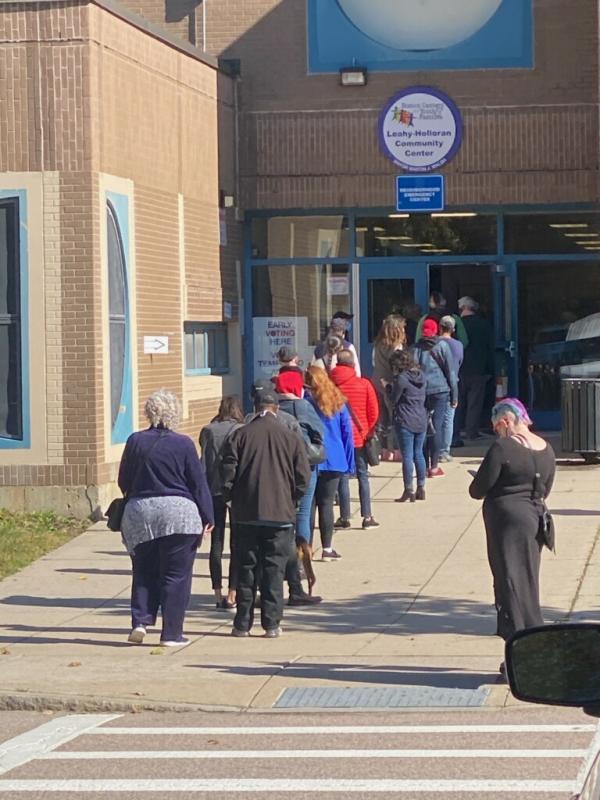
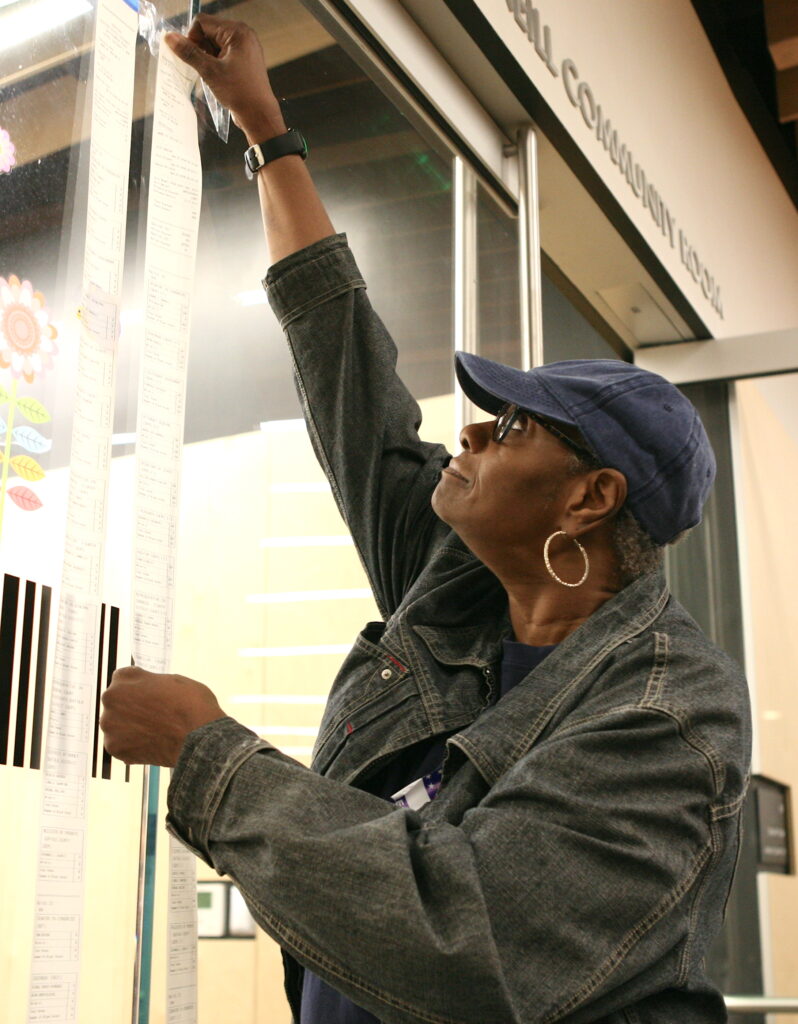
A poll worker posted results from balloting at Codman Square Library on Sept. 1, 2026. Seth Daniel photo
The polls were still open on Sept. 1, the last day of this year’s primary election, when state Sen. Nick Collins went on social media to alert potentially anxious voters. “It has come to my attention,” the four-term senator posted, “that voters in the First Suffolk District, particularly in South Boston and Dorchester, have been deemed by the City of Boston as having an ‘inactive’ voter status despite being lifelong residents and super voters.”
It was one more flare-up in a contentious race between the senator and a challenger, Latoya Gayle, who was being supported by Mayor Michelle Wu.
But veteran campaign-watchers say the voters who were surprised to find themselves declared “inactive” last month were not confined to Boston, nor were they exempt from a growing national anxiety over elections.
The message from Collins was just one of many around the country in a gathering cloud of election distrust—fed by claims of voter suppression or balloting by non-citizens, along with partisan redistricting. And attempts by the Trump Administration to integrate voting lists with other databases—so far resisted in Massachusetts—have even triggered warnings that a mechanism to detect improperly registered voters could also be deployed in mixed-status households to pinpoint candidates for deportation.
According to Traci Griffith, the director of the Racial Justice Program for the American Civil Liberties Union (ACLU) of Massachusetts, there’s still, overall, less cause for alarm locally. That’s in contrast with states, mostly dominated by the Republican Party, that have also done voter purges and heightened requirements for identification.
“We are not seeing that kind of voter suppression in Massachusetts,” Griffith said in an interview. “To assign something nefarious to this is not the direction that we are looking at, or that we’re even considering.”
The Collins feed did not report that anyone declared “inactive” had been unable to cast a vote. But voting rights advocates still question the large number of “inactive” voters throughout Massachusetts—reported by the state at about 15 percent in 2024. And they fault the use of the annual street census in local communities as the main source for updating voter status.
In the decade through 2025, the percentage of “inactive” voters reported in Boston was mostly between 10.1 and 12.6 percent. In recent years, some communities have reported significant increases, with 64 percent of the eligible voters declared “inactive” last year in Brockton.
Among the advocates monitoring this year’s results are the ACLU, MassVOTE, and Common Cause.
“We certainly have seen a very strong enforcement across the board this year,” the executive director of Massachusetts Common Cause, Geoff Foster, reported, “which is why on our hotline we’re getting more calls. And I think, generally, more people are kind of talking out right now to say, ‘Hey, I tried to vote on Sept. 1st and I found that I was inactive. What’s that all about?’”
To avoid a polling-place surprise, voters can check on their status and, if necessary, become re-activated by going to the website for Secretary of the Commonwealth William Francis Galvin.
“That’s the most important thing, to avoid the situation entirely,” Griffith advised. “And you can do that plenty of time ahead of the election, and so you know, going in, what your status is, and you’re good to go.”
Even the most habitual voters can be listed as “inactive” if they fail to respond to the city’s annual street census, which is used primarily to populate jury pools. But Massachusetts is one of the few jurisdictions that also link the census to voting status. Voters can also be deactivated if they miss multiple state elections.
Advocates and elected officials emphasize that anyone listed as “inactive” still has the right to cast a ballot. Even on the last election day, voters at a polling place can reactivate their status by showing identification or something indicating their place of residence, such as a utility bill. They can also affirm their identity and place of residence by signing an affidavit.
Early in the year, local election officials –under the supervision of Galvin’s office – are required by state law to mail annual street census forms to be filled out by residents. According to his director of communications, Debra O’Malley, the lists are maintained by local officials, though Boston’s Election Dept. is currently being supervised under a receiver designated by Galvin.
If census mailings go unanswered, O’Malley explained, local communities have to follow up by sending confirmation notices to “inactive” voters in early summer.
“As is typical,” O’Malley wrote in an email, “our office has reminded local election officials of their responsibility under the law to conduct list maintenance. This allows cities and towns to keep their lists up to date. In cities like Boston, where students are frequently moving in and out of the city, it ensures that the city can identify voters who have potentially moved out of state and begin the process of removing them from the list.
The process takes approximately 3-4 years, as inactive voters must be maintained on the list for a period beginning on the date of their inactivity and through two consecutive federal elections.”
Within Boston, the percentage of voters listed as inactive can vary from one area to another. In perennially high-turnout precincts in Dorchester, Jamaica Plain, and West Roxbury, the figures over the past decade were far below the citywide average, but the numbers were well above average in Dorchester and Roxbury precincts that usually have below-average turnouts. In the high-turnout Ward 16, Precinct 12 (with polling at Florian Hall), the ratio of “inactive” voters ranged from 2.2 to 5.1 percent—while the citywide average was, in most years, in double digits.

Statewide, the same period roughly overlaps with changes in the composition of the electorate. According to a report by the Mauricio Gastón Institute for Latino Community Development and Public Policy at the University of Massachusetts Boston, in partnership with the Latino Equity Fund at the Boston Foundation, the number of Latinos registered to vote in presidential elections increased between 2016 and 2024 by 78.9 percent.
In its analysis of 40 “gateway city” precincts with higher concentrations of Latinos — all outside of Boston — the report found that voter turnout levels were below the average for their entire communities. The analysis also showed that support in 2024 for the Harris-Walz presidential ticket (59.9 percent) fell short of the statewide figure (61.2 percent).
Though turnouts can be affected by voter engagement and campaign outreach, advocates argue that the “inactive” rates can also reflect other factors—such as how often residents move, or the ability to make a strong connection between an impersonal form letter and voting in an election seven or nine months later.
“The reality is, and the data is pretty clear on this,” said Foster. “It’s primarily an indicator that they’re missing a piece of mail every January or February and, unfortunately, what ends up happening is if you are at that check-in table and you’re an otherwise registered and eligible, still alive and living at that same address voter, is you’re inactive.”
That could also go for any eligible voter living in the same household, possibly in multi-generational families, or including adult relatives moving in or out between elections.
“I put that envelope down, and I missed the day to send it in, everyone in the household automatically gets put on the inactive order list,” said Marisol Santiago, the director of policy and organizing at MassVOTE. “So imagine families where we have a lot of them, especially in ‘gateway cities.’ In some of these towns, we’re seeing these increases too. It’s not just one person; it’s a household.”
Santiago reported high levels of “inactive” voters in this year’s primary elections in some “gateway cities” outside of Boston, including one precinct in Lawrence.
In 2022, Massachusetts made mail-in voting permanent and reduced the voter registration deadline from 30 to 10 days before an election. Advocacy groups working together as the “Election Modernization Coalition” are still pursuing other reforms, including same-day registration, a measure sponsored by Galvin as Question 4 on this November’s ballot.
One opponent of same-day registration is the conservative America First Policy Institute. Its report says the option could make elections more vulnerable to ineligible registration and duplicate voting.
Earlier this year, the National Conference of State Legislatures cautioned that same-day registration would require more staff time or volunteer work.
“This extra administrative task can be time-consuming at the same-day registration site and includes verifying registration information after the election,” the conference observed. “Many states report this is more a reallocation of costs and resources, though, rather than an additional cost.”
In 2022, the MIT Election Data Science Lab reported that scholars believed that election-day registration (“EDR”) had a “positive effect” on turnout. “While the size of this effect varies by study,” the MIT lab wrote, “scholars have generally reported three to six percent average gains in turnout in EDR states.”
In recent years, the Massachusetts coalition has also been calling for new steps to make voting accessible to people with disabilities, along with legislation to decouple voter lists from the annual street census.
According to State House News Service, Jury Commissioner Pamela Wood testified against the decoupling at a legislative hearing last year. She argued that the change would mean one less incentive for response to the census—and enlistment in jury pools.
Though response is required by law, she said that residents might even be willing to pay a fine to avoid jury duty. And some residents, fearing that jury duty could expose them to reprisals from criminal defendants, have reportedly even been discouraged from registering to vote.
Though “inactive” voters are allowed to cast ballots, Santiago says they still face another layer of procedure and confusion.
“We can make things better and more simple,” she said. “And also, with credit to poll workers, the people who are making elections run, they’re not happy, I’m sure, with having to go through this process and having to work with individual voters and also multilingual. We need more multilingual folks in our polls.”
On the last election day in November of 2024, Santiago was an observer at a polling place in Hyde Park, at Another Course to College. Due to a shortage of ballots and problems with managing lines for two precincts, she found herself scrambling to keep voters frustrated with delays from walking out. The problems were also a factor in the later decision to impose additional oversight on the Boston Election Dept.
This year, officials throughout the state are faced with one more factor that could slow lines: nine ballot questions that some voters might encounter for the first time at a polling place – in small print. The advice for voters: if possible, cast ballots early, by mail or through drop boxes, and take some time to review the questions in advance.
Copyright © 2026 Boston Neighborhood News, Inc. This content may not be re-published or re-used without written permission.
