
Copyright © 2026 Boston Neighborhood News, Inc. This content may not be re-published or re-used without written permission.
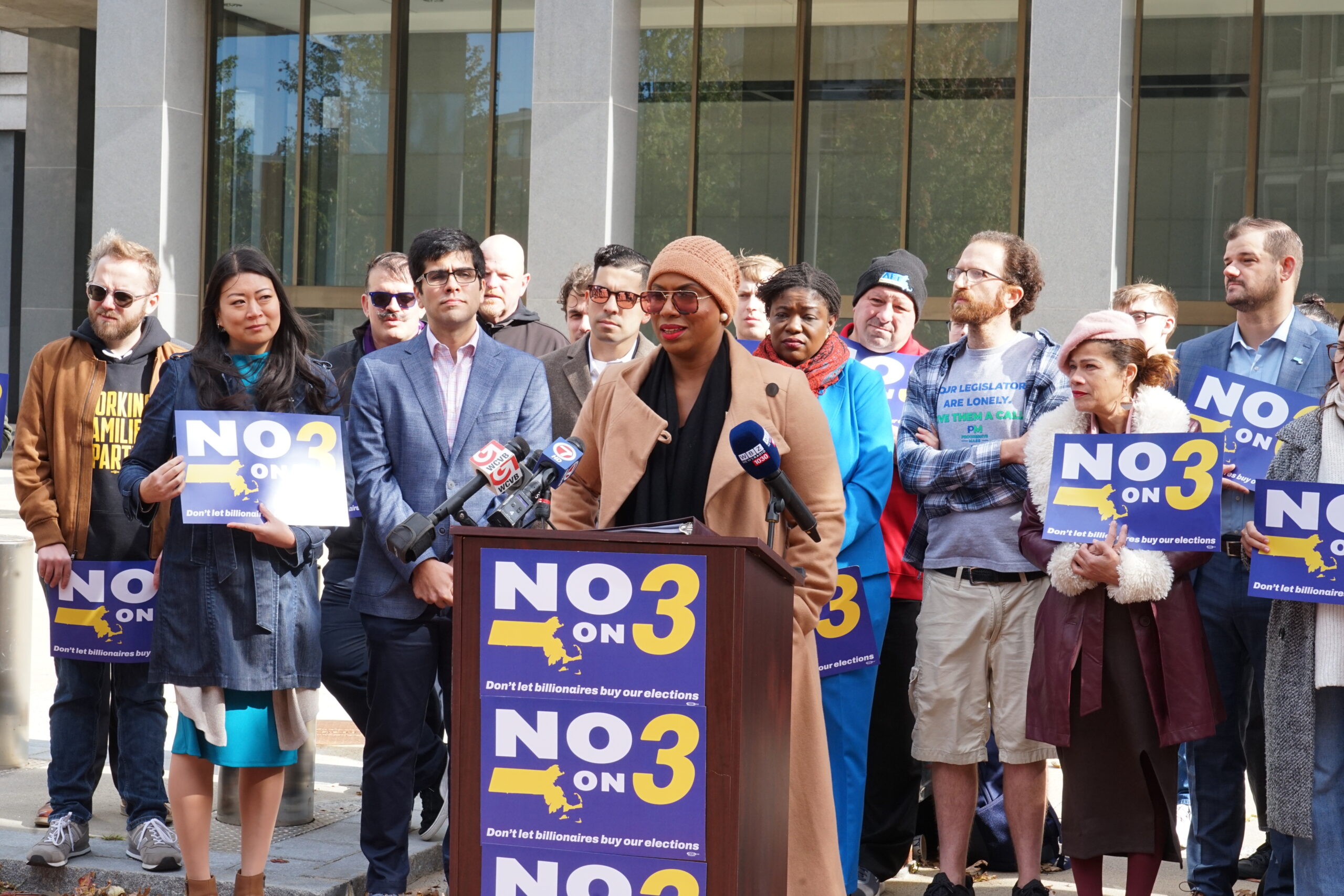
Above: US Rep. Ayanna Pressley addressed reporters on Tuesday, Oct. 20 in front of the JFK Federal building during a press conference with elected officials and union representatives in opposition to Ballot Question 3. Yawu Miller photo
If any political candidate knew the upside of sidestepping a partisan primary, it was Joe Moakley. The unconventional move propelled him to 15 terms representing part of Boston and surrounding communities in the state’s 9th Congressional District. He pulled off the feat in 1972, offering a lesson to voters currently deciding – with Question 3 – whether to replace party primaries in state elections with an “all party” first round, followed by a “top-two” runoff.
In 1970, as a third-term state senator from South Boston, Moakley ran in the Democratic primary to succeed retiring Speaker of the House in Congress John W. McCormack. Also contending were a fellow South Boston resident, City Councillor Louise Day Hicks, and the Roxbury attorney David Nelson.
Widely recognized as Boston’s foremost opponent of school desegregation, Hicks won the primary with 36.9 percent of 67,428 votes cast. In the general election, her share was 50.1 percent, with an independent candidate in a distant second place. The total number of votes cast was 100,346, with blanks at 15.3 percent.
Moakley’s next try was in 1972, a presidential election year. Hicks won the Democratic primary, earning an endorsement from her party’s liberal presidential nominee, George McGovern. Moakley waited until the general election, running this time as an independent. Also on the ballot were a “liberal” Republican lawyer from Needham and a self-labeled “revolutionary socialist” candidate.
Moakley won with 40.8 percent of the vote, over 38.6 percent for Hicks. Once again, it was only a plurality, but the total number of votes cast was 173,935 – 73.3 percent higher than the figure for the 1970 general election and more than double the figure for the 1970 primary. And Moakley’s 1972 tally, 70,571, was more than double the number for Hicks in her 1970 primary win.
Between the two election years, the 9th District was remapped. The change added suburban territory and subtracted three Dorchester wards (15-17) where, two years earlier, Hicks had outpolled Moakley by 2,410 votes.
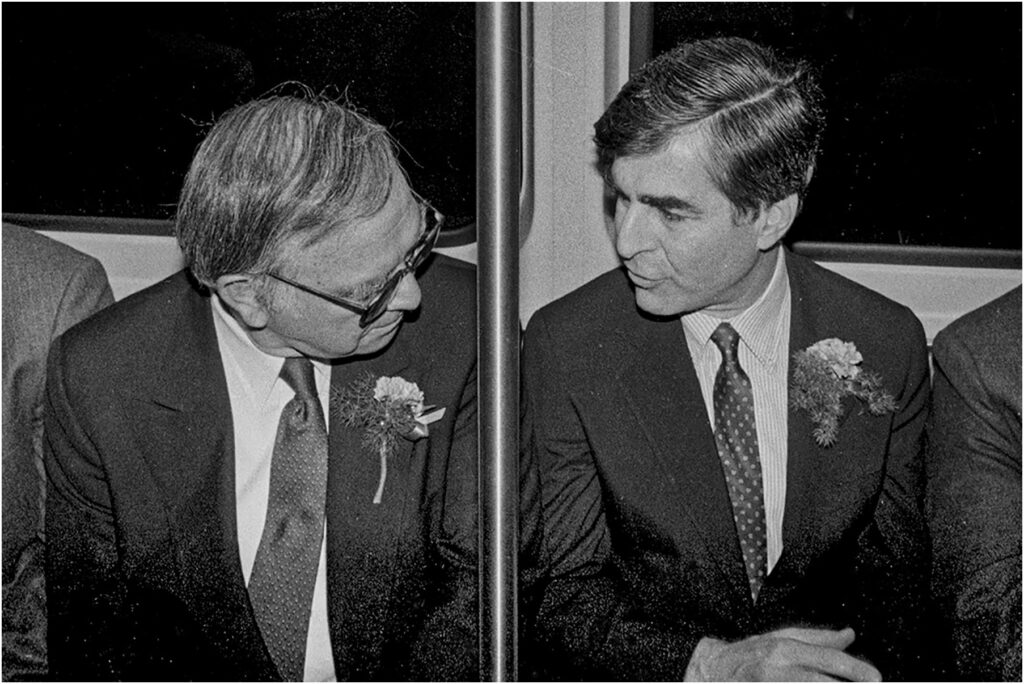
Joe Moakley and Michael Dukakis, on the first day of the Orange Line’s new Southwest Corridor segment in 1987: two Democrats who bounced back from defeats in primaries, but on different tracks. Chris Lovett photo
Yet another difference was the absence of Nelson, a Black candidate who, in 1970, had outpolled Hicks and Moakley combined in Ward 14 (Grove Hall-Four Corners-Franklin Field) by more than 3,000 votes. In 1972, Moakley, with organizational backing from Boston Mayor Kevin White, carried Ward 14, surpassing the total there for Hicks by 3,659 votes—greater than his spread for the entire district.
Moakley did not prove that incumbents were unbeatable in party primaries. Lt. Governor Frank Bellotti had upset his fellow Democrat, Gov. Endicott Peabody, in the 1964 primary. Edward J. King would defeat another Democratic governor, Mike Dukakis, in the 1978 primary, only for Dukakis to flip the script in 1982.
But, over the four decades following 1972, the closest thing to a large-scale setback for an incumbent in a party primary was in 2018, when Ayanna Pressley defeated Mike Capuano in the neighboring 7th congressional district. Her primary victory coincided with an open race for Suffolk County District Attorney, along with successful primary challenges to state representatives Byron Rushing and Jeffrey Sánchez. The turnout in Boston was just shy of 25 percent.
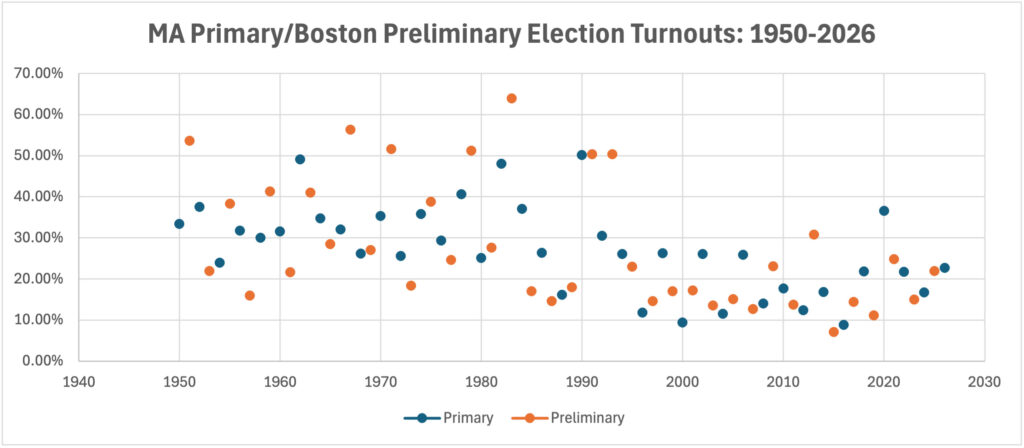
Statewide turnout for the 2018 primary was 21.85 percent—relatively high for recent years, yet well below the average for the years 1948-78. Apart from a few peak-year elections, the overall trend in state primary turnout has been downward.
Danielle Allen, a Harvard professor and the convening chair of the Coalition for Healthy Democracy, the main group supporting a “Yes” vote on Question 3, argues that the state numbers prove a need for a switch to “all-party” primaries, with “top-two” runoffs decided by larger turnouts in general elections. That reform was adopted in California in 2010.
“Turnout and competition feed each other, and in Massachusetts the cycle is getting worse. When most races have one name on the ballot, people stop showing up and elected officials stop making their case to their constituents,” Allen observed in an email exchange. “When a seat is decided in a low-turnout, low-attention September primary that only draws about one voter in five, talented would-be challengers look at those odds and don’t run at all.”
In mid-term primaries earlier this year, the Public Policy Institute of California (PPIC) credited that state’s higher turnout to redistricting and an open race for governor, though it found, overall, that turnout under “top-two” reforms has been flat in presidential primaries and had risen slightly in other primaries.
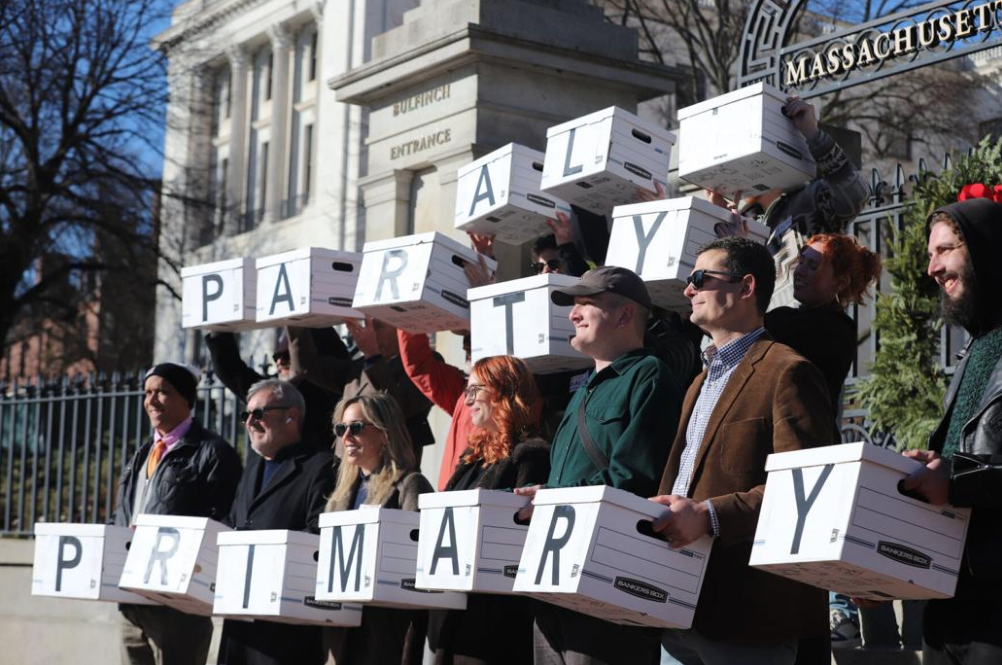
Supporters of a proposed ballot measure to implement an “all-party” primary system in Massachusetts hold up boxes full of signatures on the State House steps on Dec. 1, 2025. Ella Adams/ SHNS photo
“The top two has also changed elections,” the PPIC posted on its website, “but less than might be expected. More incumbents have faced challengers from their own party in the primary, rising from about one in six to one in three. But the incumbent’s average margin over these challengers has been larger—and the share of incumbents who advance has been about the same.”
Allen contrasted levels of competition and turnout in California and Washington State with this year’s primary numbers in Massachusetts.
“This September,” she wrote, “358 of 400 possible legislative party primaries had a single candidate, and 155 of our 200 legislative seats were effectively settled before most voters cast a ballot. Only about one in ten incumbents faces a primary challenger, a rate that has held steady since 2010. Ballotpedia ranks Massachusetts last in the country for competitive legislative elections.”
An October 2024 national report from the Bipartisan Policy Center found that turnouts in final elections were generally more representative of the pool of eligible voters, with open or nonpartisan primaries drawing a more representative turnout.
Boston currently allows “unenrolled” voters to choose a primary ballot from any one party. In 1960, 21.5 percent of the city’s voters were “unenrolled,” with Democratic enrollment at 71.5 percent. In 2024, Boston’s “unenrolled” share was the largest, at 56 percent, though still with far more Democrats than Republicans.
According to Steve Koczela, the president of the MassINC Polling Group, writing in the CommonWealth Beacon, at least part of the change can be explained by new ways of facilitating registration that automatically list voters as “unenrolled.”
Allen views the change differently, as part of a larger trend. “It’s being turned off by parties, and there’s lots of evidence to support that,” she insisted. “The national numbers share the same picture of decline, and polling of young people indicates that they are frustrated with the two-party system.”
Even in the 1980s, researchers observed that political engagement had been transformed by mass media, concentrating more attention on national figures. Political perceptions were more filtered by the “cool” medium of television, offering the directness of visuals and sound bites, but with less of the hoopla that, through the early 20th century, could galvanize a crowd in a physical public space.
In a 1989 article for the Journal of Political and Military Sociology, David H. Kamens found that focus on presidential competition made parties important for funding and expertise. But he went on to say that this failed to account for a “decline of parties as sources of partisan attachment and why ideological innovation and conflict increasingly occur outside the party system.”
Thirty-seven years later, Allen recalled when partisan attachment entailed notices of party caucuses at local post offices which, if still open, now have less walk-in traffic. “The whole information ecosystem that supported the operations of the parties in the seventies and eighties doesn’t exist any longer,” she said. “And the parties haven’t fully adapted to that.”
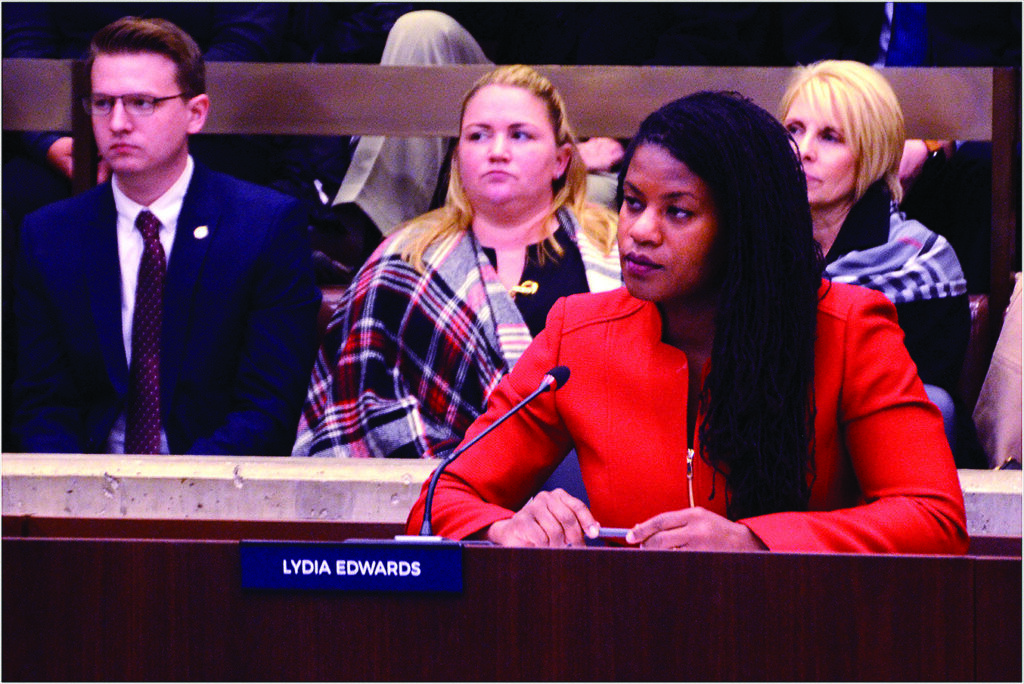
Senator Lydia Edwards as a city councillor. Chris Lovett photo
A supporter of a “No” vote on Question 3, Lydia Edwards, has won first-round elections both partisan—including this year’s for state senator in the 3rd Suffolk District—and non-partisan, in her previous role as a District 1 (East Boston/Charlestown/North End) City Councillor. And she noted that first-round turnouts have also been declining for non-partisan city contests.
“Except, maybe, if there’s an open seat on at-large [city council] and the mayor’s running, then you’ll have more people running in Boston, or at the [district level],” said Edwards. “What’s wrong is that it takes time and money. And we really do need some reforms that help working-class people, people of color, parents run for office. We do.
“We need to have ranked-choice voting,” she added. “We need to get money out of politics and pass some sort of legislation that limits or curtails Citizens United, if not a constitutional amendment here in Massachusetts. We need to look at term limits. We need to look at spending limits, not just contribution limits, but how much candidates can spend.”
In “off-year” elections, with voting only for City Council, Boston’s preliminary turnouts in the 1950s and 1960s ranged from almost 16 percent to more than 28 percent. In the “off-year” of 2007, the preliminary rate was 12.7 percent, followed by a final round turnout of 13.6 percent. As the council’s new president in 2008, Maureen Feeney responded to the dismal numbers by calling for a citywide forum on ways to increase civic engagement.
In 1976, amid the turmoil over school desegregation, a “Committee for Boston” explored ways to make the city’s cast of elected officials—at the time, entirely white—more representative of the local population. Its recommendations were converted – and significantly altered – by Mayor Kevin White and the Boston City Council into a charter change home rule petition. Had it been approved at the State House, the city would have had a more diverse school Committee elected by districts, but also partisan primaries for mayor and city council.
The committee’s report included an appendix with a case for partisan city primaries made by the celebrity historian and Harvard faculty member, Doris Kearns Goodwin, who was also the wife of presidential advisor and writer, Richard Goodwin. He later expressed support for her idea in a letter published by The Boston Globe.
“The purpose is to restore some combative vitality to the Boston political structure and to widen the choice of leadership now offered to the people of Boston,” Goodwin explained in December of 1976, two weeks before the home rule petition was approved by a notorious between-holidays vote in the council chamber.
In the preceding 1975 election, Boston voters chose from a preliminary ballot with four candidates for mayor and 36 for nine seats on an all-at-large city council. Despite the numbers, Goodwin dismissed non-partisan elections as a vestige of earlier attempts by mostly Republican Yankee Protestants to curb the influence of the city’s growing, and mostly Democratic, Catholic population.
In his own time, following the 1972 rout of George McGovern by Richard Nixon, Goodwin blamed “nonpartisanship” for making the Democratic base more splintered. Nonpartisanship, he argued, “has destroyed any semblance of organized party structure in municipal politics. It has seriously narrowed the routes through which young and talented people can move toward positions of leadership.”
A half-century later, partisan primaries came under fire from the election reform advocacy group FairVote. It counted a record number of seats in Congress being secured this year by candidates winning party primaries with less than 50 percent of the vote—after a frenzy of partisan redistricting in several states.
“The problem here is one of democratic legitimacy and accountability, as well as polarization,” the authors of the report declared. “Nominees who may not have been the most popular candidate within their party can ride one plurality primary win to several terms in Congress. Once in office, members are accountable to only a fraction of a fraction of the electorate.”
As remedies, FairVote supports ranked-choice voting for individual offices and, for multiple offices, proportional ranked choice. Even without ranked-choice voting, a similar dynamic led some candidates in Boston’s city elections to expand support and share resources through informal partnerships.
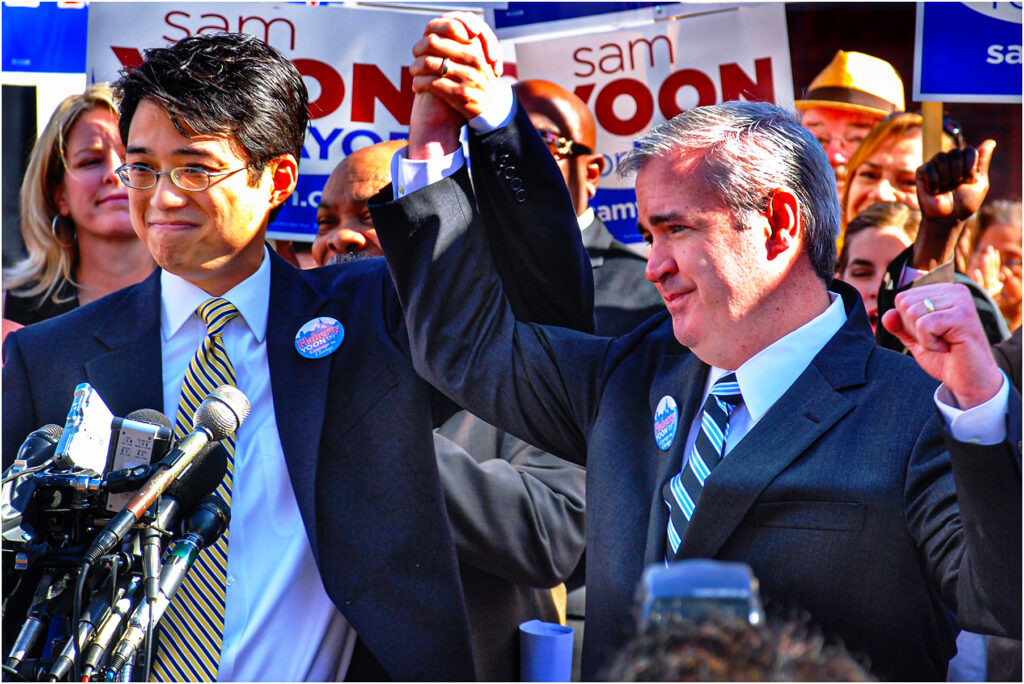
Michael Flaherty and Sam Yoon, introducing their “Floon” tandem in 2009. Chris Lovett photo
In 2009, the runner-up to Tom Menino in the preliminary race for mayor, City Councillor-At-Large Michael Flaherty, teamed up for the next round with third-place finisher and fellow councillor, Sam Yoon. In the final election, Flaherty failed to keep Menino from winning a fifth term, but the “Floon” tandem narrowed the gap, with the challenger polling strongly in areas carried by Yoon in the preliminary.
In later elections for council, there would be more partnering: between councillors-at-large John Connolly and Ayanna Pressley in 2011 and, in 2019, a three-way collaboration between Councillors Michelle Wu and Kim Janey, and council candidate Alejandra St. Guillen.
In 2026, Question 3 has marshaled its own tandems, with political figures on both sides.
In addition to state Sen. Edwards, the “no” side includes Pressley, Boston City Councillor At-large Ruthzee Louijeune, and former councillor Tito Jackson. Also on the “no” side are a number of labor and Progressive organizations.
Among the “yes” supporters are former governors Deval Patrick and Charlie Baker, State Auditor Diana DiZoglio, former State Treasurer Steve Grossman, former Congressman Joe Kennedy III, and former state representative Marty Walz. Other supporters include the NAACP New England Area Conference and the Massachusetts Women of Color Coalition.
In 2010, Patrick was reelected governor with 48.4 percent of the vote in the general election over Baker’s 42 percent, with 8 percent for State Treasurer Tim Cahill, who ran as an independent. Had “top-two” or ranked-choice voting been in effect, there might have been a different outcome.
In his 2020 challenge for US Senator, Joe Kennedy III, with 44.5 percent of the vote in the primary, fell short of the 55.4 percent for incumbent Ed Markey. There were 1.7 million votes in the primary, but more than twice as many in the general election. Had the Democratic rivals gone head-to-head in a “top-two” runoff, would a more politically diverse electorate have picked a different winner?
“The truth is we really don’t know,” Allen hedged, “but we should know. We should actually know what the whole electorate thinks. And currently we don’t ever get the chance to know what the whole electorate really thinks about an actual competition.”
Yet another change over the past half-century is the increasing attention to competition in campaign finance. The 2010 US Supreme Court’s “Citizens United” ruling removed limits on spending by corporations and unions through political action committees that were at least nominally independent of a candidate’s campaign. But there were no such limits for referendum campaigns, which have become an increasingly common vehicle for direct political action—bypassing the give-and-take, or even stalemates, between elected officials.
So far, the spending numbers reported for Question 3 have been extremely lopsided.
For May through September of this year, the “no-on-3” organization, Voting Rights MA, reports contributions of $166,1101. Donors include the State Democratic Committee, the Massachusetts AFL-CIO, SEIU Locals 509 and 1199, and the American Federation of Teachers.
From the beginning of 2025 through September of the year, the “yes-on-3” organization, the Coalition for Healthy Democracy, reports taking in $6.8 million. Many of the contributions are from private equity firms and other financial companies, with 29 donations of at least $100,000 and $1.1 million coming from multiple donors listed as affiliated with Bain Capital.
Allen characterized the donations as an outgrowth of her earlier fundraising for electoral reforms, starting in 2023, following her exploratory campaign for Massachusetts governor in 2021, and even drawing on her retirement savings. Among the earlier donors from the “democracy reform” sector, she singled out David “Randy” Peeler, who has contributed more than $1 million, starting in 2024.
A former senior advisor at Berkshire Partners, Peeler has served on the boards of the Boys and Girls Clubs of Boston and Unite America, a grassroots organization founded by the “centrist” Democrat Charlie Wheelan. Peeler is listed as a donor to multiple Democratic candidates, and Allen noted his support for efforts to limit campaign spending—in response to the “Citizens United” ruling.
“So every single donor heard exactly the same case that I have been making to the public,” said Allen. As she summed it up, they gave “because they decided that they agreed with that democracy case, namely that the whole people in a majority should be the ones making the decision in November, so that our institutions really do belong to the people, are inclusive, and have full legitimacy.”
In a response on social media, “No on 3 Massachusetts” posted a one-minute video clip, with a diverse cast of 13 speakers: political figures, labor leaders, grassroots advocates, and three Local 509 members in purple T-shirts. Their message was a brisk volley of bullet points, delivered by energized talking heads, pitting a semblance of human capital against a less visibly personified accumulation of donors.
“Private equity is spending millions of dollars to rewrite our election laws,” Massachusetts AFL-CIO President Chrissy Lynch says, a few seconds into the clip. After warnings about how a “yes” vote would hurt political parties and “working-class candidates,” Edwards declares, “We don’t need special interests defining how our democracy is going to work in Massachusetts.”
Next up is Councillor Louijeune, who adds, “This isn’t reform. This is a purchase.”
Copyright © 2026 Boston Neighborhood News, Inc. This content may not be re-published or re-used without written permission.
