

Rick Fraser, one of the participants, is touching the patterns on a tombstone. Photos by Qiyuan Wang
By Jack Schwed
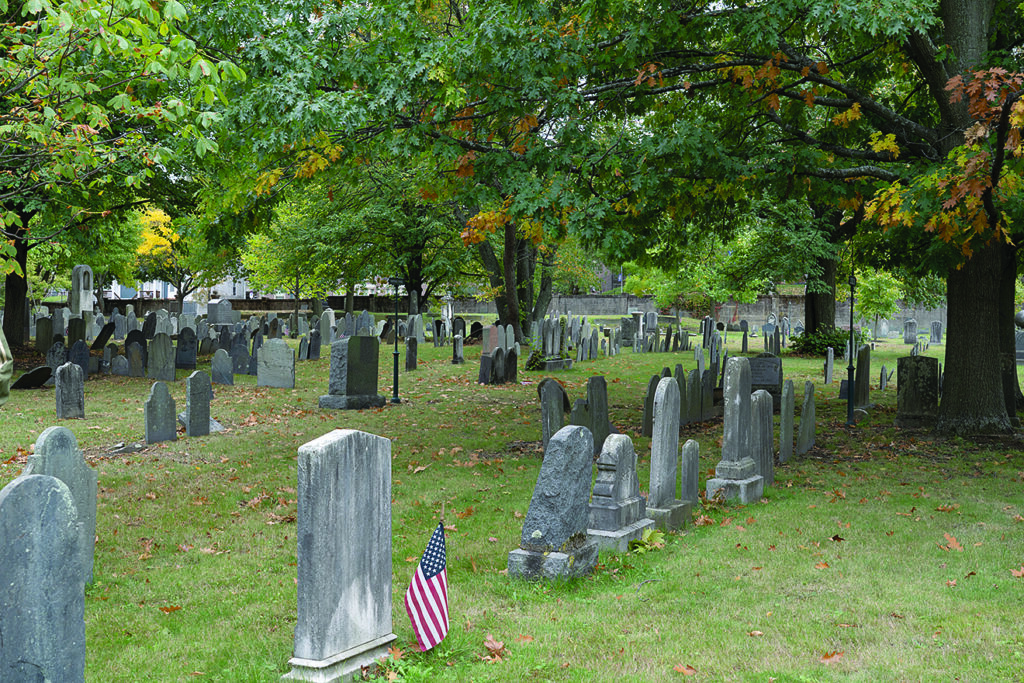
Wind swept over the autumn foliage and centuries-old gravestones at the North Burying Ground in Uphams Corner on Sat., Oct. 17 as visitors got a rare glimpse into the historic site for a day of free public tours.
Boston By Foot, an educational nonprofit, led the tours in partnership with the Historic Burying Ground Initiative, which is managed by the city’s Parks and Recreation Department as part of a broader effort to provide public access to burying grounds for educational purposes. The initial focus is on Dorchester North and the Eliot Burying Ground in Roxbury.
Samantha Nelson, BBF’s executive director, said the goal of the free public tours is two-fold: to invite those who live nearby to explore the otherwise closed-off site and to encourage people to visit Dorchester and Roxbury.
BBF has worked with the city in the past, Nelson said, but this year — for America’s semiquincentennial — they established a formal agreement permitting the organization to access the city’s burying grounds without needing to seek permission each time.
BBF, founded 50 years ago, hosts walking tours all across Boston, with the help of over 200 volunteer tour guides. Nelson selected the Dorchester North Burying Ground because of its placement in a historically vibrant neighborhood and the variety of remarkable figures buried there.
“The Dorchester North Burying Ground is just mind-boggling,” she said, “just the wide range of individuals that are buried there, the range of stories that can be told there.”
Nelson said BBF first did a public tour of the site in the summer — which was not well attended because it rained— but aims to make the free public tours a regular offering and expand the collaboration to other burying grounds.
Rebecca Camerato, a volunteer tour guide at BBF, gave a tour to a group of three people Saturday, each of whom were connected to the burying grounds but had never delved into its history until now.
Camerato, a self-proclaimed “history nerd” who grew up in Boston, said she started as a BBF guide more than 10 years ago. She said she admires the insight burying grounds provide into diverse groups of people from centuries past.
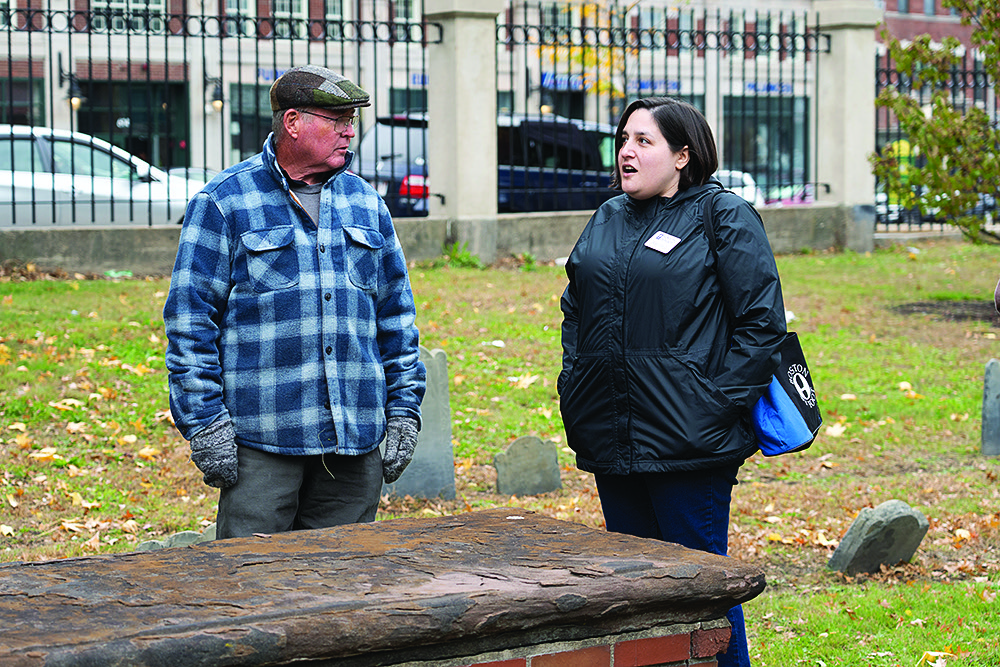
Tour guide Rebecca Camerato.
“You get to sort of see a glimpse into other people and other times, and that’s really why I love cemeteries,” Camerato said. “It’s sort of like an outdoor Wikipedia.”
Camerato said on the tour that the burying grounds were originally rolling hills — inhabited by indigenous groups — flattened over time by colonists, who eventually built the cemetery in the 1630s. Burials at the site occurred until around the 1940s, and now more than 2,000 bodies lie there, she said.
Many of the headstones had intricate etchings and iconography, including weeping willows, skeletons, hourglasses, and winged figures.
The tour highlighted several prominent people buried there, such as Richard Mather, the namesake of the oldest free, public elementary school in the US and a contributor to the Bay Psalm Book, the first published work in the country.
There is also a monument, restored by Harvard College in 1828, standing in place of the original gravestone for William Stoughton, a prominent member of the Puritan colony and the former lieutenant governor of Massachusetts who oversaw the Salem witch trials in 1692.
However, Nelson said, these tours aim to emphasize the importance of “ordinary” people too. She noted, though, that grave markers were expensive, so these individuals were still relatively prominent.
For example, there was the Belcher family, whose children’s headstones show they all died within a month of one another in 1902.
A “triple marker” commemorates three people whose rowboat capsized while crossing the Dorchester Neck on Christmas Eve, Camerato said. The event had a great impact on the community, so it raised funds to establish the headstone, she said.
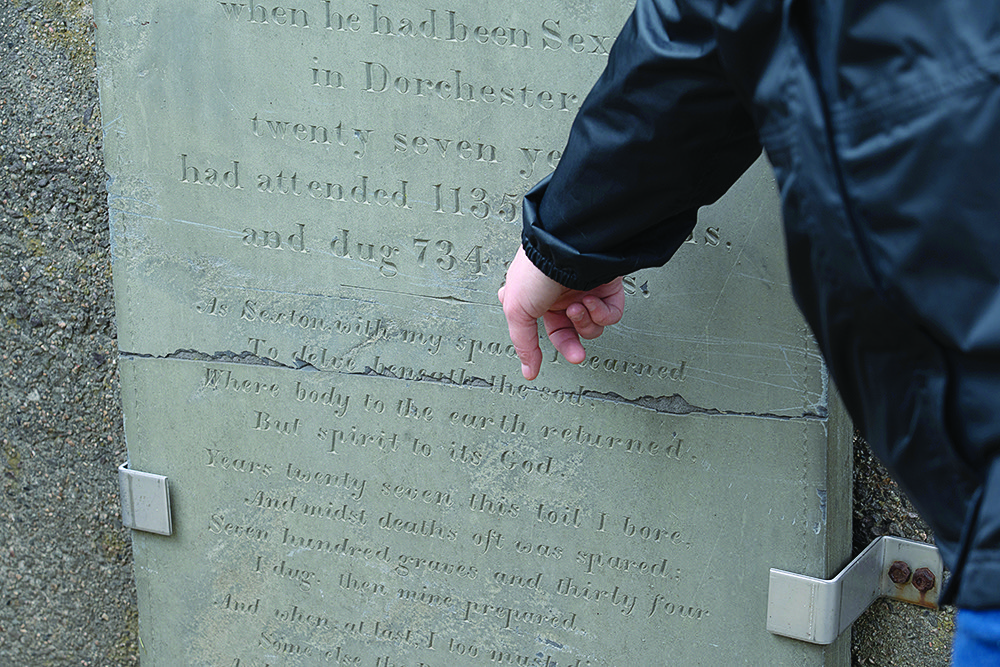
One grave marker was uniquely fastened to the wall — it belonged to the former sexton Daniel Davenport, who dug over 700 graves and buried 1,837 bodies. He constructed his headstone nearly 30 years before he died in 1860.
The final stop of the tour was the headstones of three enslaved individuals who died in the mid-18th century: Betty, Bristol and Cambridge, who was 3 years old. Camerato said the markers signify their importance within their respective households, as providing individual gravestones for enslaved people was unusual at the time.
“We learn so much about slavery in the southern states,” Nelson said. “ But it absolutely happened here in Massachusetts, and here is evidence of that.”
Daniel Herrick, a Jamaica Plain resident who’s been interested in genealogy since high school, said he took the tour because he is related to several of the families buried at the site, including the Birds, Leeds, and Humphreys. His father’s side of the family lived in Dorchester and Roxbury as far back as the 1600s, he said.
A branch of the Clapp family, who are also buried there, adopted his great-grandmother and her twin sister after their parents died, he said.
Brothers and tour attendees Rick and Scott Fraser also have a family history deeply tied to Dorchester.
Their great-grandfather, Cornelius Coughlin, immigrated from Ireland in 1903. The two said they grew up in Dorchester and have lived there ever since.
“We’ve got a lot of history here,” Scott said.
The brothers pointed out that many of the street names they grew up seeing were named after people buried at North Burying Ground. Living just around the corner from the site, they called it the “backyard” they had never seen before.
“We thought we’d come down and take a look because we’ve passed it for years,” Scott said. “We never knew the historical value of what was in here, and it is quite interesting, isn’t it?”
He called the tour “fascinating” and said that he enjoyed learning about the burying ground’s extensive history.
“It’s nice to see that something like this is open to the public, and we could take a tour with a nice person like Rebecca, who is full of knowledge and history,” he said. “What a great thing to be able to do on a Saturday afternoon.”
This story is the product of a partnership between The Dorchester Reporter and the Boston University Department of Journalism’s Newsroom Initiative.
Copyright © 2026 Boston Neighborhood News, Inc. This content may not be re-published or re-used without written permission
