

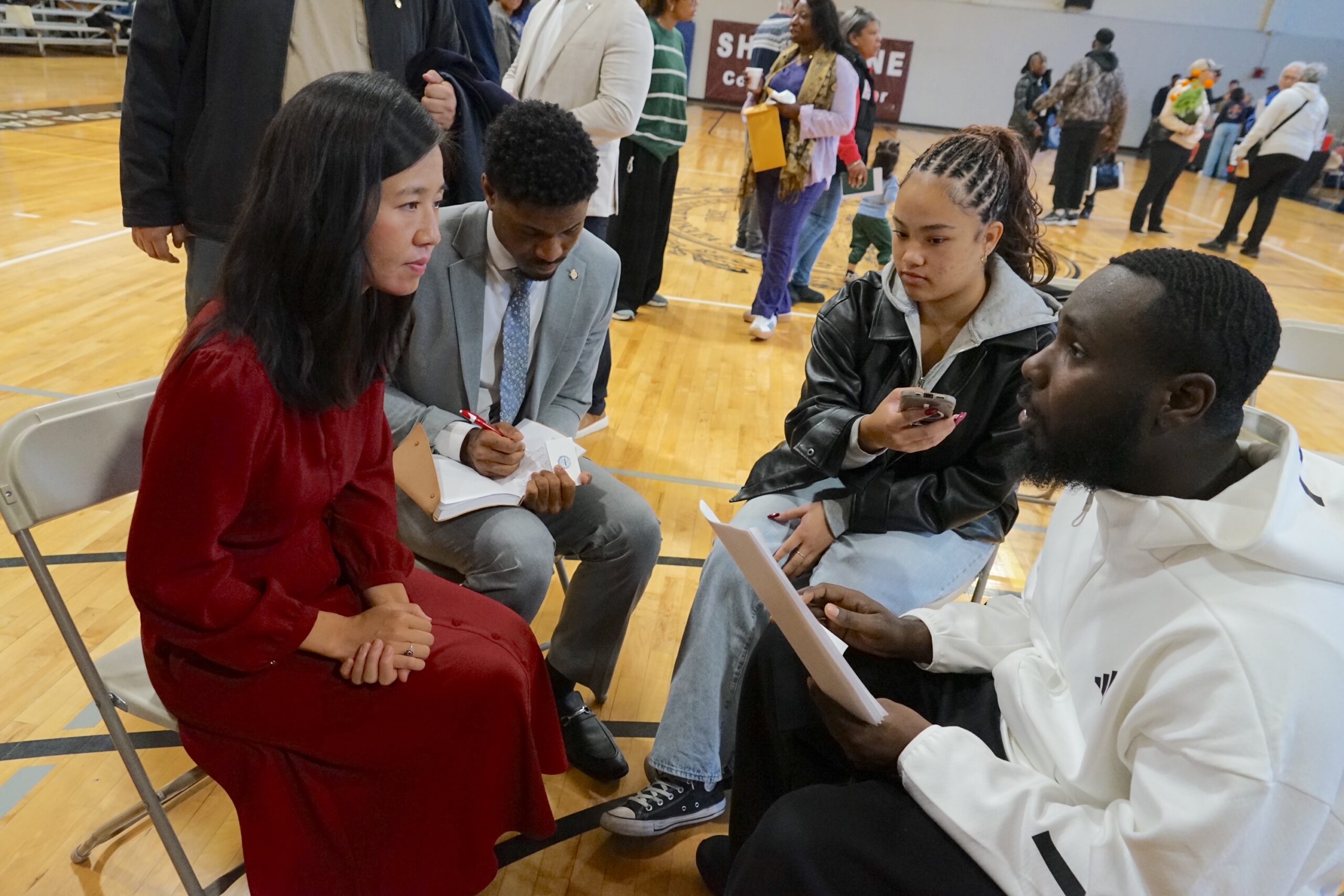
Khalil Howe, a member of the Youth Justice Empowerment Union (YJEU), spoke with Mayor Michelle Wu during a Mayor’s Coffee Hour at the Shelburne Community Center in Roxbury last month. Looking on are Wu’s Roxbury liaison Abdullah Beckett and YJEU member Star Nunez. Yawu Miller photo
Copyright © 2026 Boston Neighborhood News, Inc. This content may not be re-published or re-used without written permission.
Back in April, when youth activists were protesting a cut to the city’s year-round youth jobs program, Mayor Michelle Wu pledged to raise private funding to pay for up to 2,000 such positions.
Yet two months after students have returned to school, the city has listed little more than 500 positions for teen workers, relying heavily on a handful of well-funded non-profits and city agencies.
Activists say many of the listings on the city’s website are “professional development opportunities” with stipends as low as $100, not the year-round jobs teens have relied on to help meet family expenses.
During a Mayor’s Coffee Hour event in Roxbury on Oct. 22, Star Nuñez and Khalil Howe spoke with Wu about the loss of youth jobs and the effects on teens and the community-based organizations that lost positions.
“You’ve privatized the funding for youth jobs,” said Howe, who works with the Youth Justice Power Union.
“There are 992 community organizations that don’t have funding anymore. There have been 1,400 jobs cut completely.”
Wu responded to Howe by first asking him if he had a job, then, after Howe informed her that he’s an adult, asking him for the names of teenagers who need work.
“It’s not about specifics because this is a citywide problem,” Howe said. “There have been 1,400 jobs that were cut. Even if the ones you have listed, a lot of them aren’t for hours. They’re for stipends. It’s not even 500 real job postings.”
Howe asked Wu to be honest about the lack of year-round youth jobs, to file a supplemental budget to restore funding for such jobs, and to meet with members of the Youth Justice Power Union in November.
Responding to Howe, Wu doubled down on her offer to find jobs for specific teens.
“The best thing you can do is if you know young people who need a job, we want to make sure to plug them in because there are jobs, and I want to understand,” she said. “And instead of just putting everything into the air, get the actual names.”
Facing a $50 million revenue shortfall, Wu zeroed out the line item for youth jobs in this year’s city budget.
Youth activists called on the mayor to cut the police department’s overtime budget and take other measures to restore that funding. In June, youth activists joined a sit-in protest in the City Council Iannella chamber that resulted in eight arrests.
The handful of youth jobs activists at the Oct. 22 coffee hour did not engage in protest, but say they sought answers from Wu directly. But Howe expressed doubt his conversation with the mayor would lead to any positive gains for youth seeking work.
“It felt like a waste of time,” he said. “It reminded me that the mayor’s not here to solve these problems. It’s more like she’s showing up to do damage control for her reputation.”
Youth organizers say that beyond cutting jobs for teens, the cuts to city funding for year-round jobs has had an impact on small, community-based organizations in Boston and the populations they serve.
“The youth are part of helping advance the missions and impact of these community organizations,” said Maria Dominguez Gray, the executive director of the Phillips Brooks House.
Teen workers help students with homework, provide afterschool programming and services to other youth at many of the organizations that lost funding, Dominguez Gray said.
“We’re really significantly divesting from supports for the teens, the community-based organizations and the communities they serve,” she said.
Turning to the private sector could replace lost income for youth, but would lack the benefits to communities, Dominguez Gray added.
“I think it’s a good idea to have private sector jobs, but I don’t think the experience is the same and I don’t think those jobs are always friendly to kids of all backgrounds,” she said.
During his conversation with Wu, Howe appeared exasperated at times.
“I want to let you know how upsetting this is, because we talked last spring and I told you this wasn’t going to work,” he said of her plan to secure private funding for youth jobs. “We knew that private founding couldn’t plug this hole.”
At that point in the conversation, the mayor’s Roxbury liaison, Abdullah Beckett, ended the conversation, noting that the mayor needed to talk to other constituents.
Copyright © 2026 Boston Neighborhood News, Inc. This content may not be re-published or re-used without written permission.
