



By Chris Lovett
Reporter Correspondent
In 1953, when the Carney Hospital opened its new facility in Dorchester, the hometown poster child was Constance DiStasi, a 19-month-old triple amputee from the struggling Madison Park neighborhood of Roxbury.
Treated at the Carney and outfitted with prosthetic limbs after suffering from a rare neonatal disease, the girl was also a patient of a free-standing pediatrician with an office in Mattapan. Returning with her parents to appear at a conference two weeks after the hospital’s opening, she was hailed in coverage by The Boston Globe as a “living symbol of cooperation” between the Carney’s medical staff, her pediatrician, and an expert prosthetist.
Over the next quarter of a century, cooperation and local focus would have to be reconfigured, as free-standing physicians became scarcer and Boston hospitals, including the Carney, started collaborating with some of Dorchester’s emerging community health centers.
A half-century after that development, and two years after the Carney’s closing, the potential for a new kind of cooperation is being explored in the ongoing review of a proposal for mixed-use redevelopment of the former hospital’s 12.8-acre campus.
Despite mounting financial problems before its closing, the Carney provided an array of services, including an emergency room and behavioral health beds, along with offices for services such as diagnostics, imaging, and specialty care. Many of the same components, including the possible return of an adjacent nursing school, are envisioned in the proposal filed in May of this year by the development team—The HYM Investment Group and the nonprofit partner, My City at Peace.
Mayor Michelle Wu ordered a continuation of healthcare on the site in 2024. In April of 2025, more details on community needs were outlined in a report from the Dorchester Health Planning Working Group, chaired by the Boston Commissioner of Public Health, Dr. Bisola Ojikutu, and the president and CEO of the Mass. League of Community Health Centers, Michael Curry.
After the closing of the Carney, according to the report, community members in Dorchester, Mattapan, and other communities faced a “gap in health care and emergency room access.” But, in its conclusion, the report also acknowledged that “many of the findings reassert longstanding state and nationwide issues” requiring “broader policy interventions.”
Ties between the Carney and Dorchester health centers began to fray as early as the 1980s, before its takeover by the Catholic hospital network, Caritas Christi, and the later ill-fated takeover in 2010 by Steward Health Care, a for-profit operator backed by private equity.

A view of Carney Hospital before its shut-down in August 2024. File photo
According to the Carney’s former president and founding director of the Codman Square Health Center, Bill Walczak, the medical staff at the Carney voted in 1988 “to stop seeing most health center patients.” Unlike the Carney’s earlier patients with employer-sponsored health insurance, many of whom were migrating to the suburbs, as Walczak related in the Dorchester Reporter, the health center’s newer patients were more likely to have low incomes and public insurance that gave providers lower payments.
By the time of the Carney’s closing, some health center patients were still using the Carney, including DotHouse Health patients who went there for screenings and providers who could speak Vietnamese. Eight months after the hospital’s closing, the Working Group found that other providers in the Boston area were picking up the slack.
“Emergency departments surrounding Carney Hospital have seen increased volume and crowding,” according to the group’s report. “Use of the urgent care sites operated by community health centers in the area has increased, straining capacity and increasing wait times. Urgent care volume increased 12 percent following the closure at Codman Square Health Center and 10 percent at DotHouse Health.”
The CEO of Codman Square Health Center and member of the Working Group, Dr. Guy Fish,
says the redevelopment of the Carney campus should include behavioral health care, some level of emergency care, and space for services such as specialty care and screenings. In a city with a “wealth” of quality hospitals and barriers to care, he noted, a trip from Dorchester to downtown Boston or the Longwood Medical Area could be a time-consuming ordeal, especially for people without cars or who are ill.
“If the things that you’re recommending are not convenient to people,” he reasoned, “there’s a good chance they won’t get it done, whether that’s getting their prescription filled, their X-ray or MRI done, or being admitted to a psychiatric service. If it’s not local, it’s hard for people, and so people aren’t getting the services that they need because they’re not present here in Dorchester anymore.”
The working group recommended expanding health center capacity for urgent care, along with more access to preventive care, to reduce “unnecessary ER (emergency room) visits.” Though the group cited other recommendations for easing the statewide shortage of primary care physicians, it also suggested other ways to coordinate care, such as mobile health units and care navigators.
The report went on to observe that “having clinical space that provides increased access to screening, imaging, and testing services would help to ensure that residents are more readily able to follow through on referrals for services that help to prevent future illness.”
In a remote interview earlier this month, Dr. Fish stressed that any new infusion of primary care in Dorchester should be “done in a mindful way that keeps the social safety net and social web of medical services from getting more tattered than it was when it was ripped out to begin with, with the Carney system.”
Boston’s major health care providers have branched out with partnerships in Boston’s neighborhoods since at least the mid-1960s, when the Tufts University School of Medicine opened one of the nation’s first community health centers, at the Columbia Point public housing development in Dorchester.

Dr. Guy Fish. File photo
Backed by the federal “war on poverty” funding, the center’s goal was for residents to assume leadership through a neighborhood association, while getting help with education and access to jobs. At the time, the effort was hailed as “the first major attempt in the nation to see if health programs can be used as a springboard to social change.”
A few years later, Neponset residents established another health center, primarily in response to the decreasing number of primary care options and increasing numbers of less urgent patients at Carney’s emergency room.
Scarcely more than two months after the closing of the Carney, the 2024 presidential election ushered in a dramatic shift in health policy, based on the “Mandate for Leadership” report issued in 2023 by the conservative Heritage Foundation. The report denounced the expanded role of “equity” under the Biden Administration, which it blamed for decreasing the life expectancy of the country’s white population—a trend that other researchers have blamed on politically conservative policies and leaders, mostly in “red” states.
Along with reversing programs for “diversity, equity, and inclusion,” the Trump Administration spearheaded cutbacks in Medicaid and introduced more rigorous work requirements under Republican-passed legislation that they called the “One Big Beautiful Bill” (“OB3”).
One response to the Medicaid cuts, in September of this year, was the $3.3 million award by Wu to help local health centers handle the resulting increase in patient demand and financial strain. According to the state’s Executive Office of Health & Human Services, some immigrants living legally in Massachusetts began losing their eligibility for MassHealth coverage last month. Other recipients are facing new work and education requirements, along with more frequent vetting for renewal, starting in January.
In a report earlier this month, the Mass. Health & Hospital Assn. (MHA) warned about the strain of federal policies and other factors, including an aging population. The MHA reports that the cost of treating patients at acute care hospitals has increased since 2020 by 54 percent, with a continuing increase in the cost of “safety net” spending on patients who are uninsured or under-insured.
The MHA projects a “safety net” shortfall of $312 million next year, more than double the figure for 2023. As a result of federal cuts and other factors, next year’s figure is expected to more than double in 2028, to $834 million. Though mainly covered by providers and taxpayers, some of the cost would be passed on as higher premiums in private insurance plans.
“On top of existing cost pressures,” the MHA warned, “Massachusetts hospitals and health systems are now bracing for the most significant confluence of financial challenges in their history. Taken together, these disruptions – driven primarily by federal policy changes – will further weaken providers’ ability to stabilize, maintain care access, and withstand any additional policies that undercut revenue sources.”
The Working Group report cited other satellite care hubs, such as NeighborHealth in East Boston, as models that could increase access to primary care while decreasing the costs of acute care and even incarceration. The current proposal for the Carney campus would juxtapose healthcare buildings with 200 units of senior housing and 300 “multi-family residential” units.
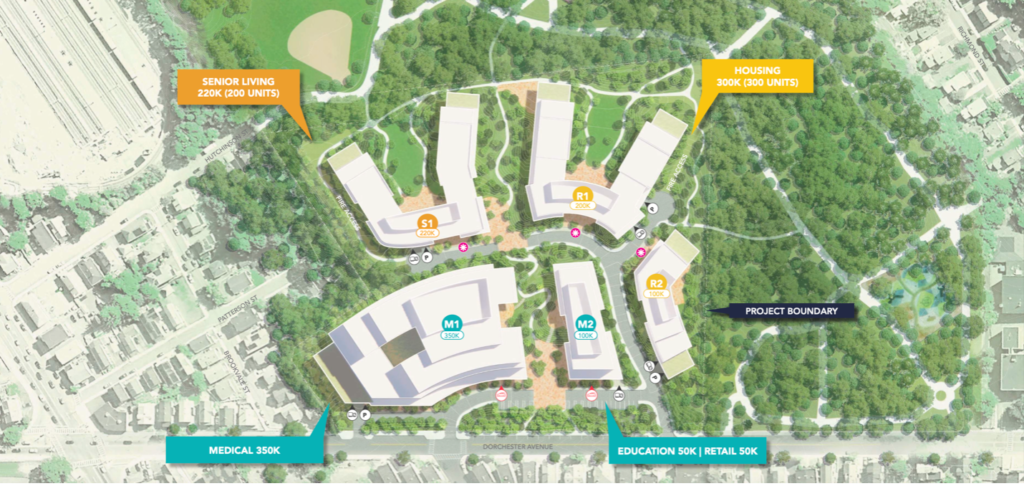
At a virtual meeting on Oct. 19, some local residents raised concerns about density and traffic, as well as the effect on the experience of the adjacent Dorchester Park. HYM’s founding/managing partner and CEO, Thomas O’Brien, told residents that the development—with all newly constructed buildings—would not result in any loss of parkland space. He added that the development team’s traffic study found that, compared with conditions during the Carney’s operation, there would be “less traffic impact.”
At the meeting, O’Brien counted “five or six” healthcare systems as candidates for possible use of the site, with “two of the larger ones” being “further along the line.” But he cautioned that the return of an “actual hospital” was unlikely.
“It’ll be a health care facility operated by a very sophisticated, large health care system,” he said. “And, so, there will be emergency services, but the level of service and all of those pieces are yet to be defined.”
In an email response, Alan Sager, a professor of health law, policy, and management, at Boston University’s School of Public Health, and the director of its Health Reform Program, wondered who would pay for rebuilding and sustaining care at the site, or commit to serving patients displaced by the collapse of Steward Health Care. “Staffing and equipment,” he wrote, “can be expensive without the volume of care and the clinical back-up offered by the ordinary inpatient care of an ordinary hospital.”
Steward’s operation coincided with a decrease in the level of state regulation of providers, which had considered care gaps and location of services. The trend under the two previous governors has been partly reversed in legislation signed last year by the current governor, Maura Healey. The measure calls for more health resource planning, along with consideration of impacts on health equity and local workforce.
“Until we know what care is needed in which locations, and what are the deficits,” Sager urged, “it will be hard to find state money to pay for care expansions to fill gaps between need and supply.”
Some of the gap left by the demise of Steward was filled when St. Elizabeth’s Medical Center in Brighton was taken over by Boston Medical Center. Over the past thirty years, flagship health systems in Boston have expanded care in Chestnut Hill and, last year, near the border of Jamaica Plain, West Roxbury, and Brookline, at the former Faulkner Hospital.

Seth Daniel photo
At the virtual meeting, O’Brien described the neighborhoods around the former Carney Hospital as a “healthcare desert.” But the Health Equity Compact, in a handout for a summit in June, highlighted other gaps, with the widest racial disparities in emergency room visits that could have been avoided with better access to primary care, in healthcare affordability, and in housing instability.
Dr. Fish — a member of the compact — referenced similar findings in an earlier study that correlated stabilization of housing with a reduction in emergency room visits at Boston Medical Center.
“These are huge savings for the health care system. But notice: I didn’t say that they were using the latest fancy machine that goes ‘bing.’ It wasn’t about technology. It wasn’t about being a tertiary center,” he said. “It was about the connectivity that’s needed at a personal level to help people with where they are to prevent these recurring patterns of use or misuse of the health care system.
“And so, the vision is that, instead of needing thoroughbreds or even horses, sometimes you need mules, sometimes you need oxen, to take it back a century or two. And community health centers are the oxen of the health care system.”
But, as Fish also suggested, filling a care gap in Dorchester could mean reimagining a market distinction between a standard and a luxury.
“Being able to be in your community and walk in,” he said, “where people look like you, people speak like you, people understand what you’re asking for and can literally take you by the hand and bring you within minutes to who you need to see to get things done: that’s a very different experience. And, in fact, people in other settings pay for that. That’s called ‘concierge.’ It’s a ‘concierge’ feeling, as opposed to being lost in a maze.”
John E. McDonough, Professor of Practice in the Department of Health Policy & Management
Harvard T. H. Chan School of Public Health, predicted a likely gap between healthcare vision and resources.
“Given the tightness of health care financial resources, especially at the governmental levels, “ he wrote in an email, “it seems a far stretch to imagine that essential state and local funding is going to appear in the current environment unless it were to appear from the wealth, for-profit healthcare world. Not likely in the short term, and possible in the medium to long term once things begin to move again in a progressive direction in 2029 with a new federal administration.
“The notion of building a campus of various health/medical/social service functions and programs seems possible,” he added, “though probably not in the guise of residents’ top priorities and preferences.”
Copyright © 2026 Boston Neighborhood News, Inc. This content may not be re-published or re-used without written permission.
