
A group of pro-Healy sign-holders, all members of the Sheet Metal Union on Adams Street in Dorchester, gathered to rally voters to their cause on Election Day in Adams Village. Seth Daniel photo
Copyright © 2026 Boston Neighborhood News, Inc. This content may not be re-published or re-used without written permission.
In Boston’s own contribution to an anti-Trump blue wave that swept across the nation this week, city voters reelected Gov. Maura Healey, US Sen. Ed Markey, and the rest of the Democratic statewide ticket by overwhelming margins in Tuesday’s state election, while also rejecting right-wing-led ballot questions that would have destroyed the marijuana industry and rolled back gun control.
Unofficial results showed that 41 percent of eligible voters participated in the election. Of that number, 78.2 percent— or 143,019— voted to give Maura Healey a second term alongside Lt. Gov. Kim Driscoll, compared to 17.9 percent for Republican challenger Mike Minogue. The result was nearly identical for Senator Ed Markey, who dispatched his GOP foe, John Deaton, by an even bigger margin, 78-16 percent.
Other statewide Democrats who faced Republican challengers— Attorney General Andrea Campbell, Secretary of State Bill Galvin, Treasurer Deb Goldberg, and Auditor Diana Dizoglio— were all rewarded with lopsided wins in Boston on their way to statewide victories as well.
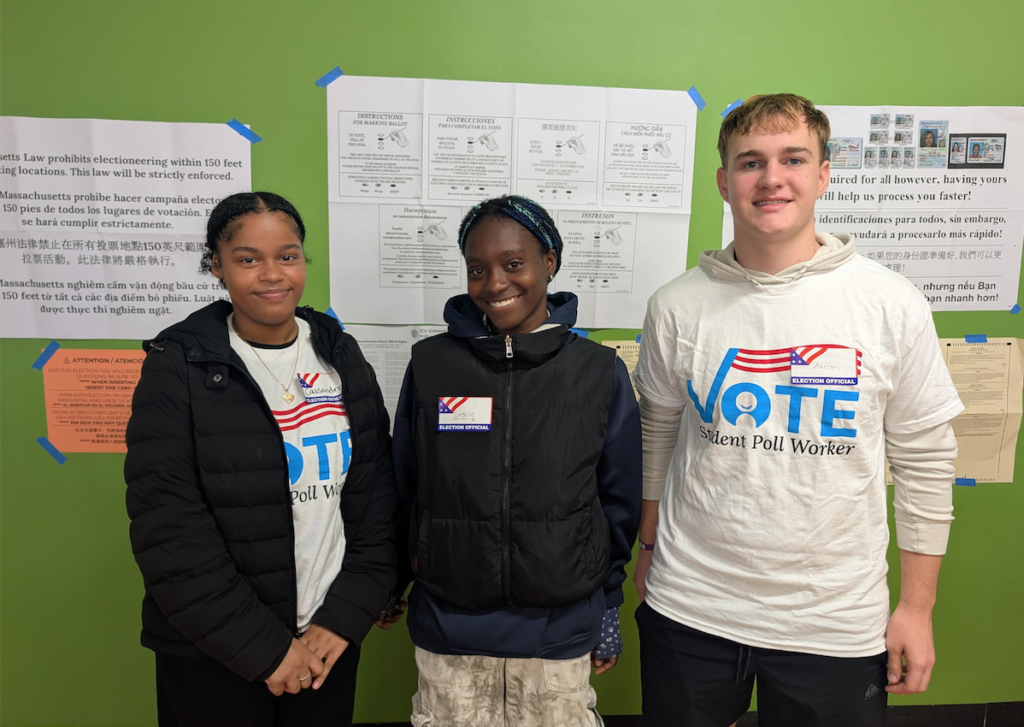
Above: Dorchester residents Cassandra Brandao, of Boston Latin Academy, Cordelia Cornish, of O’Bryant High School, and Aaron Riddle, of Boston Latin School, were diligently working the polls in Ward 17 at 450 Washington St. on Tuesday as part of the Student Pollworkers Program. Any Boston Public School student 16 and over can participate for the day and get a behind the scenes look at the electoral process. These students got extra-credit for their AP Government classes and an excused day off from school with pay. Two trainings were provided before Election Day. Photo courtesy Sarah Riddle
Two Dorchester precincts in ward 16— Florian Hall’s 16-12 and Adams Street library’s 16-9— brought the only bright spots for the Republicans. Minogue and Deaton registered wins at both polling spots, which have in past cycles voted for Donald Trump and other GOP candidates. But, as in past elections, the two Neponset precincts were outliers, to put it mildly.
As a whole, Dorchester voters roundly rejected Republican options on Tuesday by a 4-1 margin in most precincts. For example, Healey-Driscoll won 267 votes to Minogue’s 30 at Fields Corner’s 15-7 precinct. At the Codman Square library branch, one precinct— 17-6— delivered 416 votes to the Democratic gubernatorial ticket compared to 41 for the Republican side. Markey tallied 410 to Deaton’s 32 at the same precinct. And, so it went across all of Dorchester’s various wards.
US Rep. Ayanna Pressley received 103,232 votes in the Boston portion of the Seventh District, where she faced no opponent on the ballot. US Rep. Stephen Lynch received 46,743 votes, or 76.9 percent of votes cast in the Boston portion of his Eighth District, compared with 10,928 for Republican Robert Burke and 2,746 for independent Rasheed Walters. Both Pressley and Lynch were returned to Washington by large margins.
Ballot questions drew strong opinions
Like their neighbors across the state, city voters approved six of the nine statewide ballot questions and rejected three, often by wide margins.
Question 3, which proposed replacing the state’s partisan primary system with a top-two primary open to all voters, was defeated in Boston by a margin of 63.3 percent to 36.7 percent.
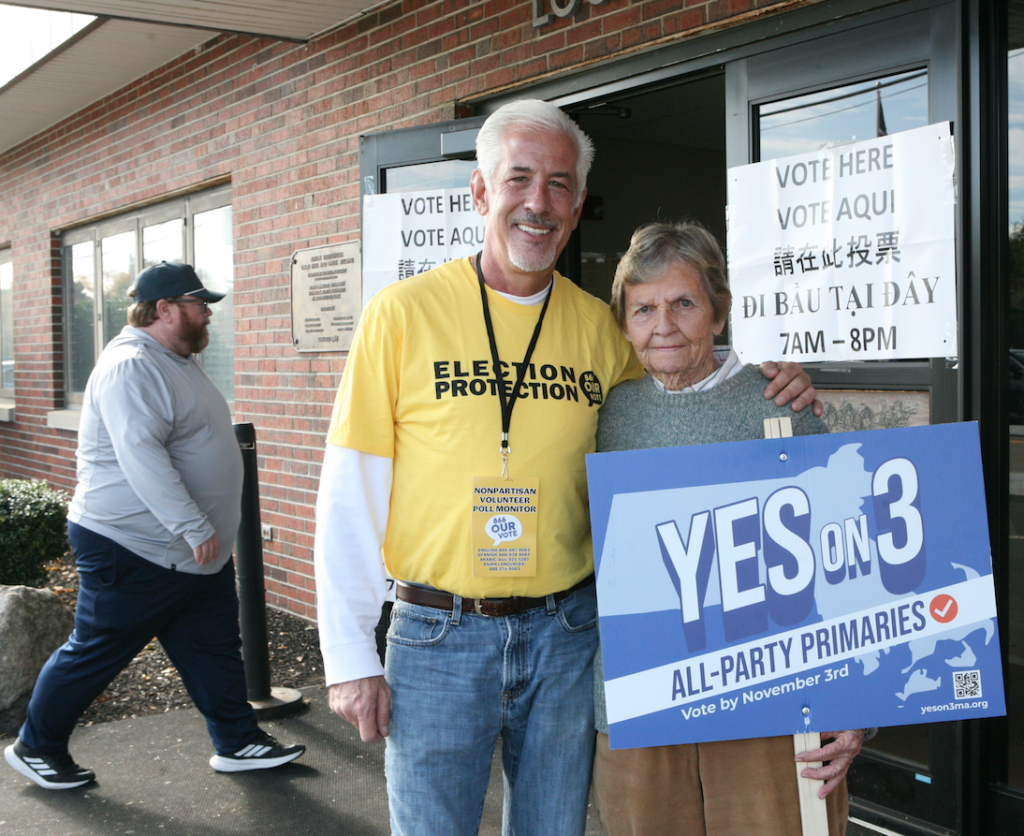
Terrance Flynn and Mary Ann Brown work the polls outside of Florian Hall in Neponset on Tuesday afternoon. Flynn was there as an Election Protection non-partisan voluntary poll observer, while Brown was there stumping for Yes on Question 3. Seth Daniel photo
Voters were even more emphatic in opposing Question 8, which sought to repeal recreational marijuana retail sales in Massachusetts. Nearly 79 percent of Boston voters opposed the proposal, with the No side prevailing by more than 100,000 votes. The statewide margin was 22 points in favor of keeping recreational weed legal.
Question 9, which sought to retain the state’s 2024 firearms law, received support from 80.8 percent of Boston voters, while statewide the measure passed with a majority of 68 percent. Boston voters also favored Election Day voter registration under Question 4, with 73.5 percent voting Yes. Question 6, concerning natural resource conservation funding, received 68.4 percent support.
Question 7, a proposal affecting zoning restrictions on single-family housing, was favored by 69.3 percent of Boston voters, but the statewide result was far closer and was still too close to call as of Wednesday morning.
At polling locations on Tuesday, voters interviewed by Reporter correspondents offered a range of reasons for turning out.
Jacqueline Hinton said she continues to prefer the traditional experience of going to a polling place and completing a paper ballot.
“I like to vote in person actually,” she said. “You get to come in, you see your actual paper, and you can sit there and fill it out. I like it, and I get my sticker.”
Hinton said she planned to put the sticker on her work badge and give another to her granddaughter for her journal.
Jocelyn Sammy voted at Codman Square Library alongside her mother, Maria Desilva, who said she voted because she believed change was needed.
“It’s time for a better world, for everybody to have a say and to receive what they really need for the future,” she said.
At the Adams Street library, Sebistián Molano, 44, said he supported Question 6, a conservation funding measure, in part because of the unusually warm Election Day weather.
“It’s November 3, and it’s 70 degrees in Boston, and we’re wearing shorts,” he said.
Molano, a parent, also voted to retain the state’s firearms regulations, citing his concerns about children having to participate in active shooter drills at school.
At Florian Hall, Maura Browne, 40, voiced concerns about the loss of neighborhood green space amid development and the conversion of single-family houses into multiple condominiums.
Quincy Roberts said he had never missed an election since turning 18. “I am a super voter,” Roberts said. “So just doing what I’m supposed to do. Let my voice be heard.”
This article was composed by Reporter editor Bill Forry with reporting from Seth Daniel, Yawu Miller, Daniela Ginsburg, and Anna Saldinger and assistance from the Boston University Department of Journalism’s Newsroom program and Statehouse program.
Copyright © 2026 Boston Neighborhood News, Inc. This content may not be re-published or re-used without written permission.
