
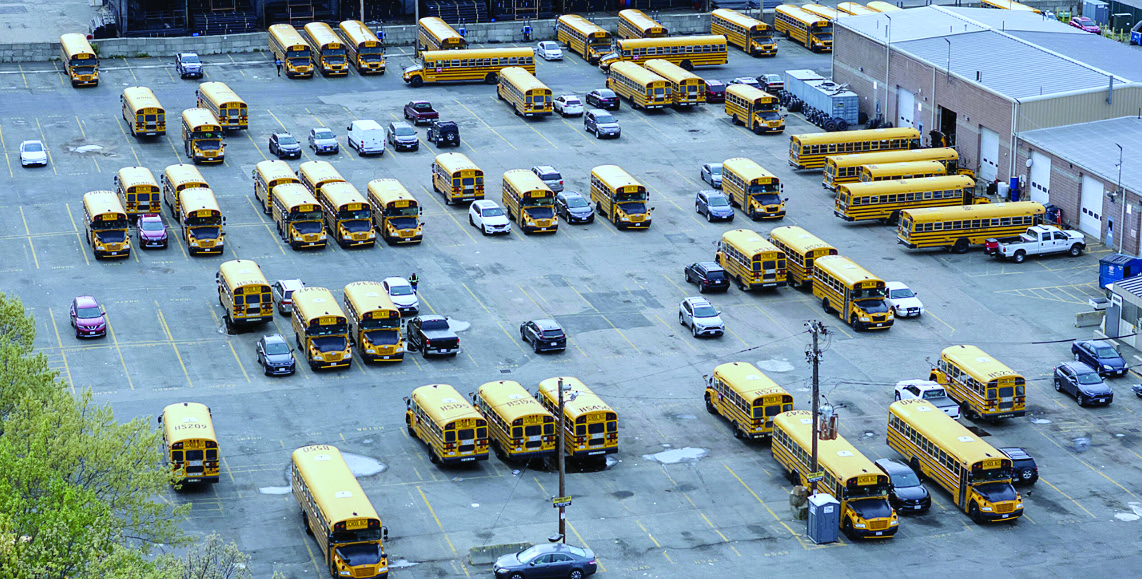
School buses parked at the Boston Public Schools Department of Transportation Readville Yard, in Hyde Park, Mass. Robin Lubbock/WBU
Copyright © 2026 Boston Neighborhood News, Inc. This content may not be re-published or re-used without written permission.
By Suevon Lee, WBUR
A single bus taking students to Boston’s James Curley K-8 School was late for the morning bell more than 150 times last year. The students riding that bus, HS510, lost up to 1,933 minutes of class time for the academic year. That adds up to about a week of missed school time.
The route is one of hundreds that were frequently late last school year, according to a WBUR analysis of Boston Public Schools data obtained via public records request.
Across the nearly three dozen total bus routes serving the Curley in Jamaica Plain, buses arrived late nearly 1,200 times last year, with some routes experiencing delays of a few minutes and others as long as 86 minutes.
Ryan Berard’s first grader rides a yellow bus to the Curley from West Roxbury. He recalled that during the last school year he spent the “first three or four months” going back and forth with school officials about his daughter’s constantly late bus.
The start to this school year isn’t any better, he added. “ We’ve had repeated, basically daily, delays.”
Parents have clamored for improvements for years, and some were incensed that the district had only recently fined its private bus contractor, Transdev, for the repeat tardiness. The company is responsible for managing the district’s yellow bus school service across roughly 600 bus routes and fleet of 750 buses.
Last spring, district officials in part blamed short staffing, mechanical issues, and bad winter weather for Transdev falling short of its 95 percent on-time goal, but said many delays had improved after consolidating routes and hiring new drivers.
The most number of delays occurred at the start of the school year in September and October — typically a rougher time as drivers adjust to new routes — and colder months of late January and February, when Boston dealt with one of the snowiest winters of the last decade.
Still, WBUR’s analysis of last year’s data shows at least a dozen dates spanning March, April, and May in which there were around 100 or more delays across the district. Those spring months are when elementary students prepare for and take annual MCAS tests.
The data analysis looked exclusively at morning delays and did not include the thousands of instances in which buses did not show up at all. Boston Public Schools did not respond to request for comment on last year’s pattern of delays.
While shuttling kids in a dense urban metropolis like Boston can include any number of unforeseen hiccups due to congestion, construction, or bus mechanical issues, WBUR’s analysis found the worst delays hurt some schools and students dramatically more than others.
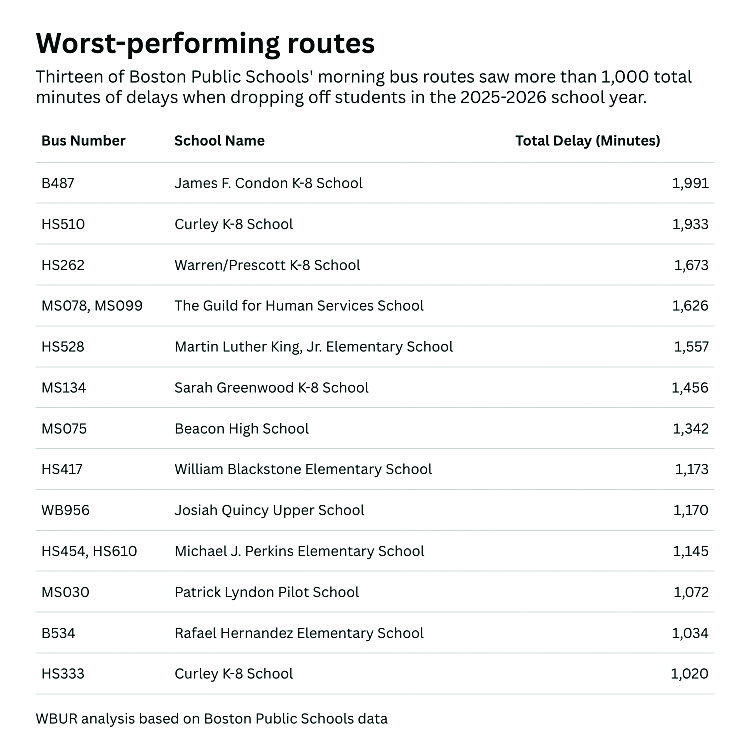
More than a dozen individual bus routes had total delays exceeding 1,000 minutes. The data includes bus rides that were one minute past school start time up to 89 minutes late. At some schools, delays approaching 30 minutes occurred on near-consecutive days, even weeks.
Students riding bus HS387 to Richard J. Murphy K-8 School in Dorchester arrived at the front door roughly 27 minutes late on average for nearly two consecutive weeks between Sept. 9 and 23.
For passengers of bus HS262 to Warren-Prescott K-8 in Charlestown, all 10 months of the school year saw a string of delays. But the district’s data showed among the worst was a three-week stretch between April 16 and May 7 when the bus ran behind an average of 23 minutes each day.
Delays are clustered around the start of the school year. In the first week of school, students riding B006 to Thomas Edison Elementary in Brighton last year lost 205 minutes of class time. That’s in large part due to a 77-minute delay on their first day and 75-minute delay on the third day.
At the Curley, the first day of school in 2025 shows a 17-minute average delay across multiple bus routes. Enrolling 955 students in pre-K to eighth grade, the school has one of the largest populations of elementary students in the district and involving roughly three dozen bus routes.
It’s perhaps not surprising the school would rack up the highest number of delays in the district, but even schools with half as many routes ran up a tally. Buses to Edison Elementary, for example, were delayed 514 times across 18 bus routes throughout the year.
Schools that had at least one 87-minute delay or longer include: Match Community Day Charter School, Mildred Avenue K-8, Michael Perkins Elementary, William Blackstone Elementary, Rafael Hernandez Elementary, KIPP Academy Boston, Thomas Edison Elementary and John Eliot K-8.
In an interview, City Councillor Erin Murphy was frustrated, but unsurprised by the minutes of learning lost to bus delays, saying it reflects “weeks of educational time missed. This is my fifth year on the council, and I’ve held one every year, sometimes twice a year,” she said about council hearings on late buses.
“Tardiness affects obviously overall culture and education for students,” she noted. “Maybe they’re missing math every morning. Maybe they’re missing reading. Or maybe their class goes to gym and art or a specialist first thing every morning, and they’re missing that. They’re missing breakfast. We should be able to get our students to school, and we should be able to get our students home from school.”
It’s unclear how many students ride on any given bus route. Or where exactly in the district they travel. WBUR requested map routes of the most chronically late buses, but the district did not immediately provide those.
The district’s contract with Transdev targets a minimum 90 percent on time morning arrival rate as a key performance indicator. On average, the morning on-time performance rate was 91 percent last school year, according to the district.
The City Council scheduled a hearing Monday to discuss school bus performance so far this school year and any “corrective action” that’s needed. The bus system serves more than 18,000 riders, including students who attend charter schools and students with special needs who require transportation to out-of-district schools.
Transdev, the district’s bus operator since 2013, started its most recent $630 million contract with Boston Public Schools in July of 2023; it expires in June of 2028.
Built into the district’s contract with vendor Transdev is a carrot-and-stick system: Transdev received a $27,300 incentive for achieving at least 92 percent on-time morning performance in April, May, and June of last school year, according to a BPS spokeswoman. While Transdev got that bonus, it still had problems on specific routes that haven’t been solved, leading to the same children missing minutes of school each week.
Last school year, the city penalized Transdev with $400,500 in fines for blown trips around the same time period of March through the end of the school year in June.
Meanwhile, parents seethe with frustration. So far this year, Berard, in West Roxbury, estimated that his daughter’s bus has dropped her off roughly a half hour after the 8:30 a.m. bell about 15 times. “Our morning routine has crumbled because it’s impossible to know when this bus is going to come,” he said.
The bus drops students off at a Roslindale school before she hops on it to head to the Curley in Jamaica Plain. Berard said she often misses school breakfast and can often feel embarrassed when she walks in late “when class has started and kids are already sitting at their tables.”
As someone who works downtown, Berard said, the school bus “is by far the best way to get her to school.
Being able to take her to the bus stop and get her on the bus … allows me to kind of go get on my own bus to get to work,” he noted, adding that he’s grateful his employer is flexible enough that he can ensure his 6-year-old boards her bus.
“ I’m sure that there are a lot of parents across the city who might have to just leave their kid [at the bus stop],” he said, “who wouldn’t know for two hours what was going on.”
This story was first published on Nov. 2 by WBUR. The Reporter and WBUR share content through a media partnership.
Copyright © 2026 Boston Neighborhood News, Inc. This content may not be re-published or re-used without written permission.
