
The state’s probation commissioner discusses
how policy changes affect people in Dorchester
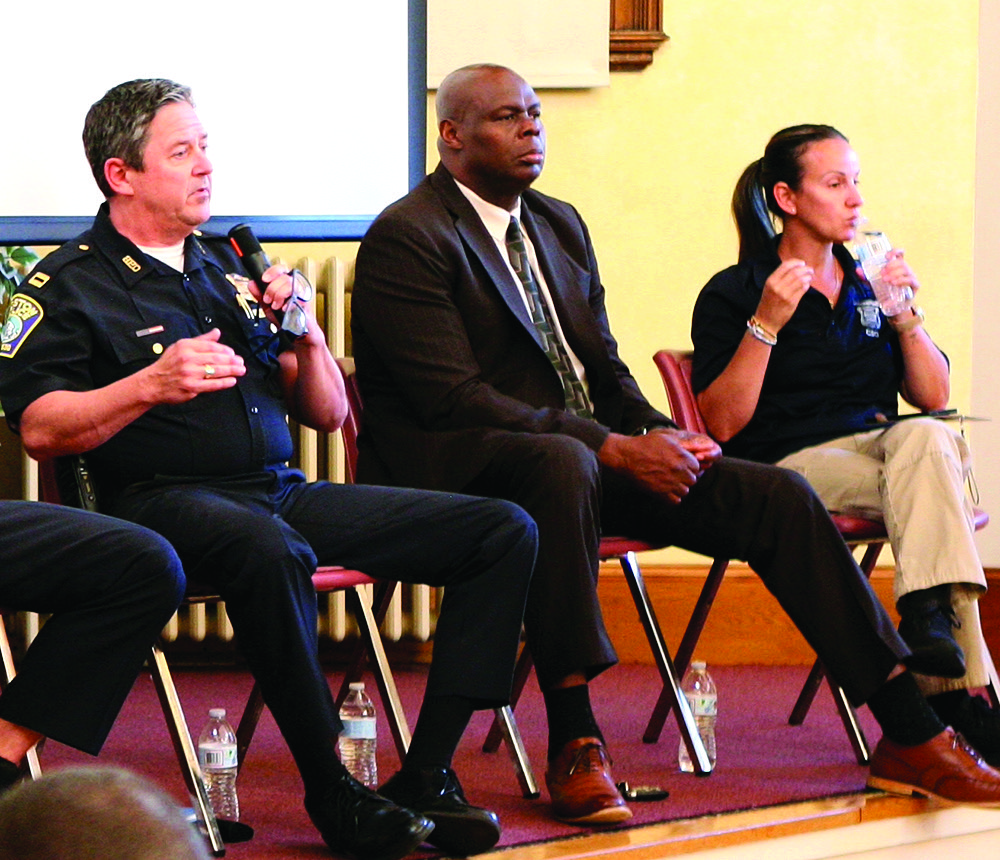
The state’s Probation Commissioner Pamerson Ifill (center) participated in a public safety discussion at the Great Hall in Codman Square in August. Seth Daniel photo
Copyright © 2026 Boston Neighborhood News, Inc. This content may not be re-published or re-used without written permission.
By Jack Schwed
Pamerson Ifill has prioritized support and rehabilitation to reduce repeat offenses and probation violations since becoming Massachusetts probation commissioner in 2023. He removed the monthly fees of $50 to $65 that people on probation paid to offset the costs of supervision by probation officers. And he plans to implement smaller, watch-based GPS monitoring for women and juveniles as an alternative to heavy ankle bracelets.
“We want to bring a level of dignity back to the world,” said Ifill, who is the state’s first Black probation commissioner.
The Reporter interviewed Ifill to discuss how these policy shifts impact court-involved individuals in Dorchester and beyond. The interview has been edited and condensed for clarity.
Q. Since the elimination of supervision fees, what trends are you seeing in the Boston Municipal Court caseload, specifically for Dorchester?
A. Court fees and fines have, more often than not, remained a troubling gateway for people who can’t afford to pay the fees and funds into the system as a result of a violation. So traditionally, fees and fines are the ways that people end up in violation because a significant portion of people that we know, not just in Massachusetts, but anywhere in the criminal justice system, are dealing with resources and poverty.
The fact that we don’t violate individuals because they can’t afford to pay makes life easier. Violations are down overall across the Commonwealth of Massachusetts 52 percent, but specifically to the Dorchester District Court, they’re down 32 percent.
Q. You’ve previously talked about “flipping the script” so that probation doesn’t drag people out of work or counseling just to check a box. What does this mean for Dorchester residents with rigid work schedules?
A. Last year’s fiscal constraints sort of hampered some of that, but our goal is to meet people where they’re at, but really to provide much more flexibility, see people during non-traditional hours, and stop disrupting people’s work. And so, Dorchester is one of those courts that also does Night Light with the Boston Police Department, where probation officers go out and visit individuals in the community during non-traditional hours.
But our goal, really, across the Commonwealth, is to continue to drive that because we know that a lot of folks have difficulty and flexibility getting out of work, especially our populations who are struggling to find employment, and when they do find employment, it isn’t necessarily always as secure.
Q. Can you tell me a little bit more about your strategy of shifting the focus more toward support and rehabilitation in order to reduce recidivism?
A. If we’re going to make a difference in reducing recidivism, then we’ve got to help people to get out some of the same ruts that they’ve been involved in for weeks, for years, for decades, and really try to in our community justice support centers with employment, education, and cognitive behavioral therapy.
The average probation officer now workking in Massachusetts has a master’s degree, 68 percent are female, and they’ve got more than eight years of experience in human services or education in that field. And so, we really focus on individuals that got the kind of skills and skill sets that can work with populations.
The other thing that is huge for us: We went from a department that was 21 percent diverse that is now 33 percent diverse. So, we look like the communities we serve. We speak the same languages. We’ve had the same kind of experiences growing up as people, as children. Some of our folks are people who are living some of the same set of circumstances as the individuals we work with.
Q. Can you tell me about some of your other goals as probation commissioner?
A. We’re focusing on young adults, emerging adults. We know that population is overrepresented. They represent about 9 percent of the population, but about 15 percent of the individuals in our correctional system. We want to provide much more support services, training, and development to help that population.
We’ve improved our GPS monitoring. We’re switching to some watch-based models that will allow us to really work with juveniles and especially women, because we want to have a much more humanistic approach to the GPS instead of the massive ankle bracelets.
Sometime in April, we’re shifting to smaller ankle units as well because we want to be more inconspicuous for individuals. We want to bring a level of dignity back to the world, and again, we want to continue to drive our violation rates down.
Q. Before being appointed commissioner, you were the chief probation officer for Suffolk Superior Court. How did working directly with Boston and Dorchester families shape the high-level policy changes that you’re now implementing?
A. I got a chance to help a lot of young men and women, but also a lot of people who were struggling at the margins — who, if not by their own decisions, some systems have failed them, whether it’s education, employment, family, or social support. And so, being able to work across Suffolk County in that capacity and work with a dedicated crew of people, it was really important to realize that a lot of young men and women charged in Superior Court had a multiplicity of different issues.
Working with the Boston Police, working with all of the different entities and agencies, where you get a better understanding of neighborhoods and communities, was really important. Using that experience in Suffolk Superior Court has allowed me to inform a larger opinion about ways we can really improve the system.
Q. What might someone who lives in Massachusetts not understand about the probation system that you think would be important for them to know?
A. We are in the second-chance business. We’re here to work and support individuals. We spend a lot of time with our community justice support centers on employment training, substance abuse, mental health therapy, trauma support, motivational interviewing. We are really focusing on getting it right, and so making sure that people aren’t over-supervised, that they’re supervised at the right level.
Very few people understand and know that we have an entire victim services unit that focuses on the needs of victims and survivors, and so we spend a lot of time trying to make sure that victims have the kinds of information and resources that are available to them beyond their trial date.
So, if you are on probation and you had a victim in your case, we will work with that victim until that probation is concluded, and sometimes that can be 5, 10, 15, 20 years. We notify victims of change, of compliance, of violations. We are good at accountability. What we’re really interested in is helping people to change and improve their circumstances, and we’re really interested in making sure that we have a high level of public safety.
This article is the product of a partnership between the Dorchester Reporter and the Boston University Department of Journalism’s Newsroom Initiative.
Copyright © 2026 Boston Neighborhood News, Inc. This content may not be re-published or re-used without written permission.
