
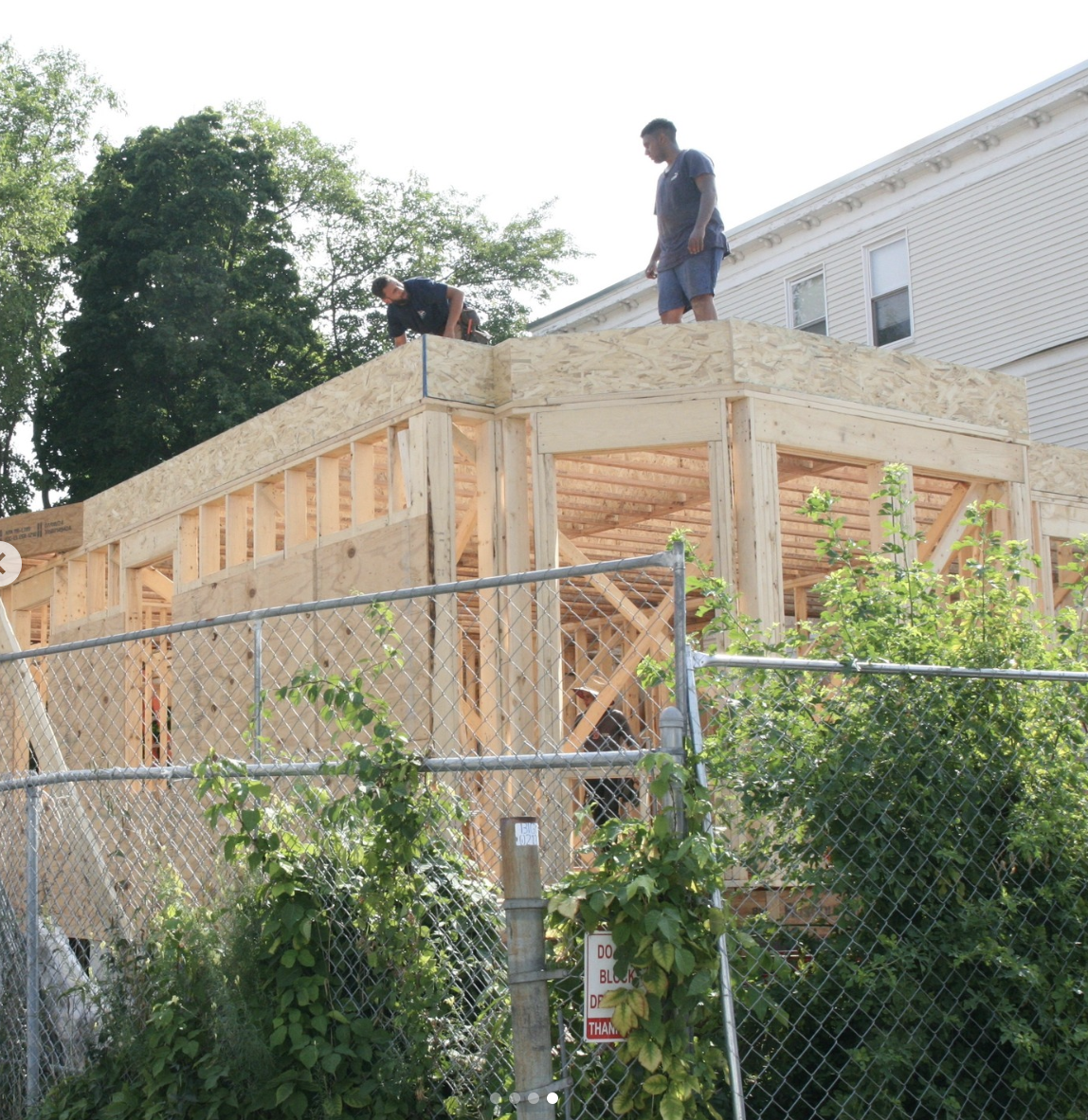
Above, workers are shown building a three-story house on Morton Street in Mattapan last year. Seth Daniel photo
Copyright © 2026 Boston Neighborhood News, Inc. This content may not be re-published or re-used without written permission.
Mayor Michelle Wu’s administration today unveiled another series of proposed changes to Boston’s affordable housing and commercial development policies aimed at jump-starting projects that have stalled amid high interest rates, rising costs, and other economic pressures.
The latest round of reforms would give developers more flexibility in meeting affordable housing requirements, allow them to spread payments over seven years instead of two, and reduce certain fees for condominium projects. It would also temporarily exempt smaller residential developments from the city’s Inclusionary Zoning requirements and freeze an automatic increase scheduled to take effect in January.
“In the face of continued economic headwinds exacerbated by federal actions, we are making targeted adjustments to help more projects move forward and create more affordability,” the mayor said in a press release announcing the various proposed changes on Monday.
The mayor’s top two housing officials, who briefed reporters on the emerging plans on Monday morning, said that while the city’s core approach to funding affordable housing is left intact, the proposed changes represent a recalibration of policies focused on the so-called “Inclusionary Development Policy” (IDP).
“We recognize that the cost of building housing has increased, and we want to be responsive to these realities,” said Sheila Dillon, Boston’s chief of housing. “These program changes are designed to encourage the development of new housing while maintaining our commitment to affordability.”
Dillon and Chief of Planning Kairos Shen said the aim is to make residential construction more financially viable in a difficult real estate market. Wu’s administration has already introduced an office-to-residential conversion program, a Housing Accelerator Fund, and targeted tax abatements designed to dislodge projects stuck in the pre-construction phase.
The latest proposals would modify the city’s Inclusionary Zoning program in four ways.
• First, developers who choose to make payments to the city in lieu of constructing some required affordable units on site would be allowed to spread those payments over seven annual installments instead of two.
• Second, the payment-in-lieu fee for condominium projects would be reduced from 75 percent to 50 percent of the difference between the market value of a condominium and its income-restricted value. That would restore the fee to its level under the city’s previous IDP.
• Third, the threshold for triggering Inclusionary Zoning requirements would increase from 7 units to 10 units for a two-year period. Projects containing seven, eight, or nine homes would therefore be exempt from the requirement during that period.
• Finally, the city would eliminate a rule requiring affordable units built off-site to be located within a half mile of the market-rate development. Instead, city housing and planning officials would work with developers and neighborhood stakeholders to determine appropriate locations, which would still have to be within Boston.
The proposed changes could have particular significance for smaller residential projects in neighborhoods like Dorchester and Mattapan, where developments containing fewer than 10 apartments or condominiums are common.
Shen said the city has historically averaged approximately 14 projects annually in the seven-to-nine-unit category. But that activity has declined dramatically, with only one such project recorded in 2026.
“We would like to actually make sure that this band, even though it’s only approximately 14 projects, that those can go forward without the burden of providing the inclusionary unit at that scale,” Shen said.
The city’s previous affordability policy had used a 10-unit threshold, which was lowered to seven as part of the 2023 reforms.
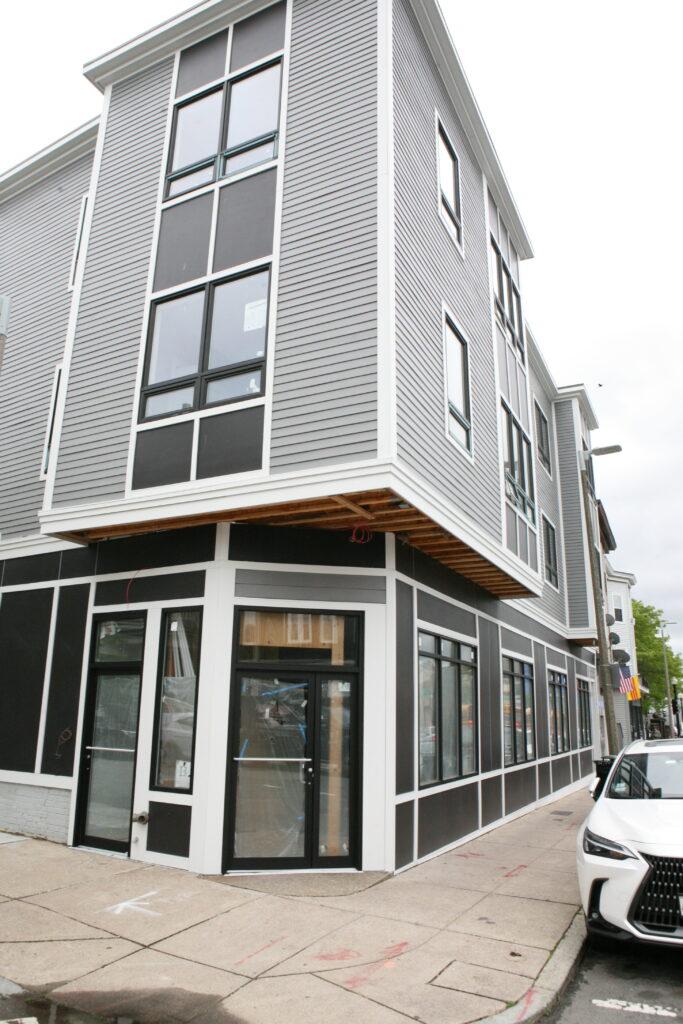
Above, a newly-built project at 1078 Dorchester Ave. in Dorchester. Seth Daniel photo
Shen stressed that the temporary exemption is not a guarantee that smaller projects will become financially feasible.
“There are many projects that are smaller than 10 units or 7 units that are not feasible currently,” he said, noting that construction costs, land prices and building code requirements can all affect whether a development can move ahead.
The administration’s decision to preserve the 17 percent affordable housing requirement, plus the additional 3 percent for voucher-supported households, is significant because developers have argued that Boston’s affordability mandates contribute to the financial difficulties facing new construction.
During Monday’s briefing, officials were asked why the city was modifying payment schedules and other requirements rather than reducing the overall affordability percentage.
Dillon said the administration is trying to balance two competing priorities: encouraging market-rate housing production while ensuring that lower-income residents can continue to find homes in Boston.
“We want to work with developers to ensure that their market-rate projects can move forward, and we also want to make sure that Boston is a home for everyone,” Dillon said.
Kathy Brown, executive director of the Boston Tenant Coalition and co-coordinator of the Coalition for a Truly Affordable Boston, offered support for the changes in a statement issued through the mayor’s office.
“The changes being made are preferred over rolling back IZ from 20 percent to 13 percent of units built,” Brown said.
Dillon said extending the payment schedule would preserve the total amount owed by rental housing developers while allowing them more time to meet their obligations. For condo developers, however, the city would collect less per unit when developers exercise the payment-in-lieu option.
Dillon said the administration believes the city would ultimately benefit if the lower fees allow more projects to advance.
“We’re seeing so few condominium developments move forward now; it actually will be a gain because we’ll see more projects advance,” she said.
The city’s linkage program requires qualifying commercial and institutional developments to contribute funding for affordable housing and job training. Originally adopted in 1983, the program was expanded in recent years to cover developments of at least 50,000 square feet, down from the previous 100,000-square-foot threshold.
Under current rules, commercial linkage fees are adjusted annually for inflation. Without intervention, the rates would rise automatically at the start of 2027. Shen said the scheduled increase would be approximately 4.09 percent.
“We’ve had a few developers come in to talk about potentially restarting some of these commercial projects that have been stalled in the downtown, in particular,” Shen said.
He acknowledged that freezing the fees would not necessarily make an unworkable project financially viable on its own but said it would avoid adding another burden.
The job-training portion of commercial linkage payments would continue to be collected in two installments.
Since 1983, the city’s Neighborhood Housing Trust has collected more than $280 million through linkage payments, according to Shen. Between 2015 and 2025, the Neighborhood Jobs Trust collected approximately $30 million to support organizations serving more than 10,000 low- and moderate-income residents.
The proposals laid out today are scheduled to go before the Boston Planning and Development Agency board on Thursday this week (Nov. 12).
The Inclusionary Zoning changes would also be subject to City Council review. Under the process described by officials on Monday, the council would have 60 days to reject the changes by a two-thirds vote before they could proceed to the Zoning Commission.
The commercial linkage changes would require approval by the Zoning Commission before the scheduled increases take effect on Jan. 1.
Copyright © 2026 Boston Neighborhood News, Inc. This content may not be re-published or re-used without written permission.
