

Copyright © 2026 Boston Neighborhood News, Inc. This content may not be re-published or re-used without written permission.
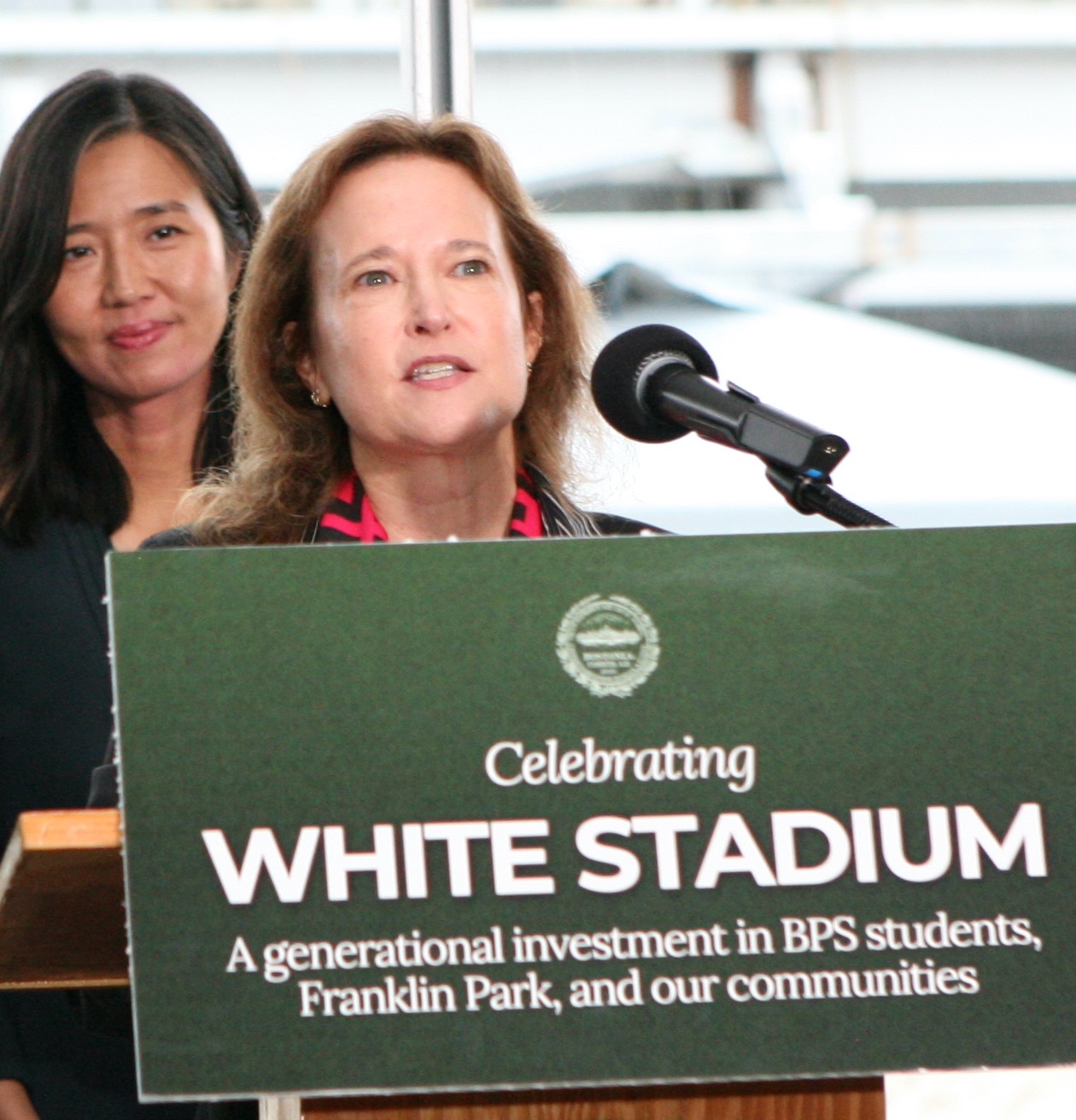
Boston Legacy FC owner Jennifer Epstein spoke at a Nov. 6 topping-off event at White Stadium as Mayor Wu looked on. Seth Daniel photo
Opportunity Zone tax incentives, a Trump-era vehicle that seeks to encourage targeted investment in select census tracts across the nation, have emerged as a key tool to help the Boston Legacy Football Club as it finances its $250 million share of the overall $325 million reconstruction of White Stadium.
Franklin Park, where the stadium is located, is one of several Boston tracts that have recently been re-designated as Qualified Opportunity Zones (QOZ). Other sites include Columbia Point and the Morrissey Boulevard corridor in Dorchester.
The designation allows landowners and investors to avoid paying all or part of capital gains taxes generated from large sales of businesses or property by investing in projects nominated and approved by city, state, and federal governments.
A capital gain is the amount of profit – the sales price minus the purchase price – that is achieved in a sale and then taxed federally by as much as 20 percent.
In the case of White Stadium, the Boston Unity Soccer Partners (BUSP) — the entity that owns the Legacy team— has argued that the designation is essential to them funding substantial investments and accessing more capital for the stadium and the surrounding community.
In a letter to Mayor Wu in June 2026 that The Reporter obtained by a Freedom of Information Act request, the BUSP executive team called the designation “foundational” to their “investment strategy at White Stadium and the surrounding community.” It would, the letter states, unlock “significant tax-advantaged investment structures that are central to the economic viability and attractiveness of the project.
“Without it,” the letter noted, “BUSP cannot achieve QOF (Qualified Opportunity Fund) or QOZ Business status, the private capital needed to fund the $250 million stadium renovation becomes harder and more expensive to raise, and the investment thesis for the club and surrounding community is weakened.”
The designation also “unlocks tax-advantaged investment across three distinct tranches of capital, representing a total investment opportunity well in excess of $1 billion,” the letter said. “This reflects the scale of private capital that becomes accessible to White Stadium, the Grove, and BUSP to invest in the surrounding community specifically because of the QOZ designation.”
Team officials say the “surrounding areas” reference means vendors and small businesses working within Franklin Park, the Stadium or The Grove.
“The Opportunity Zone designation is limited to the census tract for Franklin Park, which includes White Stadium and The Grove,” said Jennifer van Dijk, team president. “When the letter refers to investing ‘in the surrounding community,’ it is referring to the community benefits White Stadium brings, including community programming, increased public access, local hiring and BUSP’s broader community commitments — including more than $252M in community benefits over the next 15 years.”
White Stadium is owned by Boston Public Schools but is now leased long-term to BUSP – allowing the team to qualify for the federal program.
The use of the Opportunity Zone benefits, however, has its detractors, including some neighbors and groups who have been vocal critics of the White Stadium project and the city’s agreement to lease the BPS asset to a private, for-profit sports franchise. They object to Franklin Park being used as a “tax haven” to advance investor interests that have not been fully vetted with the public.
On Nov. 5, the Franklin Park Opportunity Zone was officially renewed through a revamped federal “OZ 2.0” program that is now permanent and part of the Big Beautiful Bill that will take effect on Jan. 1, 2027.
Franklin Park’s census tract was first included in the Opportunity Zone program during Trump’s initial term in 2017 with bi-partisan support federally.
John Barros, now the interim director of the Massachusetts Convention Center Authority (MCCA), was part of the team of former Mayor Marty Walsh’s administration that chose to include Franklin Park as an Opportunity Zone.
“When we drew them up, we looked at places where it could be attractive for public-private partnerships,” Barros told The Reporter last week. “In Franklin Park it was particularly the Shattuck area – not the park itself – but also something maybe around the Zoo because the Zoo needed investment or around the Shattuck and the back end there.
“We prioritized locations with public-private partnerships and with infrastructure buildouts,” he noted. “That’s really why Franklin Park was a part of it.”
In announcing the renewals this month, US Treasury Secretary Scott Bessent hailed the Trump administration’s initiative for “giving investors, entrepreneurs, and local leaders the long-term certainty they need to commit capital to communities that have been overlooked for too long.
“Today’s announcement of the new designations will help direct private investment to these communities, expand economic opportunity, support job creation, and unlock long-term growth in these communities across the country,” Bessent said in a statement.
The re-designation will allow BUSP to take the further step of setting up an investment vehicle in the form of QOZ Business entity status and a Qualified Opportunity Zone Fund (QOF). The team did not participate previously in the Opportunity Zone program, a spokesperson said.
In a statement this week, the team told The Reporter it was grateful to have the Franklin Park zone renewed by city, state, and federal authorities.
“Opportunity Zones are a critical tool to unlock and encourage long-term private investment in Boston,” said van Dijk. “This designation strengthens the long-term financial foundation of White Stadium, a public facility owned by Boston Public Schools and builds on the significant progress already underway.”
Added a spokesperson for the Wu administration: “Opportunity Zone designations are a critical tool to spur economic development in Boston neighborhoods and unlock private investment. These targeted designations will help accelerate construction and support business growth, in conjunction with the City’s efforts to streamline permitting, advance thoughtful rezoning, and facilitate City, state, and federal investment.”
In the June letter from BUSP executives, the financing was characterized as critical to its $250 million renovation of the Stadium. It forecast that the team is predicted to be valued at $750 million within 10 years.
“All continuing investment into the area surrounding White Stadium, including programming at Franklin Park, operational infrastructure, and local hiring, can flow through QOZ-compliant structures,” read the letter. “This means other actors, not just BUSP, are incentivized to invest in Franklin Park, compounding the community economic benefit over the life of the designation.”
That rationale evokes emotional rebuttal from objecting parties.
“It’s very alarming and I’m very concerned as someone from the surrounding area,” said Mattapan’s Pamela Jones, chair of the Franklin Park Defenders, which was one of the parties that initiated an unsuccessful lawsuit that sought to block the project last year. “I am devastated that not one of our city or state elected officials have come into the community to share this information or ask us what we want to see in this Opportunity Zone.”
Reggie Stewart, who serves as chairman of the Boston NAACP Climate and Environmental Justice Committee, said he, too, is alarmed by the use of Opportunity Zone benefits in this case.
“These investors treat the community like the stock market,” said Stewart. “They come in and buy it and wait for the time period to lapse and the stocks to go up and drop it – take all of the capital gains and leave tax free. In the meantime, they drive up prices for existing homeowners and increased tax bills will push these homeowners out and then come more investors.”
Stewart says he’s disappointed that the Wu administration and the soccer team are embracing a program heralded by Trump.
“That’s a piece of this I find particularly egregious with all the performative outrage against Trump,” he said. “What are we doing here?”
Melissa Hamel, a founding member of Coalition for Region-wide Services that has opposed the redevelopment of Shattuck Hospital into a larger campus for people battling addiction, said not enough people know about the investment strategy.
“It’s unfortunate that so many people in the community are blind to what’s going on here,” she said. “I don’t think most people will understand this until it hits them, and maybe they’ll be the ones selling their properties and cashing out.”
The Legacy’s ownership contends that the funding plans are simply a way to use the stadium as a catalyst to develop more opportunities in the Park, offer up to 500 jobs, and bring in new resources – as well as make Boston a hub for women’s sports.
“The practical effect for the city is significant: a club that can attract this type of equity investment is better capitalized, more financially stable, and more capable of making sustained, long-term investments in the surrounding community,” the Legacy’s June letter asserted. “It also positions Boston as a destination for women’s professional sports investment more broadly, which may in turn attract other teams to the city.”
Read more about Opportunity Zones and how they work at DotNews.com.
Copyright © 2026 Boston Neighborhood News, Inc. This content may not be re-published or re-used without written permission.
