
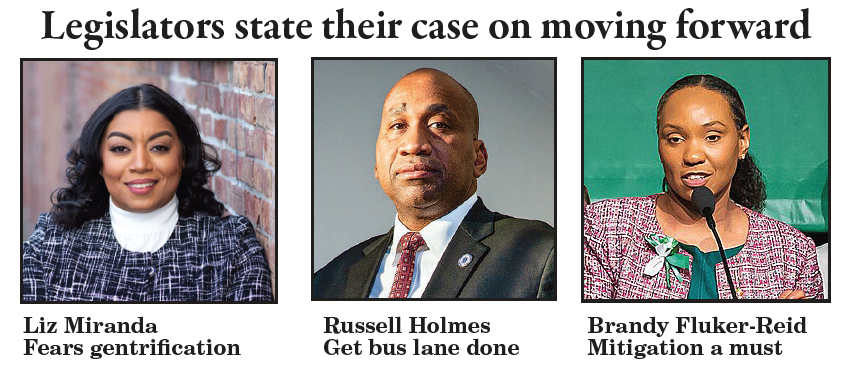
State Rep. Brandy Fluker-Reid’s ideas about the future look of Blue Hill Avenue come from direct experience. The Mattapan Democrat regularly rides the bus routes that run from Mattapan Station as part of her commute into the State House and constituent events.
“I often use public transportation to get to where I need to go,” she said.
In June, she participated in a ride-along with MBTA officials as they pointed out different options for how a center-running bus lane could work along the corridor, looking at the plusses and minuses of different lane configurations at intersections along the avenue.
So where does she stand on the controversial redesign of the busy thoroughfare? “I’m not fully opposed to it,” she said. “I know the 28 is the longest-running bus line in Boston. It takes an hour from Mattapan to Nubian Square.”
But, she told The Reporter last week, any potential support she may offer is conditional.
“I can’t support anything that doesn’t protect the Black and Brown businesses. I’m reserving support until I can make sure there’s mitigation for them.”
Her position is similar to that of state Sen. Liz Miranda, who says she generally supports the idea of redesigning Blue Hill Avenue, but wants the community process to “reset.”
Miranda, a Roxbury resident who does not have a car and uses the MBTA, conducted her own online survey of about 300 constituents last year to arrive at her position.
“In that process, it came out that about 20 percent of the community really supports the project but 80 percent were opposed or had questions about it,” Miranda told The Reporter. “The community was really like, ‘Hey, I think we need to go back to the drawing board and what can you do to prevent gentrification?’”
Miranda did not supply The Reporter with the full results of her survey.
There have been other studies conducted by the MBTA and city of Boston that are publicly available and show significantly more public support for the project than Miranda has reported.
Like Fluker-Reid, Miranda is concerned about the impact to businesses along the corridor and what a redesigned thoroughfare will mean for auto traffic. Last month, she announced that she has filed legislation that would mandate that the MBTA include an “anti-displacement” strategy for any new transportation infrastructure projects.
“I didn’t file this bill to prohibit bus rapid transit,” she said. “I didn’t file this bill to say no to rail expansion. I didn’t say no to transit-oriented development. The bill is really trying to focus on ensuring that as we plan these projects — whether they happen in Boston, whether they happen in Lowell, Worcester, Hyannis, wherever — that our communities really have a chance to think about housing policy and transportation together, because I think that that’s the misstep.
“We are also talking,” she added, “about one thing at a time. In our communities, we can’t afford that.”
Among other elected officials who represent portions of Blue Hill Avenue, state Rep. Russell Holmes has been the stronger supporter for the current plan, which includes a center-running bus route with platforms. It’s something that he has advocated for since he was first elected in 2010.
“If we want to improve transit in Blue Hill Avenue, what needs to improve is service for the 40,000 riders who use the bus every day,” he said. “As a public transit user, I see the experience we have, being treated as second-class citizens.”
Holmes acknowledges that the community is split on the center-running bus lane, but says it has to get done.
“My goal while I’m elected is to do things that are hard,” he said. “This is one of the hard projects I want to get done.”
Making that happen has proven more challenging in recent months. Two city councillors— Miniard Culpepper of Roxbury and Brian Worrell of Dorchester— have called for any center-running bus plan to be abandoned. Instead, they want the MBTA to plan and fund an underground extension of the Orange Line from Ruggles Station to Mattapan Square, a project that could take many years to accomplish in ideal circumstances.
Transit advocates and neighborhood activists have long complained that Blue Hill Avenue between Mattapan Square and Grove Hall is overdue for a redesign. Pedestrians have to traverse a span of six lanes bisected by a wide median strip to cross the avenue, which most recently was redesigned to facilitate the flow of traffic through Mattapan and Dorchester.
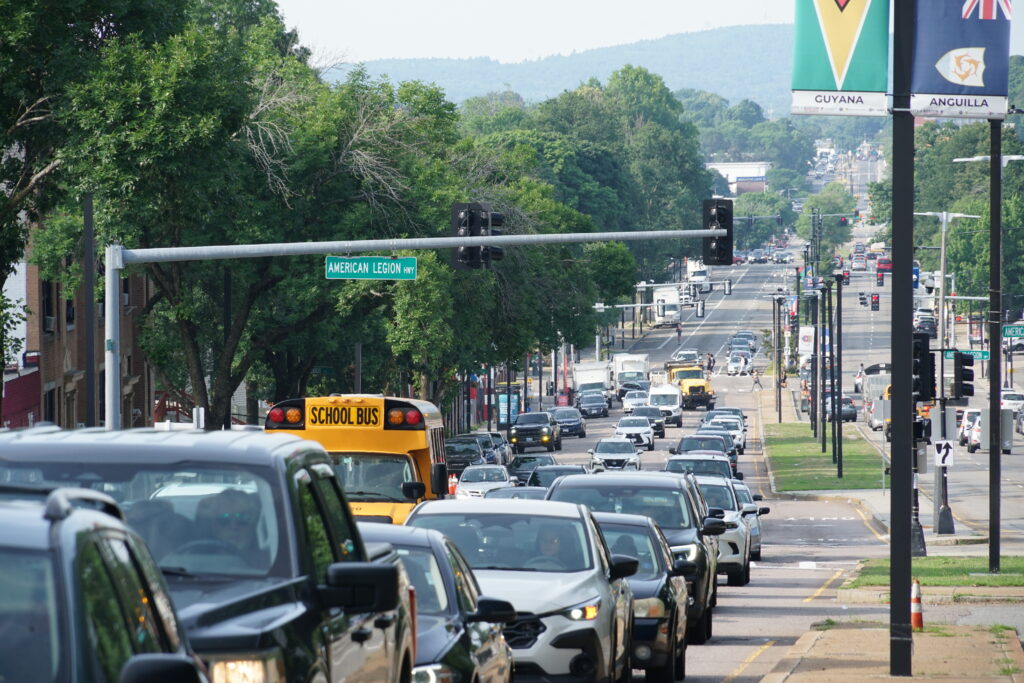
A view of Blue Hill Avenue near American Legion Highway looking south towards Mattapan Square as seen on Monday. Yawu Miller photo
Miranda points to the avenue’s intersection with Harvard Street and Talbot Avenue, where patrons of Sun Pizza and Happy Supermarket often stymie traffic.
“That is some of the worst congestion in the city because people double- and triple-park there,” she said. “I almost got hit by a semi-truck there and there was a woman pushing a carriage in the crosswalk.”
Renderings of the proposed redesign show intersections narrowed with bump-out curbs and protected bicycle lanes along with the center-running bus lanes. Transit advocates say these kinds of bus lanes are the most effective way to ensure public transit riders don’t get caught up in the congestion along the avenue.
But, critics say, the loss of curbside parking spaces would be detrimental to small businesses along the avenue. They also quarrel over the need for the bike lanes in a city where less than two percent of commuters use a bicycle to get to work, according to US Census data.
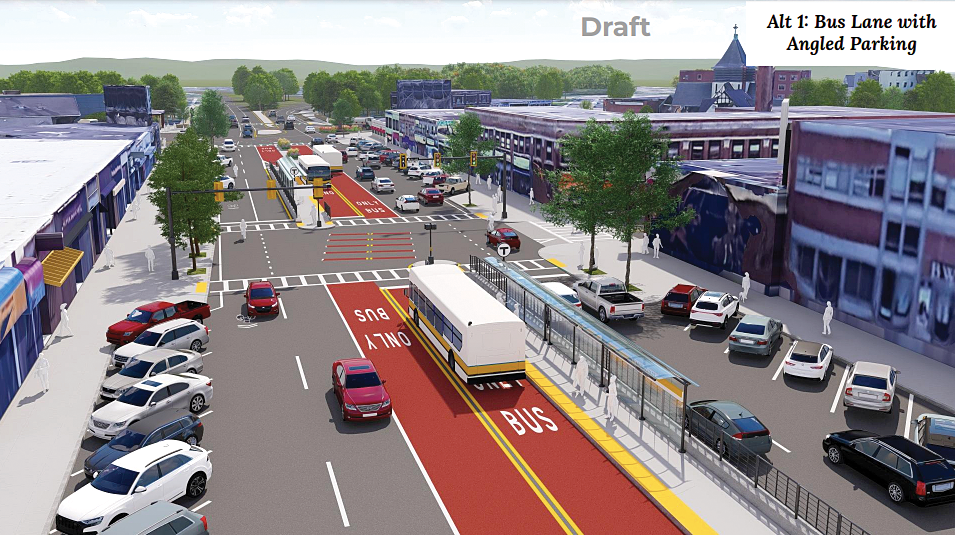
A rendering from a 2024 public meeting shows how bus lanes and angles parking might co-exist in Mattapan Square. MBTA image
Fluker-Reid said the proposed bike lanes, which would replace curbside parking along select stretches, would not only be detrimental to commercial interests but also to churches and nonprofits.
“I don’t see a world where bike lanes and businesses both exist,” she said.
She suggested the city could identify vacant lots near the thoroughfare that can be converted into public off-street parking lots. She also hopes planners can persuade local churches and non-profits to make their lots available for shoppers when they not in use for services.
For all that, she acknowledges that some change must come to Blue Hill Avenue, even if it means fewer travel lanes.
“Change is hard,” she said. “I think about when they took down the bridge over Forest Hills. As someone who drives there, I have to say, traffic actually flows.”
