

‘Buying big amounts and selling little bits’
By Gage Vieno
Reporter Fellow
For most businesses, reaching a 90th anniversary is an accomplishment. For the R.H. Lindsay Co., the event represents much more: survival amidst the rise and fall of an entire industry.
Founded in Boston in 1936, the family-owned wool merchant firm has weathered the long decline of textile manufacturing in New England, the globalization of the wool trade, economic recessions, and changing consumer habits and under the leadership of third-generation owner Phil Lindsay and his daughter Grace, reinvented itself once again, this time by supplying artisans, fiber artists and small mills across the country while remaining firmly rooted in Dorchester and the Greater Boston area.
“It’s really four different stories with each generation,” Phil said. “Starting from the heyday when the Fort Point Channel area was where all the wool was stored from around the country. Then came the slow, long decline as imports started changing the market.”
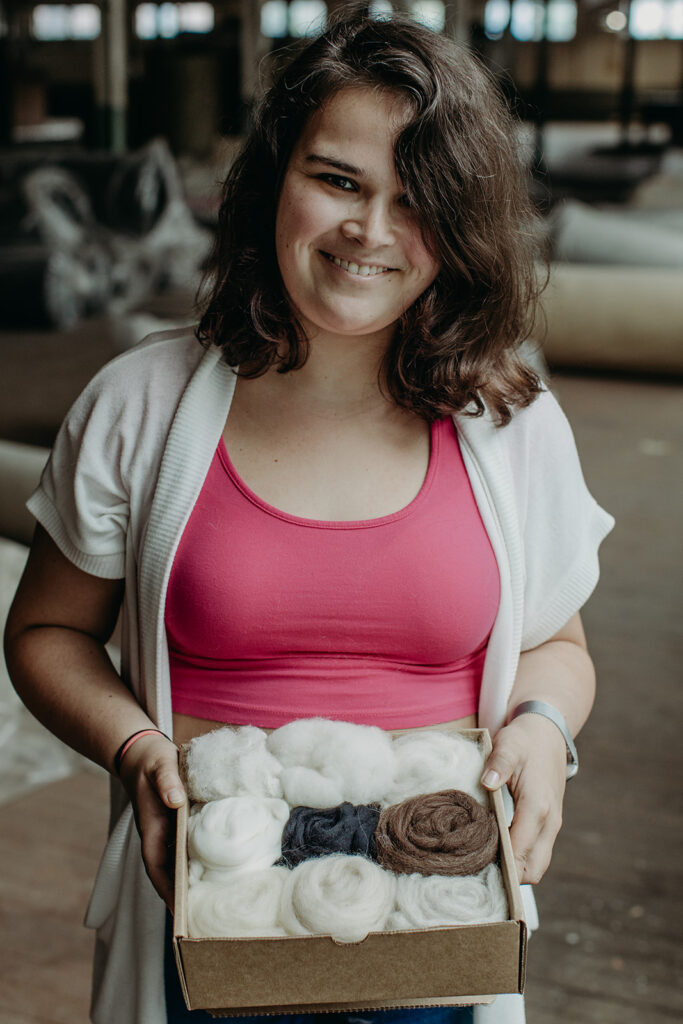
Grace Lindsay. Photo by Sasha Pedro
Instead of disappearing along with the many businesses that once filled Boston’s historic wool district, R.H. Lindsay adapted.
“We always sort of had the sideline selling to artisans and crafters,” he said. “Buying big amounts and selling little bits. That’s primarily what supports our business today.”
The company’s history stretches back to founder Ralph Haliburton Lindsay, whose determination became a family legend. After returning from Navy service following World War I, he struggled to find work before persuading a leading Boston wool brokerage to hire him (he hid in its restroom before pitching himself to an executive). He worked his way from warehouse laborer to salesman before founding R.H. Lindsay Company in 1936.
Said Phil in an interview: “During World War II, all the wool that was raised in the country was brought to [the Seaport District] to be sorted and redistributed through the mill network in New England,” said Phil Lindsay. “There were hundreds of wool businesses there.”
“My great-grandfather founded the business and sold wool by the millions of pounds,” said Grace, a fourth-generation member of the family business. “Now we sell wool by the pound.”
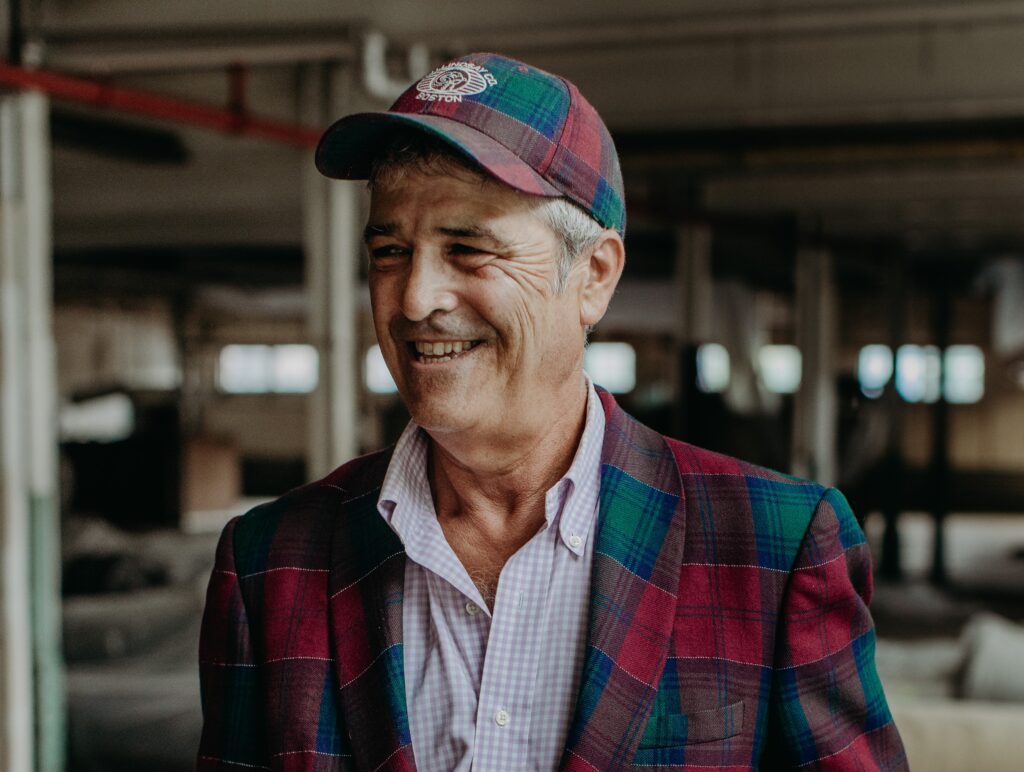
Phil Lindsay. Sasha Pedro photo
R.H. Lindsay currently has a warehouse in Canton that is open to the public for viewing twice a year, while its offices remain in Dorchester. Its origins in the Greater Boston area have remained integral to the business.
Rather than relying on a handful of major textile manufacturers to take its wool, the company now services hundreds of independent customers, many of them family-owned businesses, fiber artists and small wool-processing mills.
“The larger businesses in the United States don’t really exist anymore,” Grace said. “Now we’ve got hundreds of little people doing their thing.”
That shift has helped fuel what both Lindsays describe as a growing resurgence of interest in natural fibers and handmade products.
Grace’s path into the family business wasn’t a straightforward one. After earning an engineering degree, she built a career at the Massachusetts Institute of Technology, working in finance and technology licensing. But after years of helping other companies commercialize innovations, she found herself wanting something different.
“I got a little tired of helping others work for their own glory,” she said. “I caught the entrepreneurial bug.”
At the same time, her father was gradually introducing her to the family business. Already interested in embroidery, cross-stitch and other fiber arts, Grace found herself increasingly drawn to the wool community.
“A lot of our customers are women-owned businesses,” she said. “A lot are just one-person or family businesses. It was really refreshing after working with biotech and tech companies to be in an industry where people are making things with their hands and making a living doing it.”
When she officially joined R.H. Lindsay in 2019, her father said he never expected that outcome, but it was certainly a welcome one. “I just thought she’d be crazy to go into the wool business,” he said jokingly.
Now he credits Grace with helping shape the company’s future. “Without her, I don’t know what I’d be doing,” he said. “We certainly wouldn’t be filling this space with as much wool as we have. Grace is definitely the inspiration.”
The woolen items that customers are seeking today are often far different from those of decades past. Dryer balls, hand-spinning fibers, and recycled products are some of the company’s fastest-growing offerings as more consumers embrace knitting, crochet and other fiber arts.
As R.H. Lindsay enters its tenth decade, the Lindsays see opportunity in serving a growing community of makers rather than chasing the massive textile contracts that once defined the industry.
“We have an open house twice a year, and everyone walks in the door just so excited to see so much wool in one place,” Grace said. “Knowing how happy people are who use our products to make things with their hands—to make art and spread joy and creativity—that’s what makes me feel proud of it.”
