

By Chaplain Clementina M. Chéry
Special to The Reporter
A great deal has been happening in our city. We are confronting ongoing violence and homicides, unsolved cases, wrongful convictions, exonerations, appeals, and parole hearings. Yet, in many of these public conversations, the families of homicide victims remain missing.
That is why survivors of homicide victims must vote in the election for Suffolk County’s next district attorney. Survivors should become informed, examine each candidate’s record, ask necessary questions, and vote according to their experiences, values, and hopes for justice.
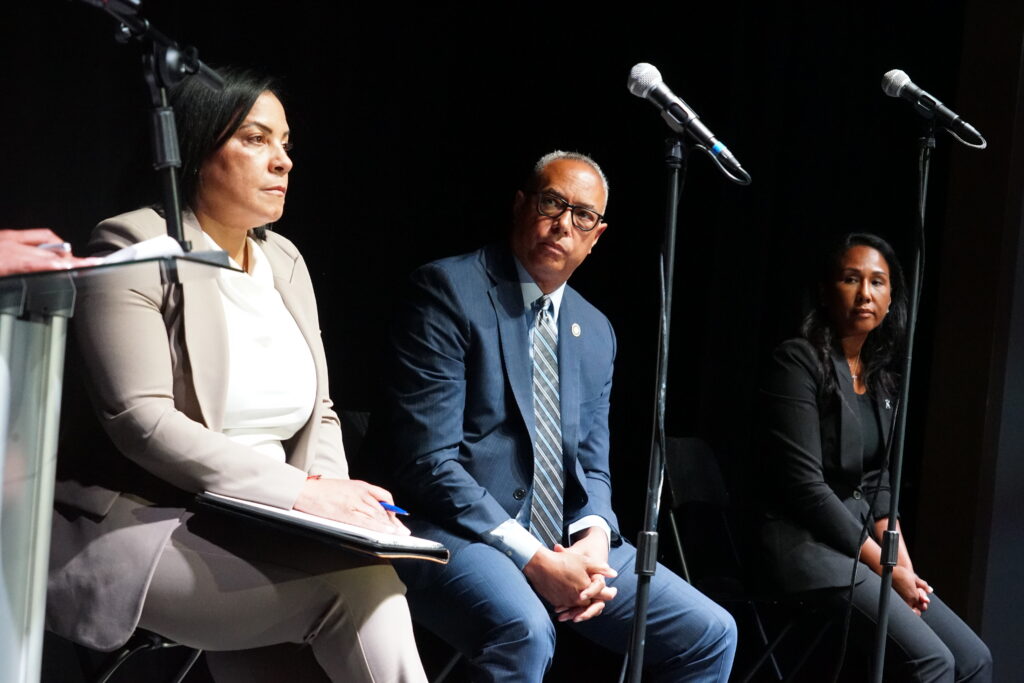
The candidates for Suffolk County DA are shown at a Roxbury forum this month: (from left) Rachael Rollins, DA Kevin Hayden, and Linda Champion. Yawu Miller photo
More importantly, I urge every survivor: Vote in the name of your loved one who was murdered. Vote in honor of the life they lived, not only because of the way they died.
The district attorney’s office determines how survivors are notified and supported, how evidence is evaluated, how unsolved cases are addressed, and the response when a conviction is questioned. The DA also makes decisions involving plea agreements, appeals, exonerations, and parole hearings. These decisions can affect families for decades.
Justice should never require us to choose between supporting survivors, protecting innocent people, and holding those responsible for harm accountable. These are complementary responsibilities, not competing values.
I know this personally. My son, Louis D. Brown, was killed at only 15 years old when he was caught in the crossfire of a shootout on Dec. 20, 1993. More than 30 years later, serious questions have since been raised about whether the man convicted was responsible for the bullet that killed Louis.
When a conviction is overturned or found to be unreliable, the victim’s family does not stop being a victim. The homicide becomes unsolved again.
Correcting a wrongful conviction is necessary. But families must not be abandoned as that correction occurs. They deserve to know whether the homicide will be reinvestigated, what went wrong, and who will remain beside them as they begin the painful search for truth again.
For more than 30 years, the Louis D. Brown Peace Institute has worked with the Suffolk County District Attorney’s Office across different administrations. Our commitment has never been to a political party, candidate, or individual officeholder. Our commitment is to families, healing, truth, accountability, and justice.
Through our partnership with Professor Andrew Haile and students from Northeastern University School of Law, survivors have helped produce five important bodies of research with clear recommendations.
• “Who Killed Louis Brown?” calls for truth, transparency, investigative accountability, and the continued pursuit of those responsible when a conviction is seriously questioned.
• “One Size Does Not Fit All” calls for individualized, culturally responsive, and trauma informed support that recognizes that every family and every homicide is different.
• “A Scheme for All” recommends a victims’ compensation process that is more accessible, equitable, responsive, and transparent.
• “Unsolved but Not Forgotten” calls for consistent communication with families, public information about unsolved cases and clearance rates, investigative accountability, and continued engagement over time.
• “When Justice Fails Twice” examines wrongful convictions through the experiences of homicide victims’ families and calls for honest communication, continued family support, careful reinvestigation, and a commitment to finding the truth.
Together, these reports remind us that a conviction is not the only measure of justice. Justice must also include how families are notified, prepared, treated, informed, and supported before, during, and long after a case moves through court.
Before voting, survivors and other Suffolk County residents should ask every candidate these questions to learn how each candidate intends to protect survivors’ rights, respond to families’ needs, and put their promises into practice.
Survivors must not be treated merely as witnesses, case numbers, or sources of testimony. We are constituents and voters who carry knowledge gained through experiences we never asked to have.
We can participate in this election without blaming or shaming. We can respect the constitutional rights of every person while insisting that the rights, dignity, and humanity of surviving families remain central.
Vote for the answers your family is still waiting to receive. Vote for truth, accountability, compassion, and a justice system that does not forget families after the headlines fade or a case is closed. Vote in the name of your loved one who was murdered. Their life mattered. Your voice matters. Your vote matters.
Chaplain Clementina Chéry of Dorchester is the president and chief executive officer of the Louis D. Brown Peace Institute.
Copyright © 2026 Boston Neighborhood News, Inc. This content may not be re-published or re-used without written permission.
