
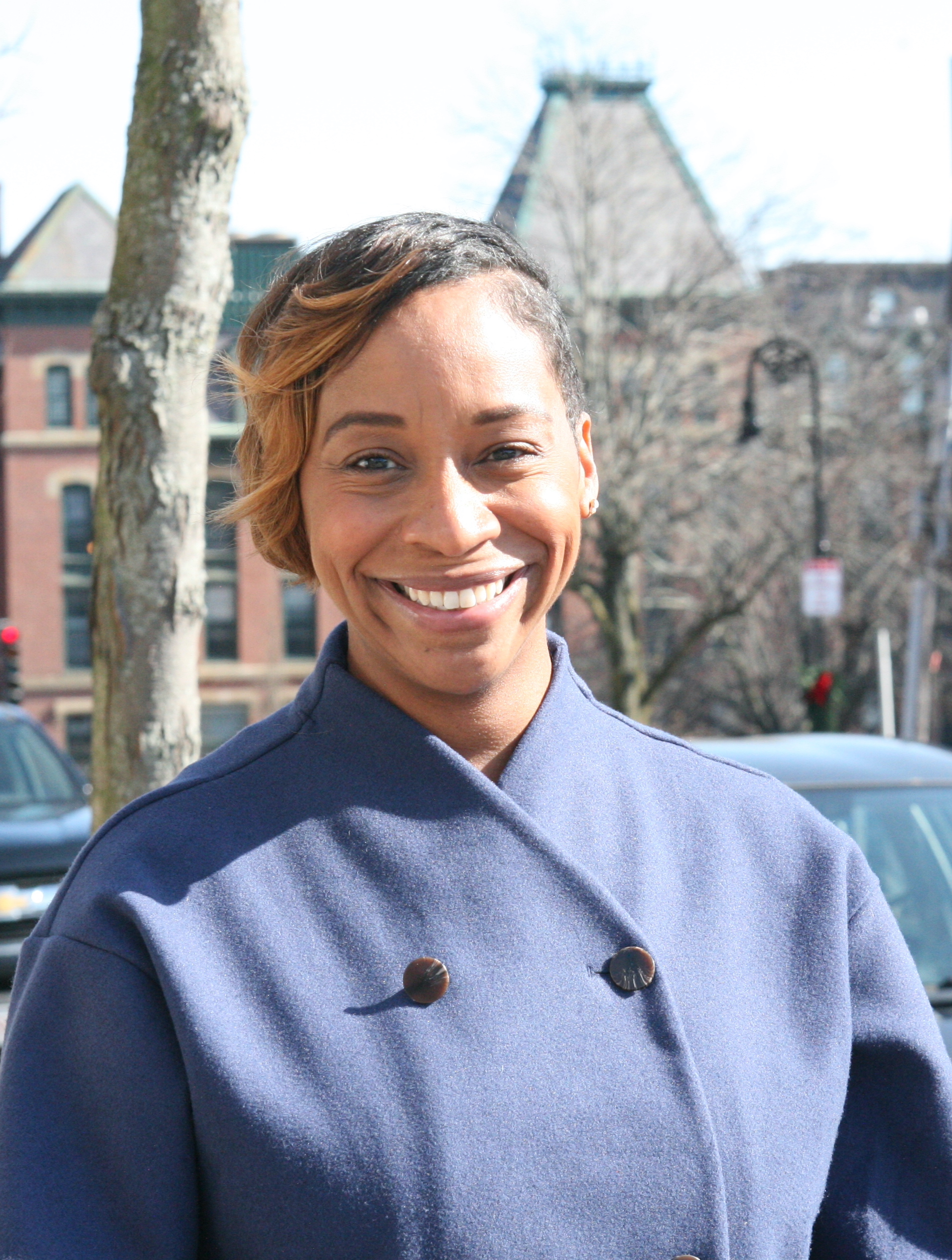
Photo: Brianna Suckey was the Queen of the Bands and led the Kids Carnival Parade in Dorchester on Saturday, Aug. 22 while making sure everyone knew her Jamaican heritage. Seth Daniel photo
Copyright © 2026 Boston Neighborhood News, Inc. This content may not be re-published or re-used without written permission.
A new study published last week shows that the number of Massachusetts residents with Caribbean heritage is close to 800,000, or 11 percent of the state’s population. The number includes people who were born in the Caribbean along with those born here with roots in the islands.
While there is a strong presence in Lawrence and Springfield, the majority of the populations from the 13 Caribbean countries studied lived in Boston – specifically Dorchester, Roxbury, Hyde Park, and Mattapan.
“Among the groups, we noted Dominican [Republic], Haitian and Jamaican communities have the largest population representation in the data with concentrations in Essex County, Suffolk County and Plymouth County…For the Dominican [Republic] community, the data analysis shows around 131,000 people with the largest concentration in Essex County (Lawrence) and the City of Boston,” said UMass student researcher Jeffrin Johnson during meeting to announce the news on Aug. 26.
The study, known as the Massachusetts Caribbean American Data Project, is a partnership between the University of Massachusetts Amherst’s data analytics team, led by Professor Nauman Tazeem, and the Boston-based Authentic Caribbean Foundation (ACF).
“This data gets us a seat at the table,” said Andrew Sharpe, the chairman of ACF who hails from Jamaica. “Since we started ACF 14 years ago we have seen a vast improvement in the Caribbean community. We have more visibility, including a representative in Boston’s Office of Cultural Affairs and we have a lieutenant governor elected that is of Caribbean heritage and several city councillors. We have been really working this effort and working collaboratively with organizations and institutions so we’re not left out or overlooked.”
He added, “You hear it all the time that Massachusetts has one of the largest Caribbean communities but to really see the data and watch the data, the result is out there for all to see. We’re really pleased with this project for that reason.”
The initiative emerged after the 2020 federal census, where ACF was asked to help organize the community to fill out census forms. One key piece was a question where respondents could write in their heritage in addition to their race. Many Caribbean residents in the past might have filled out the ‘Black’ category without the ability to write in their heritage, such as Grenada or Jamaica, for example.
The new question allowed organizers and data analysts to be able to more accurately drill down on the Caribbean population in Massachusetts to include the Dominican Republic, Haiti, Puerto Rico, Jamaica, Antigua/Barbuda, St. Lucia, Grenada, Barbados, Cuba, Trinidad & Tobago, Belize, Bahamas, St. Vincent and the Grenadines, and Other (including St. Kitts & Nevis, and Guyana).
The project looked at population counts from the Census Bureau’s 2023 estimates, student clubs, community organizations, business data, and restaurants – often doing a hard scrub of the internet to pull up data linked to Caribbean businesses or organizations.
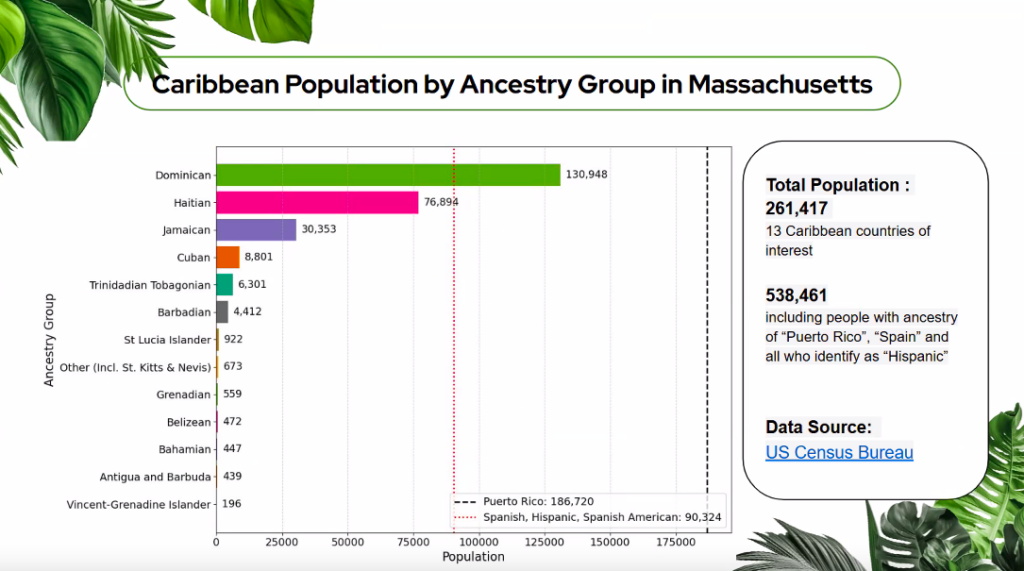
Overall, while numbers are still a work in progress, the total statewide population of Caribbean folks landed at 799,878. There were 261,417 in that number who were clearly from the 13 Caribbean countries of interest, and 538,461 that listed ‘Puerto Rico’ or ‘Spanish’ or ‘Hispanic.’
The largest population group were Dominicans, not to be confused with those from the Commonwealth island of Dominica, with 130,948 people, the vast majority coming out of the Lawrence area. Some 26,703 resided in the City of Boston.
Haitians were the second largest group with 76,894 residents, and the largest concentration (19,361) in Boston.
Other groups were listed as follows:
•Jamaicans, 30,353 (10,773 in Boston).
•Barbadians, 4,412 (1,920 in Boston).
•St. Lucians, 922 (628 in Boston).
•Grenadians, 559 (179 in Boston).
•Antiguans & Barbudans, 439 (256 in Boston).
For the Haitian community, the data showed they were the group with the most businesses, though the base is still in its infancy and the numbers of Dominican-owned businesses appeared to many to be significantly undercounted.
“Haitian businesses have the largest representation at 45 percent of all Caribbean businesses, followed by Puerto Rico at 22 percent,” said student researcher Ajay Sharma.
Of the Caribbean businesses identified, 140 were in Boston and 68 of those were in Dorchester or Mattapan.
Haitian communities also boasted the most community organizations— 12 in total— including Haitian Americans United and Association of Haitian Women in Boston.
That said, there was a strong current of community organizations in the Boston area such as the Caribbean American Carnival Association of Boston (CACAB) representing many nations together.
“Haitians may have the strongest representation…but the overall organizational landscape is not limited to one community and nationality,” said student researcher Shwetha Ranprabhu. “Many represented the Caribbean community more broadly.”
A key constituency in attendance at the Aug. 26 meeting were members of the diplomatic corps from the Caribbean. In attendance were Grenadian Ambassador Tarlie Francis, Haitian Consulate in Boston’s Regine Etienne, and St. Vincent and the Grenadines Ambassador Lou-Anne Gilchrist, among others.
“For our government, we are putting great focus on our diaspora,” said Gilchrist. “We have already been trying to get numbers for our diaspora and this is very helpful. It is very important to us because we need to know where St. Vincentians are and connect with them to build community and stay in touch.”
Sharpe noted that the history of Caribbean people in Massachusetts goes back to the 1600s when research documents show that Captain William Pierce of the Massachusetts ship “Desire” returned to Boston from the West Indies “carrying cotton, and tobacco, and slaves.”
“Don’t care what ‘em say, we aren’t going nowhere, and we came here and contributed to the building of this nation,” Sharpe said. “We are ‘One Caribbean,’ and we should look at ourselves like that because together we are stronger.”
Copyright © 2026 Boston Neighborhood News, Inc. This content may not be re-published or re-used without written permission.
