
Copyright © 2026 Boston Neighborhood News, Inc. This content may not be re-published or re-used without written permission.
UMass Boston Chancellor Marcelo Suárez-Orozco will step down on Feb. 1 after seven years leading the Dorchester campus, telling The Reporter in an interview on Monday that the university is on stable footing and that the time is right to “turn it over to the next generation.”
Suárez-Orozco, who turns 70 this month, informed the UMass Board of Trustees about his plans this morning during a meeting in Boston.
He will remain at UMass Boston after a sabbatical, returning to the faculty and concentrating on research, writing, and teaching focused principally on climate resilience and the ethical use of artificial intelligence.
“It’s been the honor of a lifetime,” Suárez-Orozco told The Reporter. “I came to our country over 50 years ago, like many of our students, with nothing — no English, $50. Both my parents were teachers. That’s all they could give me to send me to safety here, escaping the generals.”

Suárez-Orozco fled his native Argentina as a teenager during the military dictatorship and eventually earned bachelor’s, master’s, and doctoral degrees at the University of California, Berkeley. He was serving as a dean at UCLA when UMass President Marty Meehan recruited him for the UMass Boston role.
In a statement announcing the news, UMass President Marty Meehan praised Suárez-Orozco’s tenure, saying a chancellorship that “began during the dark days of the Covid pandemic will conclude with UMass Boston’s Beacon shining brighter than ever.”
He added: “As much as we would like to retain Marcelo’s leadership, we understand and applaud his desire to devote his full attention to these critical global issues.”
Suárez-Orozco said his age and what he sees as the improved condition of the university prompted the timing.
“I’m turning 70, and that focuses you,” he said. “My father died quite young, and every day, to me, is a miracle.”
And, he said, “the campus is stabilized in ways that we haven’t been for a long, long, long time.”
When he arrived, Suárez-Orozco said, much of the university leadership consisted of interim appointments. “Now everybody, everyone, is in a permanent position. World class,” he noted.
“So, this is the right time. Things are stable.”
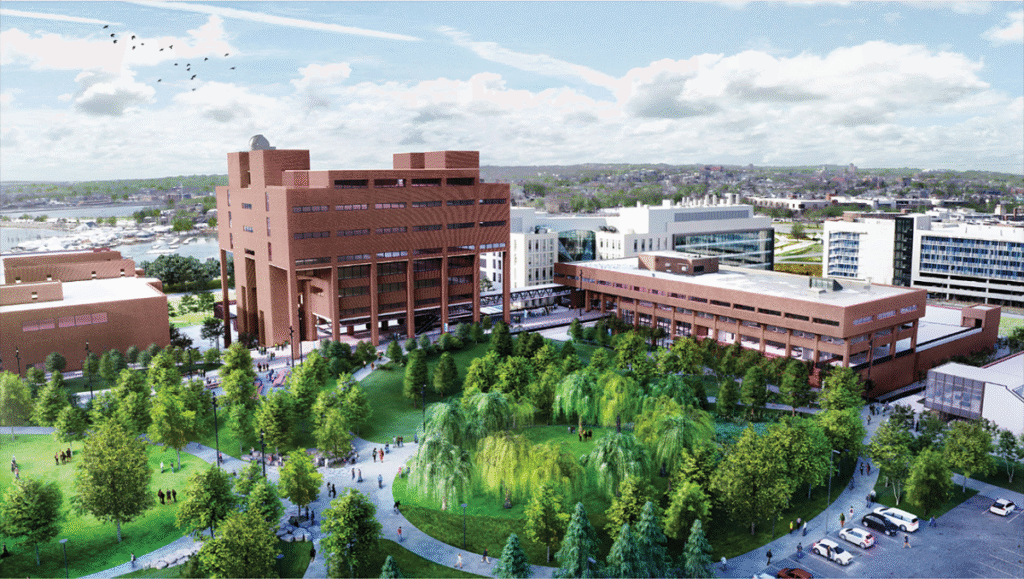
His tenure, which began just as the 2020 shutdowns started, has seen a period of major physical and institutional transformation at the Columbia Point campus. The university says that $293 million in capital investments were made during his tenure, including the completion of the green quadrangle at the heart of the campus, renovations to the Clark Athletic Center and softball stadium, and work on long-deferred maintenance.
UMass Boston achieved Carnegie R1 status in 2025, placing the school in the top tier of American research universities.
“The most beautiful of all to me personally is Carnegie reclassified us as an R1,” he said. “That’s Harvard. That’s UCLA. That’s the great research universities. And number one in the country in terms of open access to top research.”
UMass Boston also assembled a record $87.6 million in new research funding in fiscal 2025 and has raised more than $180 million toward a $250 million fundraising campaign, according to Meehan’s office.
One of Suárez-Orozco’s signature initiatives, the Beacon Pledge, covers tuition and mandatory fees for eligible in-state students. He said the program flowed directly from UMass Boston’s historic mission of serving students whom more selective institutions often were not designed to reach.
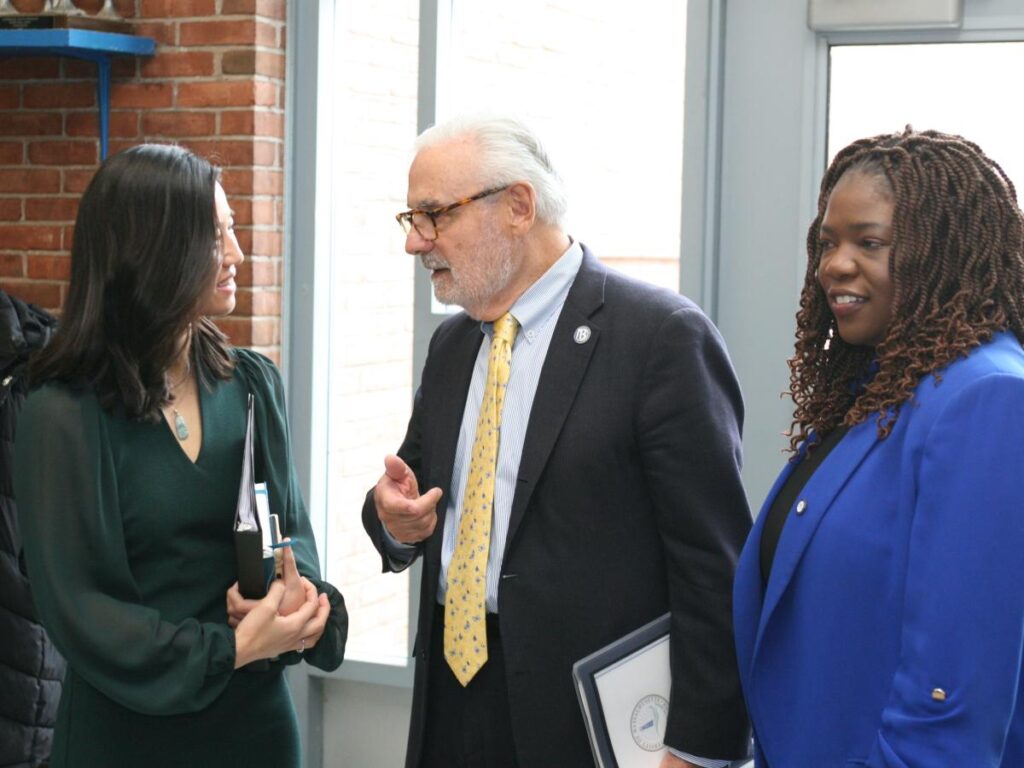
The chancellor, center, with Mayor Wu and Councillor Ruthzee Louijeune, right, at a 2024 press conference. Seth Daniel photo
“We, as a university, were imagined and engineered to serve the students — young, not-so-young, returning students, vets, all these, you name it — that the other universities, I know them well, I taught at many of them, they’re not built to serve,” he said.
For Boston in particular, he said, demographic change makes that mission increasingly important.
“Our city is a city where the only sector, demographically speaking, growing is our kids growing up in immigrant-origin families: Caribbean, Asian, Latina, African,” he said. “Those are our students. Those are the students we serve.”
Through the Beacon Pledge, he said, UMass Boston was able to “sign a compact with our families” promising a high-quality education without unaffordable tuition.
“If you make below a certain amount, we cover the tuition and the fees,” he said. “I’m very proud of that.”
The initiative helped UMass Boston welcome its largest in-state first-year class in fall 2025 — 1,994 students — including, Suárez-Orozco said, “the largest numbers of BPS kids ever.”
In a statement reacting to the news of his plans, Mayor Michelle Wu called him an “extraordinary leader for UMass Boston and our City.”
“His work has expanded opportunity for students, brought closer UMass Boston’s connection to our communities and helped link Boston’s climate-resilience efforts to conversations happening around the world. I was honored to join him at the Vatican Climate Summit, where we shared Boston’s climate progress, learned from leaders across the world, and brought back ideas to help advance our work here at home. His leadership has made a lasting difference in our City and I know he will continue to make an impact in his work at UMass and beyond. On behalf of the City of Boston, I wish Chancellor Suárez-Orozco the best in his next chapter.”
Suárez-Orozco says that he is not retiring from public life or leaving Boston. He plans to devote more time to climate resilience — including the threats facing the waterfront surrounding the UMass Boston campus.
“Dorchester Bay is very fragile. Boston [Harbor] is very fragile. The Charles River basin is very fragile,” he said. “And we need to show — we need to step up. We need to protect this iconic city. If we can’t do it in Boston, it cannot be done.”
He also plans to continue his study on the ethical use of artificial intelligence. Suárez-Orozco said that UMass Boston sought early on to ensure that students were not merely consumers of AI technology but understood how it worked and could participate in shaping it.
The university subsequently created an institute focused on applied AI and the technology’s implications for employment, ethics, and democracy.
“What are the ethical issues? What are the job impacts? What are the impacts on the practice of democratic citizenship?” he said. “Everything changed now.”
He plans to convene a Boston summit on AI at the Dorchester campus before leaving his post, he told The Reporter on Monday.
Decisions about choosing his successor will be handled primarily through Meehan’s office, but Suárez-Orozco stressed that he will remain fully engaged as chancellor through Feb. 1.
He predicted the position would draw considerable interest.
“Look, the campus is in great shape,” he said. “Boston is an iconic city. Our campus is a beautiful campus. This is a noble mission. This will attract a lot of folk.”
He said that his interactions with the students what he treasures most about his time as chancellor.
“It reminds you of the great power and extraordinary beauty of public higher education in our country,” he said. “There’s a place for you. There’s a place where you’re going to be respected. You’re going to be challenged. You’re going to be pushed to stretch. Where you will thrive and where you belong.”
And Suárez-Orozco sought to dispel one rumor about his departure. “There’s a lot of gossip that I’m going back to L.A.,” he said. “I’m not going back to L.A.”
His granddaughter, he added, lives here — and has already acquired a Boston accent, thanks to time spent at the Boys and Girls Clubs of Dorchester.
“You can’t go to L.A. with that accent,” he joked.
Copyright © 2026 Boston Neighborhood News, Inc. This content may not be re-published or re-used without written permission.
