
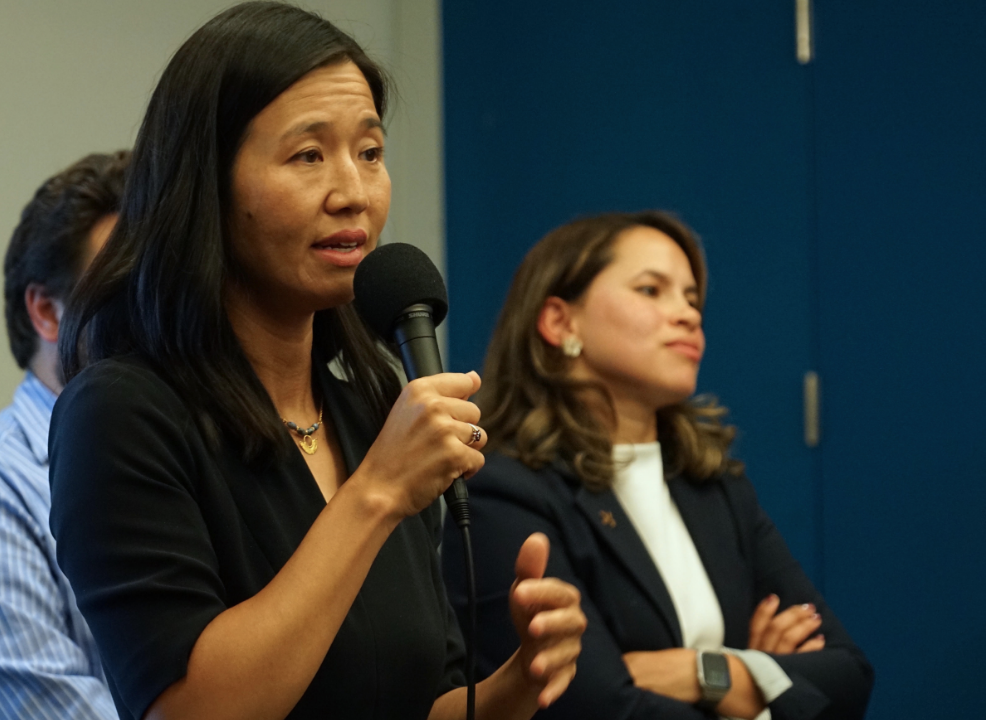
Above: Mayor Michelle Wu and Boston Parks and Recreation Director Diana Fernandez Bibeau take questions from audience members at a meeting on White Stadium held at the Bruce Bolling Municipal Building in Nubian Square. Yawu Miller photo
Copyright © 2026 Boston Neighborhood News, Inc. This content may not be re-published or re-used without written permission.
Mayor Michelle Wu and other city officials discussed their latest approach to managing traffic and parking in and around Franklin Park and White Stadium at a public meeting in Roxbury on Tuesday evening.
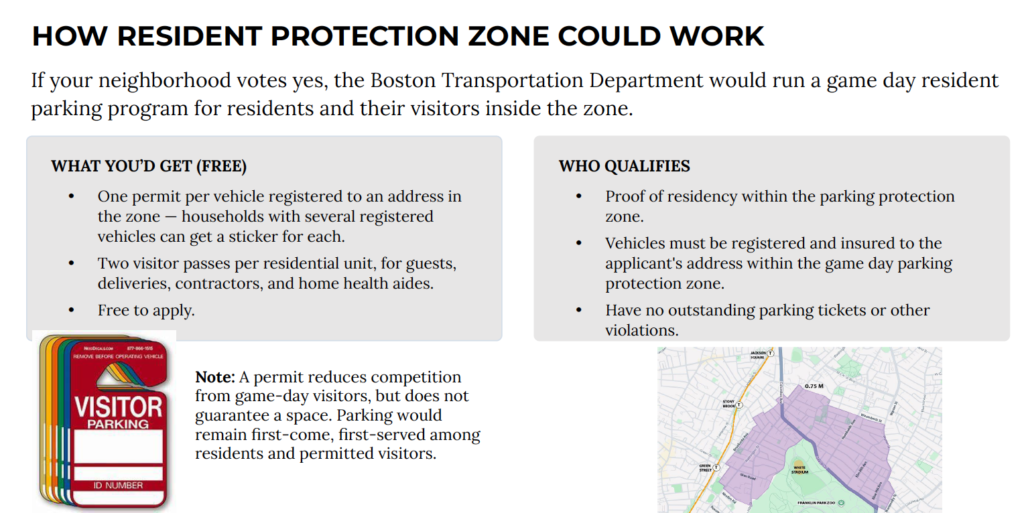
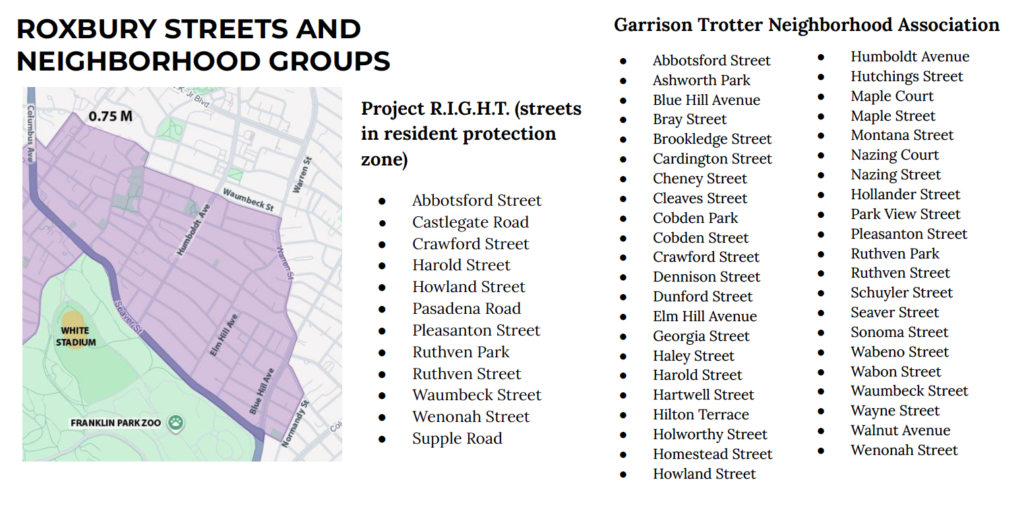
The city’s current proposal includes a no-parking zone that would cover .75 mile radius around the stadium.
While homeowners whose non-commercial cars registered to their address would qualify for a parking permit, cars lacking such a permit or a visitor’s pass would be subject to a $100 ticket and a $130 tow. The parking ban would remain in effect for two hours before a game start time and remain in effect during two or more hours of game play and for two hours after.
On Tuesday, Wu said residents will be able to opt-in or out of a game day parking bans within a certain radius of the stadium.
“Your voice will drive decision-making on this front,” Wu said. “It’ll be a street-by-street decision through the neighborhood associations.”
During the meeting at the Bolling Building in Nubian Square, officials showed elements of their latest draft transportation plan. They estimate 6,600 spectators will use shuttle buses from remote parking sites and MBTA stations, 3,300 spectators will walk or bike to the stadium and 1,100 people will utilize ride shares. But the plan provides few concrete details on the impacts on local traffic.
“I don’t care what kind of plan they put together, there’s not enough space,” District 7 City Councillor Miniard Culpepper told the Reporter. “We don’t have enough space around Franklin Park to accommodate what people are proposing.”
Culpepper, who is pastor at the Pleasant Hill Baptist Church and is supportive of the overall stadium project, says the no-parking zone would place an unfair burden on neighborhood residents, businesses and institutions.
Under the current plan, a 4 p.m. start time for a pro soccer game would mean parking would be restricted between 2 p.m. and 8 p.m. On a Saturday during the summer, such a ban could restrict regular activities such as church festivals and impact other local institutions such as the National Center for Afro American Artists.
“How are you going to force people to get a permit and then tell them they can’t have people over for a cookout?” he said. “You can’t restrict people from moving around in their own neighborhood so other people can come in. That’s racist. We live here. We pay taxes here.”
Concerns about parking and traffic have now become the focal point for some neighbors who were part of an unsuccessful legal challenge to the stadium plan.
Known and the Franklin Park Defenders, many of them joined a lawsuit led by the Emerald Necklace Conservancy that sought to block the reconstruction of the stadium. The state’s Supreme Judicial Court ruled in favor of the city of Boston and Boston Legacy FC ownership last month.
Louis Elisa, one of the most outspoken members of the Defenders group, also serves as president of the Garrison Trotter Neighborhood Association.
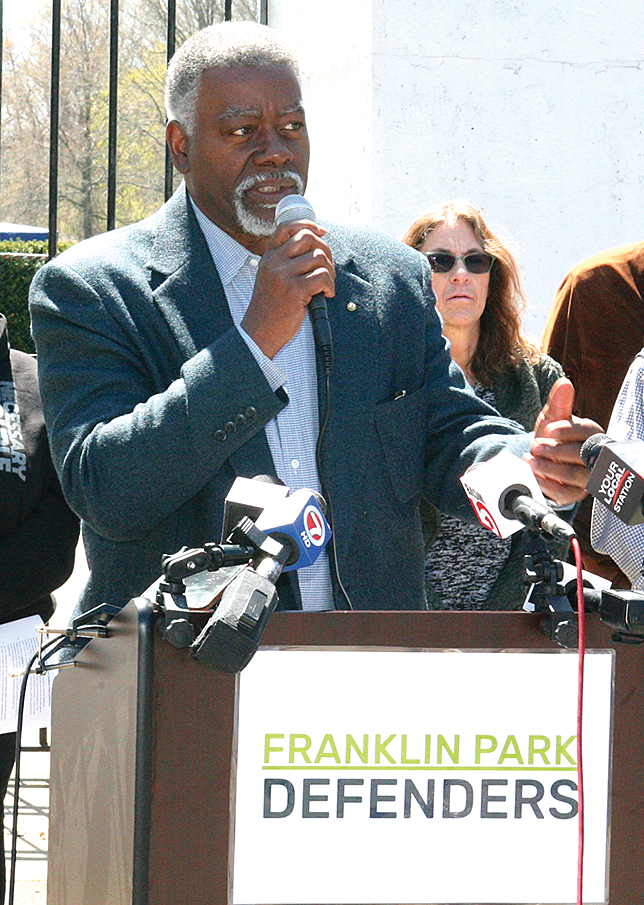
Elisa (above) contends that the mayor is forcing abutters to choose between restrictions that will limit the activities of churches, local businesses and institutions in the neighborhood and soccer fan parking that would have the same effect.
“There’s not real choice,” he said. “She’s obfuscating so people don’t know how seriously our rights are being curtailed. It’s like asking do you want to be shot or stabbed.”
Under the current proposal, parking inside Franklin Park would also be restricted during the same hours as in the surrounding neighborhoods. While zoo patrons and people using the golf course would have their parking lots protected, casual users of the park would have to request a two-hour parking pass through the city’s Park Boston app, Wu said.
The National Women’s Soccer League games — up to 20 per year — could take place any day of the week, with weekend games limited to no more than two per month. During the months when school and the pro soccer team’s schedule overlap — March, April, May, June, September, October and November — the parking restrictions and traffic generated by the games could conflict with activities at the 11 schools in and around the parking-restricted zone including pickups, parent-teacher conferences.
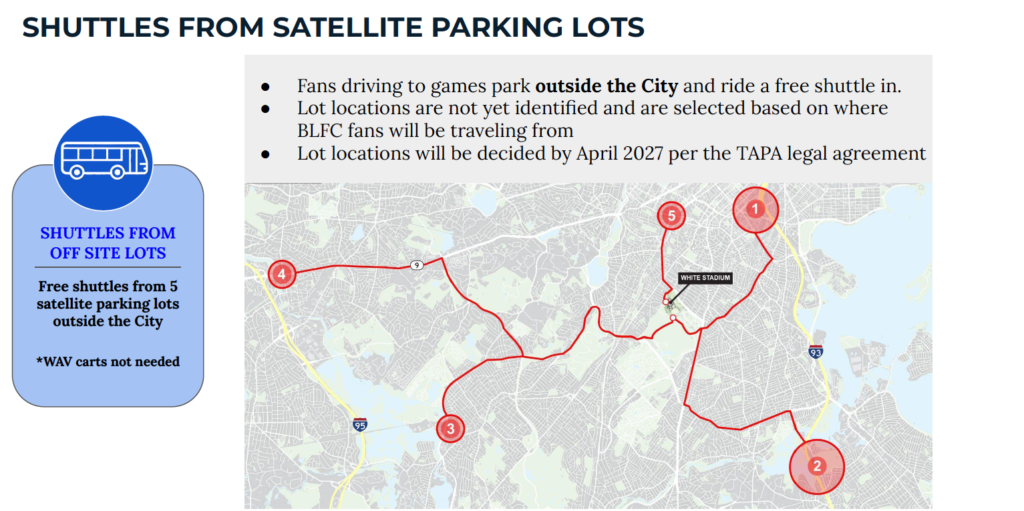
City officials are planning for 124 shuttle buses that would enter and exit the park during a two-hour period before and after the game.
Speaking at a meeting of stadium foes last Wednesday, former state Sen. Dianne Wilkerson said the shuttles would exacerbate traffic in the areas around the park.
“Everyone is getting around the same streets at the same time,” she said. “They’re likely going to back traffic up into the neighborhoods.”
The city’s plan calls for shuttles bringing the 4,400 game attendees they estimate will opt for the shuttles from five as-yet-identified remote parking lots. The plan estimates an additional 2,200 attendees will ride shuttles from the Ruggles and Forest Hills MBTA stations on the Orange Line and the JFK/UMass stop on the Red Line.
The city may be underestimating the number of shuttle trips, Elisa said. To move all 6,600 passengers with just 124 trips, each bus would have to carry approximately 53 riders. But because attendees are expected to arrive and depart from the stadium over a two-hour period, it seems unlikely each bus trip would be at capacity.
“That’s not how staging works,” Elisa said. “They’ve deliberately miscalculated to deceive people into believing there will be less of an impact on traffic.”
Community members have voiced concerns about the impact of the shuttle buses and ride share traffic on game days.
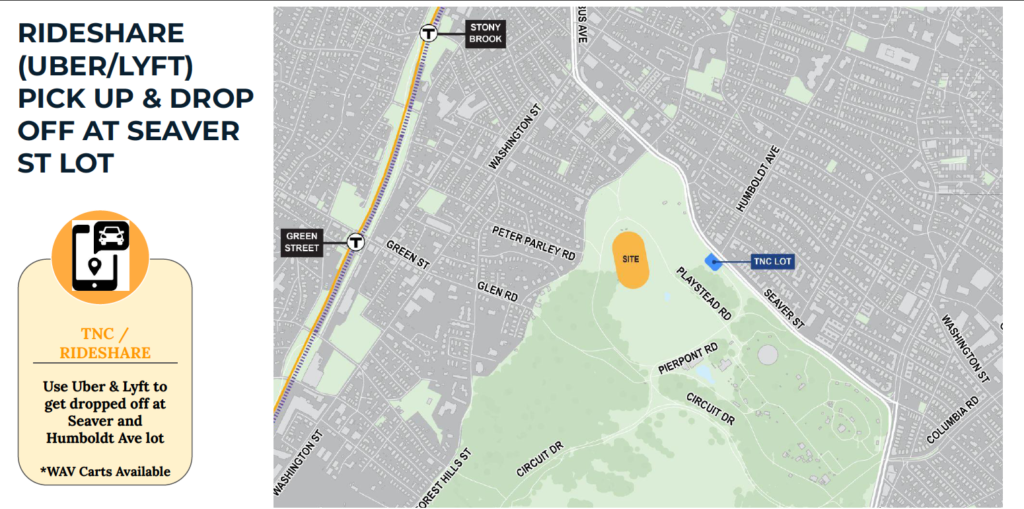
Under the city’s traffic plan, buses and ride-share cars would approach White Stadium on two-lane streets such as Walnut Avenue and Humbold Avenue, then discharge and pick up passengers in narrow parking areas within Franklin Park. Critics of the plan say the ride-share drivers — most of whom would likely drop passengers off in the hour before the game starts — would create unworkable traffic along Humboldt Avenue and Seaver Street.
“What we are seeing is that they’re not looking at the people who live in the neighborhood now,” Roxbury Neighborhood Council Chair Connie Forbes told the Reporter. “We have families, we have businesses we have churches. I can only imagine what it would be like with ride share drivers dropping off passengers.”
According to a presentation at Tuesday’s meeting, the community input process began this week with neighborhood-wide informational meetings and a public survey. For Roxbury, the survey opened Sept. 15 and is scheduled to close Oct. 24. The city will then share the results with neighborhood association leaders in late October so they can review the feedback before their November meetings.
On Dec. 8, a city-appointed White Stadium Neighborhood Advisory Committee is expected to review the neighborhood association recommendations alongside the broader survey responses. The city says the final decision on parking protections will be announced in winter 2027.
Public meetings on the topic continue this week.
The next meeting is tonight, Thurs., Sept. 17, from 6 to 7:30 p.m. at the Perkins Community Center, 155 Talbot Ave. in Dorchester. That will be followed by a Mattapan meeting on Wed., Sept. 23, from 6 to 7:30 p.m. at the Mattahunt Community Center, 100 Hebron St., and a Jamaica Plain meeting on Thurs., Sept. 24, from 6 to 7:30 p.m. at the English High School auditorium, 144 McBride St.
Copyright © 2026 Boston Neighborhood News, Inc. This content may not be re-published or re-used without written permission.
