

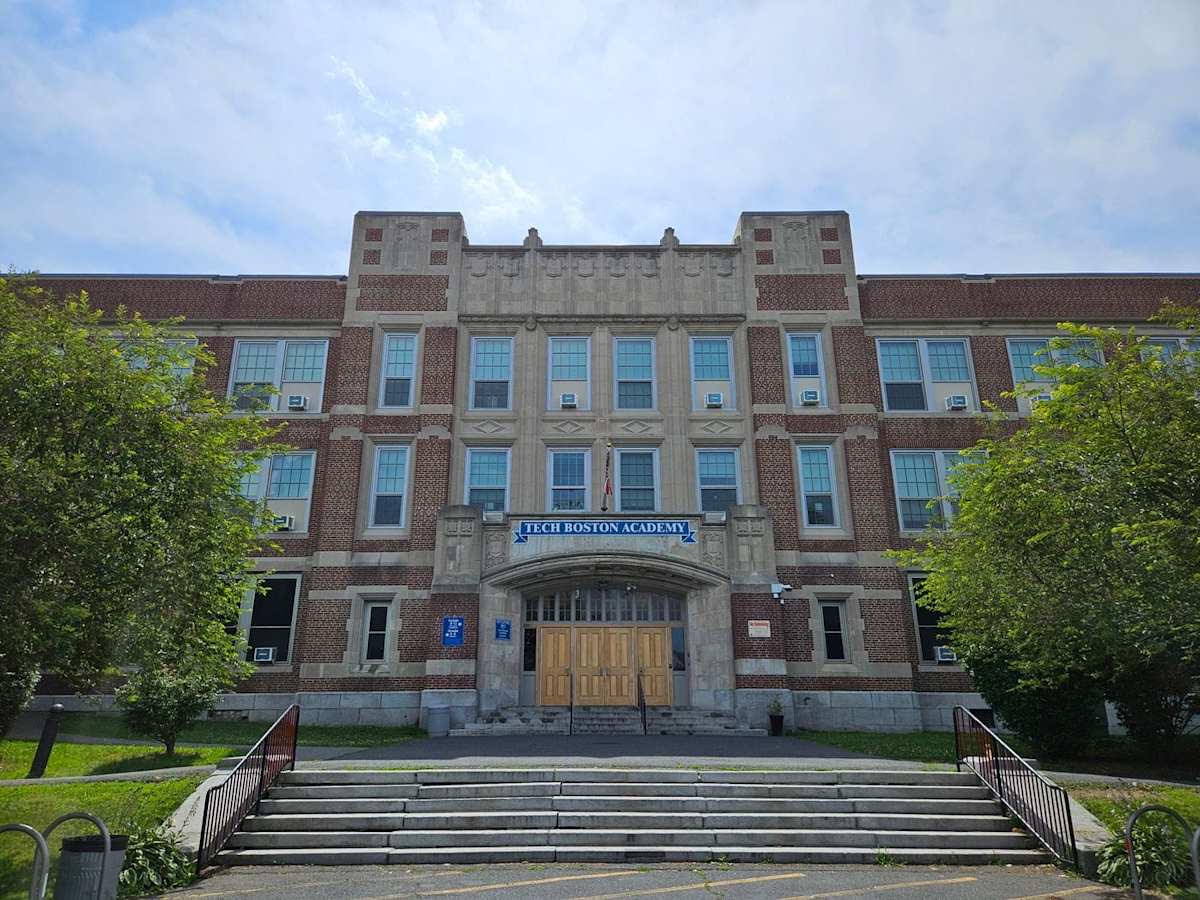
Above, Tech Boston Academy in Dorchester. BPS image
Copyright © 2026 Boston Neighborhood News, Inc. This content may not be re-published or re-used without written permission.
While much of the public discourse around the Boston Public Schools is focused on the 3,921 high school students who attend the city’s three exam schools, the Boston Municipal Research Bureau is calling attention to the challenges facing the nearly 14,554 students who attend the district’s 31 open enrollment high schools, citing MCAS scores, under-enrolled school buildings, and chronic absenteeism as key issues.
“BPS has multiple initiatives to support high-needs students and a vision to offer advanced college courses and accelerated science, technology, engineering, and mathematics (STEM) opportunities,” reads the report, which was released late last month. “Despite this, BPS does not yet ensure that all high schoolers are mastering grade-level tasks or are successfully completing a core set of coursework that prepares them for post-secondary careers.”
In a statement sent to The Reporter, BPS officials said the district has increased graduation rates and expanded opportunities for students in open enrollment high schools, including access to AP coursework and early college enrollment.
“Boston Public Schools remains focused on advancing a robust strategy for our secondary schools that ensures every student has access to high-quality instruction and supports, expanded programming through improved facilities, and a supportive learning environment,” the statement reads.
Much of the Bureau’s report compares Boston’s schools to those in what the state’s Department of Elementary and Secondary Education considers comparable districts such as Lawrence and Brockton and notes that open enrollment schools in Boston have greater numbers of high needs students than those districts and they have fewer students meeting or exceeding expectations on the MCAS exam.
But the comparison of Boston’s open enrollment schools with comparable school districts may be skewed by the existence of the exam schools in Boston.
Whereas Brockton, Lawrence, and most other school districts have just one high school, Boston’s use of exam schools warps the statistics for its open enrollment schools because the exam schools require an entrance examination and generally offer better resources and more diverse course offerings than the open enrollment schools, effectively removing the highest-scoring students from the equation.
Schools such as Cambridge Rindge and Latin or Brookline High are judged on the scores of all high school students, those who score high and those who do not. The lack of school buildings with higher-than-average concentrations of poverty, learning disabilities and other challenges masks the disparate educational outcomes in those communities.
District-wide, 33 percent Boston’s K-12 students are English language learners and 68 percent are low-income. At the city’s oldest exam school, Boston Latin School, .3 percent of students are English language learners and 33 percent are low income, according to data BPS reported to the Massachusetts Department of Elementary and Secondary Education.
“It’s like having two different school districts in the same city,” said Travis Marshall, a member of the BPS parent group Quality Education for Every Student.
The Research Bureau’s CEO & President, Steve Poftak, said he intentionally left the exam schools out of his research in order to shift attention to the open enrollment schools.
“The whole point of this paper is that three-quarters of kids don’t go to exam schools, and we need to start talking about them,” he said. “We also can’t accept the answer that the relatively poor outcomes on the MCAS are because we’re skimming off the best students. That doesn’t release us from the obligation to better educate these students.”
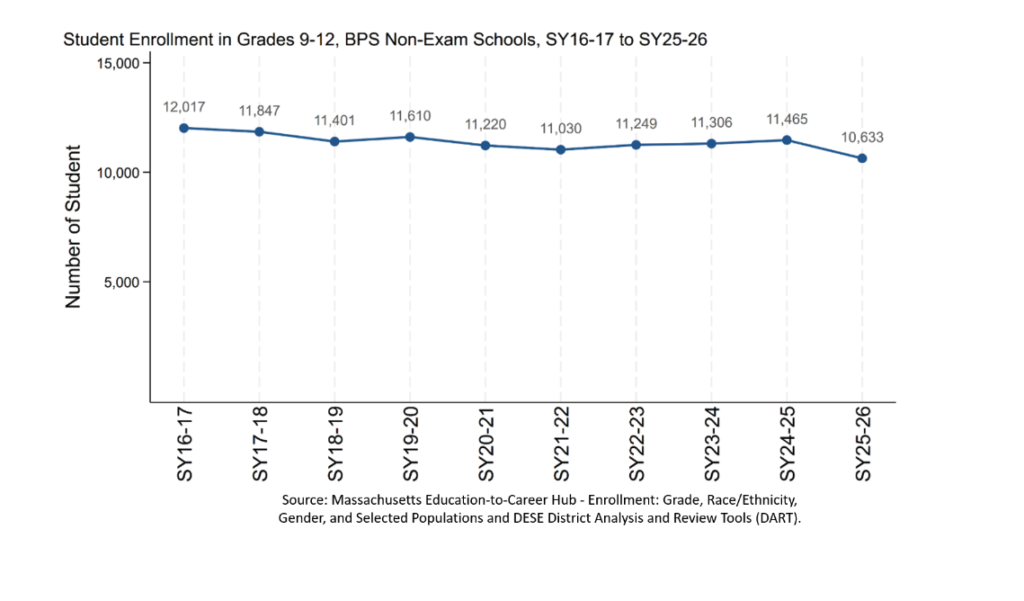
A key challenge facing open enrollment schools is a decline in the student population. As the most highly sought after schools in the district, the exam schools have seen their enrollment numbers remain steady. But the 31 open enrollment high schools have seen their number drop from 12,017 to 10,633 over the last 10 years. That drop has left 13 open enrollment school buildings at less than three-quarters of their capacity.
While BPS officials have in recent years announced school closures with little opportunity for parents and students to weigh in, Poftak said that city officials and members of the public should at least have a shared understanding of where enrollment is going in the schools.
“What we would like to see is more comprehensive, integrated planning,” he said.
The Bureau report also found that 51 percent of students at open enrollment schools had chronic absenteeism — missing 18 or more days without an excuse. Poftak noted that BPS officials gave a detailed presentation in 2023 outlining a tiered intervention approach to the problem but said the district has not revisited the issues since then.
“Do we know anything about what got done, what worked, what didn’t work” he said. “I think it would be an interesting area of inquiry for the School Committee.”
Among the report’s recommendations are that the School Committee play a more active role in monitoring the district’s progress with open enrollment schools. The report also called on the district to give the School Committee “consistent, timely, and periodic reviews of performance metrics” and suggested that “these reviews should strive to maximize the timeliness of the data and its relevance to policy making.”
Growth scores called key metric
While many view MCAS exam results as a reliable metric to measure schools and school districts, some say those test results aren’t being used correctly.
Because the state’s Department of Elementary and Secondary Education weighs the raw test scores for three-quarters of its evaluation, and weighs the growth in test scores for just a quarter, schools and school districts with higher concentrations of low-income students and English language learners are considered lower-performing than those serving more affluent families.
Alain Jehlen, who publishes the Boston Parent Schoolyard News, argues that growth scores measure the extent to which students are learning and should therefore be given more prominence than the raw scores, which are a snapshot of where a student is at in any given year.
“The percentage of low-income kids in schools accounts for most of the variation in MCAS scores,” he said. “Growth scores show how kids are doing in the schools, from start to finish.”
While students in Boston scored lower than those in wealthier districts like Lexington and Weston, they had measurably higher growth in their scores, Jehlen notes. In Boston, 68 percent of students are low income versus 10 percent in Lexington and 8 percent in Weston.
Boston’s growth scores are average for the state, despite the fact that it has higher percentages of high needs students, students with disabilities and English language learners.
Yawu Miller is a veteran Boston reporter and the co-founder and editor of The Flipside, an online news site. He is a regular contributor to The Reporter.
Copyright © 2026 Boston Neighborhood News, Inc. This content may not be re-published or re-used without written permission.
