
Copyright © 2026 Boston Neighborhood News, Inc. This content may not be re-published or re-used without written permission.
Congressman Stephen F. Lynch says the sweeping Democratic victories in this month’s midterm elections have given his party a “dual mandate” to confront corruption in the Trump administration while also delivering results on affordability, which he says should start with restoring Medicaid funding to help both blue and red states.
In a wide-ranging interview with the Reporter on Wednesday (Nov. 18), the South Boston Democrat, who was just reelected to his 13th full term representing the Eighth Congressional District, said the election results were a total repudiation of Trump’s policies and the Republican-led Congress that abetted them.
But Democrats can’t rest on their laurels, he warned.
“We’ve got two years,” Lynch said. “We have to remember, try to discern why the American people chose us, and I think it was a rejection of the Republicans, clearly, but also, the identity of those issues that they want us to focus on.”
“They don’t want the corruption. There was a clear rejection of that. So we’ve got to restore faith in government,” Lynch said. “We’ve got to hold people accountable and responsible for the corruption that has gone on, and that has been significant. But we’ve also got to make sure we focus on the issues that will gradually bring those prices down.”
The interview took place as House Democrats gathered on Capitol Hill to organize their leadership team. Lynch expressed enthusiasm for the elevation of Massachusetts Congresswoman Katherine Clark in the House leadership team under Speaker-in-waiting Hakeem Jeffries.
“Oh, huge,” Lynch said of Clark’s role, noting that the Massachusetts delegation stands to gain additional influence through senior members Richard Neal and Jim McGovern.
“They’re both well deserving and they’re very much team players, and they’re concerned about the entire delegation, making sure we’re in a good spot,” he said.
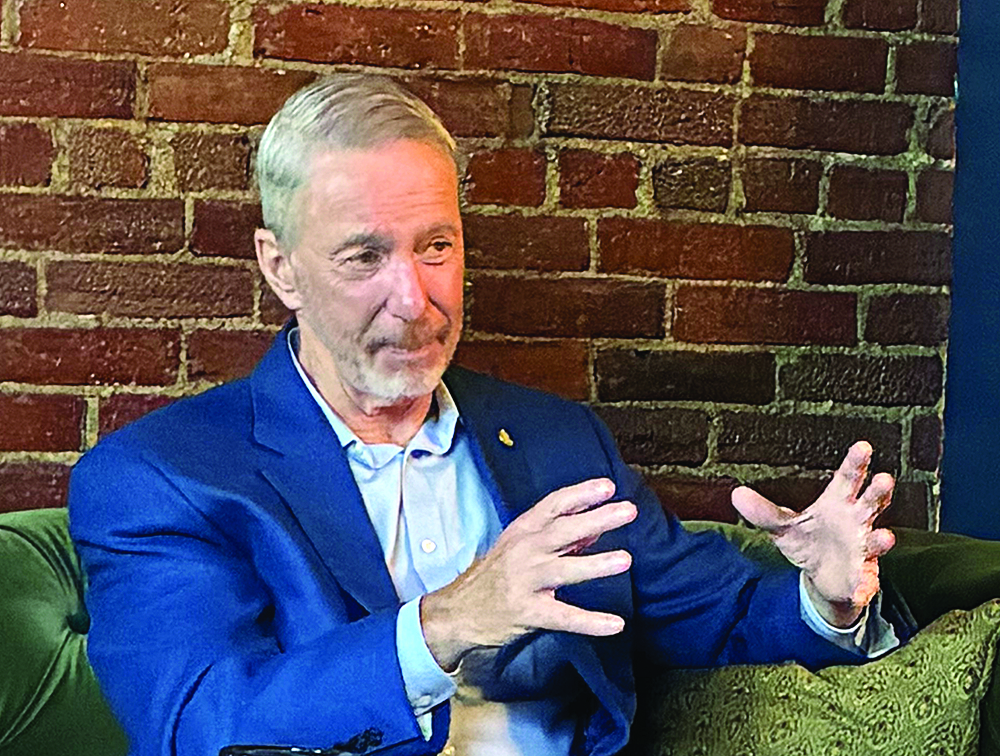
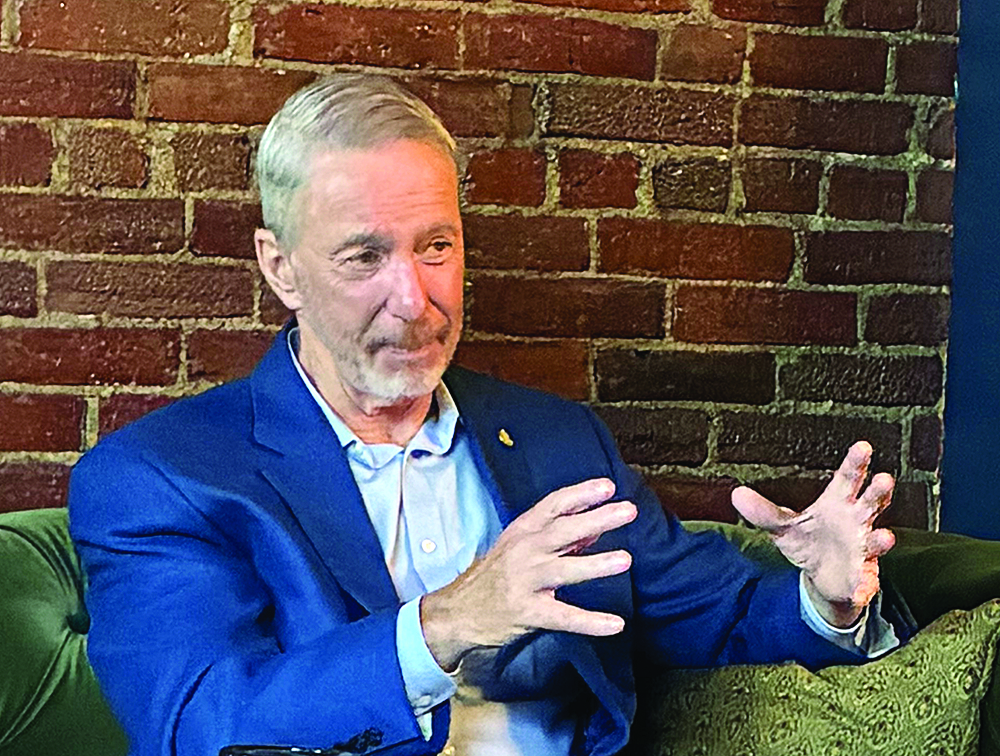
Congressman Stephen F. Lynch spoke during an interview with the Reporter in Oct. 2026. John P. Forry photo
Lynch said the delegation is already discussing how to secure representation on the House Transportation and Infrastructure Committee, citing major needs across Massachusetts, including another bridge over the Cape Cod Canal.
“We have some very keen and urgent infrastructure issues across the state,” he said. “We work as a team.”
Medicaid cuts are immediate concern
Although Democrats will not be in the majority until January 3, Lynch said there may be an opportunity to address one of his most pressing concerns — cuts to Medicaid that threaten the financial stability of hospitals and health centers — before the current Congress adjourns.
Federal funding is scheduled to expire on Dec. 11, creating the possibility of attaching health care provisions to legislation that would keep the government operating.
“I’m very worried about that because we’ve got some wobbly hospitals in our district, and I just, I’m worried about them surviving,” Lynch said.
Lynch says restoring Medicaid funding may attract more Republican lawmakers, who are confronting similar concerns about hospitals in their own states.
“Every single one of our hospitals and health centers relies on about a third — from 33 to maybe 42 percent — of their funding through Medicaid. So we’ve got to fix that,” Lynch said.
“People are worried about Mississippi and Nebraska and Kansas. They’re worried about their hospitals closing. So I think we can get consensus on that with them.”
The immediate threat to health care facilities should take precedence over some of the other legislative battles Democrats are considering before January, Lynch says.
“You try to seek the path of least resistance, and I think there’s less resistance on the Medicaid piece,” he said. “I think it’d be easier to pick up votes on that issue than trying to pick up votes on the War Powers Act.”
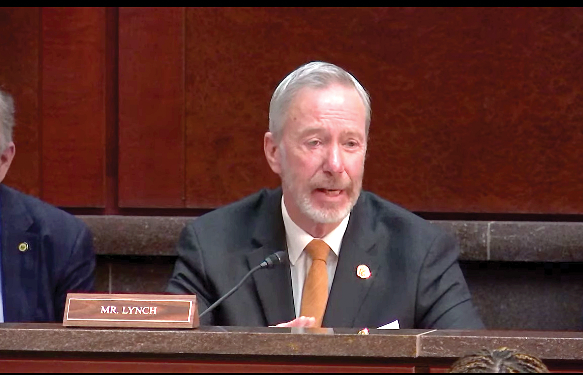
Congressman Lynch is shown during a Congressional hearing in 2025. Screenshot
‘Dare him to veto it’
Lynch agreed with Sen. Ed Markey’s suggestion, discussed in a separate Reporter interview this week, that Democrats should establish an aggressive legislative schedule aimed at sending major bills to Trump’s desk.
“I agree with Ed, and he’s been through the wars,” Lynch said. “I think our responsibility, House and Senate, is to really identify big changes that we can adopt and put them on the president’s desk…We need to put more good bipartisan legislation on his desk and dare him, dare him to veto it.
“We’re in a different strategic position, but I think the first step is to put that legislation together that everyone can be proud of, that people can work on.”
A wholesale overhaul of ICE
Lynch sees potential for a bi-partisan effort to reforming Immigration and Customs Enforcement, the federal agency whose heavy-handed and sometimes murderous tactics in American cities are deeply unpopular. Lynch has heard individually from Republican colleagues who share concerns about the conduct of ICE agents.
“I think there are a significant number of Republicans that agree with us that ICE has to take their masks off. They’ve got to put body cameras on,” Lynch said. “I was here when we established the Department of Homeland Security [in 2002]. ICE was on the border. ICE was on the border. It was not running through our cities and terrorizing, they weren’t killing American citizens like they are now.”
Lynch wants ICE to go back to its original focus on the border.
“We’ve got to completely engineer and reposition ICE, get them back on the border, doing what their traditional job was, and get them out of our cities,” he said. “Make sure that the people that are coming into that program are well-vetted. They don’t have backgrounds that are suited or temperaments that are suited to serve in that respect.”
Trump’s immigration crackdown is causing wider economic and social disruptions, Lynch says, including among businesses that employ immigrants with legal protections and universities that recruit students from overseas. He singled out Temporary Protected Status, or TPS, which allows eligible nationals of designated countries, including Haiti, to remain and work legally in the United States for specified periods.
“I think the business community is seeing what the impact is on people who had TPS or our university system that had student visas,” Lynch said. “We’ve seen a bunch of an exodus of students that were here on legal visas, student visas, that their families felt insecure having their kids might be snatched up and sent to a third country.”
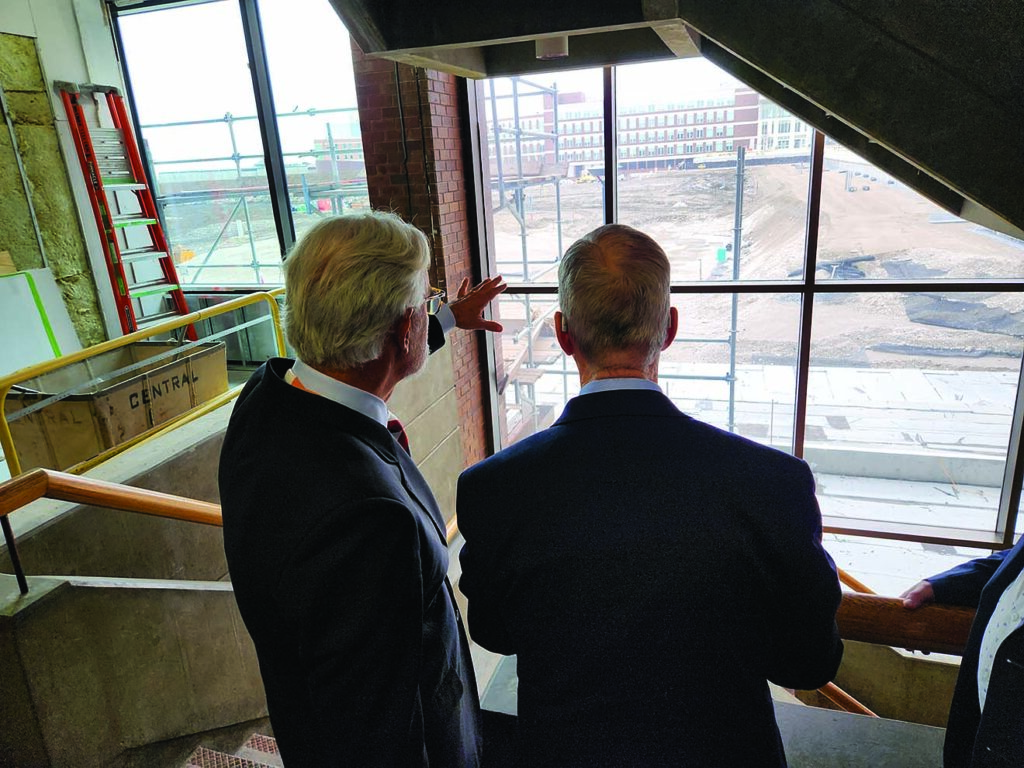
Congressman Lynch, right, toured a UMass Boston site under construction with Chancellor Marcelo Suárez-Orozco in 2023. Reporter photo by Seth Daniel
At UMass Boston, Lynch estimated that roughly 20 international students known to him had been affected by such concerns.
“Their parents said, ‘No, thanks. I’m not going to risk my child going to a third country,’” he said.
Lynch hopes Democrats can find enough Republican support to address TPS protections and the treatment of people already in the country legally.
“I think we can make a lot of progress in that area,” Lynch said. “Ideally, we need broad, full-spectrum comprehensive immigration reform. But something more immediate is just the way ICE has been out of control.”
Lynch, who has longstanding friendships and working relationships with some Republican lawmakers, drew a distinction between those personal relationships and the direction of their party.
“The president has put Stephen Miller in place and given him a more prominent role,” Lynch said, adding that Republican members have just picked Ohio Republican Jim Jordan, with whom he has had repeated confrontations during congressional investigations, to lead their caucus.
“I have fought with [Jordan] many times on different issues,” Lynch said. “He’s pugilistic, I would say, in terms of his attitude. I can be that way too, so maybe part of that’s me.”
Opposes more funding for Iran war
Lynch reserves some of his sharpest criticism of Trump over the ongoing war with Iran.
“I think the single most decisive and impactful issue that we can tackle is what’s going on in the Middle East, Strait of Hormuz, that region,” Lynch said. “That’s driving the cost of gasoline, that’s driving the cost of heating oil in our district. That’s driving the transportation of everything that we use each and every day.”
“If we can fix that, stabilize that, you’ll see gas prices and oil prices come down significantly,” he said. “That’s probably the single fastest way of making changes in people’s lives and give them a demonstrable example of their lives getting better.”
Lynch says the administration’s request for an additional $67 billion to support the military operation is a non-starter for him.
“The president has and the administration has never really fully come to Congress to explain what the mission is, what the length is, what the object of this all is,” Lynch said. “They said it was going to be a week, we’ll be done in two weeks. Now it’s, what is it, seven months, eight months?”
His Republican colleagues have also grown frustrated, too.
“I’ve had my Republican colleagues walk out of some of the briefings because they were not forthcoming with answers to some pretty basic questions that we were all asking them,” he said. “They’re asking right now for $67 billion, and I don’t think there’s 218 votes to get them, to give them that money. Certainly, I’m not going to support that.”
Housing, infrastructure and artificial intelligence
Lynch said he expects to remain on the House Oversight and Financial Services committees, where he hopes to expand work on housing affordability. He is a founding member of the Congressional Affordable Housing Caucus, established with three other lawmakers who grew up in public housing.
“We’re seeing it in Kansas City and New York and in Boston where nurses, truck drivers, construction workers, teachers can’t afford to live in the city,” Lynch said. “We’re focusing on that as well as those people who are trying to come out of a homeless situation and get a roof over their head, as well as some of these young kids that are coming out of college and can’t buy their first home.”
Lynch also raised alarms about recent interruptions to the nation’s transportation and communications systems, particularly last Friday’s nationwide aviation ground stop.
“That’s not just a glitch. That’s a clear and present danger that we have to get at,” he said.
He warned that increasingly sophisticated artificial intelligence technology could present additional threats to infrastructure.
“If those fall into the hands of some of our adversaries, God knows what they might do to our power grid or any of these communication systems that we use,” Lynch said. “That could cost American lives.”
Lessons from the campaign trail
Lynch spent part of the fall campaigning for Democratic candidates in Ohio and New York, including former Sen. Sherrod Brown and congressional candidates seeking to win traditionally Republican territory.
He said the most striking experience was hearing directly from voters who had previously supported Trump.
“It was heartwarming to see so many people who had formerly supported Trump and then were like, ‘We didn’t vote for this. This is not what we signed up for,’” Lynch said. “I’ve always had an abiding faith in the wisdom of the American people,” he added, although Trump’s political success had at times shaken that confidence.
Now, with Democrats preparing to take power, Lynch said the burden is on his party to justify the voters’ renewed trust. Experience has taught him that momentum from “wave” election victories can be fleeting.
“I prefer the blue waves to the red waves,” he said with a laugh.
Copyright © 2026 Boston Neighborhood News, Inc. This content may not be re-published or re-used without written permission.
