

Moves advance
current design
with center lane
for bus riders
The Boston Regional Metropolitan Planning Organization (MPO) voted unanimously after three hours of discussion on Thursday to advance the current design for the Blue Hill Avenue project, which includes the controversial center-running bus lane, and formally steer $80.3 million in federal grants to the Long Range Transportation Plan (LRTP).
A pair of 23-0 key votes unlocked $80.3 million in federal funding through the Capital Investments Grant Small Starts program, the largest piece of funding in the $163 million project. The first vote placed the plan into the LRTP and the second entered it into the 2027-2031 Transportation Improvement Program (TIP).
The money had been allocated by the federal government, but it awaited the procedural step of its acceptance, without which no federal transportation project can advance.
The MPO is a group of regional transportation planners comprised of state and local governments – from MassPort to the Town of Concord – who set transportation project priorities for the region and control the delivery of actual funding dollars for those projects by putting them on the LRTP and the federal TIP.
The project was first presented to the MPO by the City of Boston and the MBTA at an Oct. 1 meeting, and a public comment period closed Nov. 2.
Lynsey Heffernan, of the MBTA, noted at the outset of the meeting that the funding was approved by the Trump administration in February and that they were requesting the next step to be taken by the MPO to get in the pipeline so they can begin things “in the new year.”
Representatives from the MBTA and the City’s Streets Cabinet and Boston Transportation Department (BTD) spent about an hour presenting the project’s history and its current designs – including leaning on the existing Columbus Avenue center-running bus lane as a successful example.
“Columbus Avenue is providing bus riders with some of the best time-saving metrics in the MBTA service area,” said the MBTA’s Andrew MacFarland.
Interim Boston Streets Chief Chris Osgood conceded that there still is a lot of opposition to the project, but that tweaks to the plan – like adding two lanes for vehicle traffic on 75 percent of the corridor – is changing that. “Public sentiment is trending in a positive direction even though there are those that still don’t like the project,” he said.
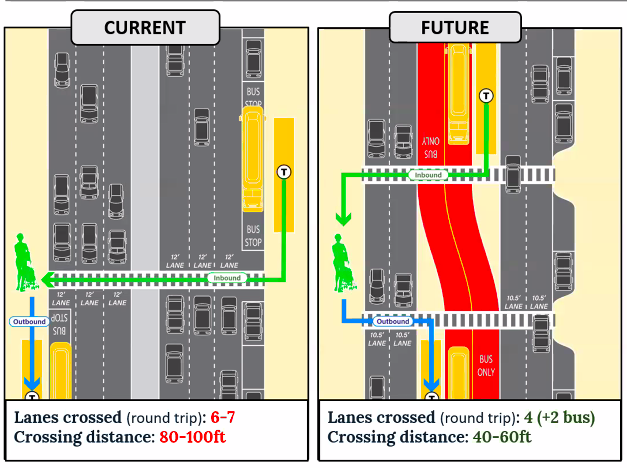
A rendering of the existing street conditions and the proposed center-running bus lane configuration. City of Boston rendering.
Some elected officials tended to see that differently, with two of the three state representatives on the call – state Reps. Chynah Tyler and Chris Worrell – voicing opposition to the project, while state Rep. Russell Holmes voiced support, as did City Councillor Enrique Pepen through a representative. For their part, Councillors Brian Worrell and Miniard Culpepper voiced opposition to the center-running bus lane.
“I wouldn’t say public opinion is going in an upward direction on this project from the community,” said Tyler. “I hear more constituents against it than for it.”
Added Rep. Worrell, “I went to 30 businesses on the corridor and 27 out of 30 overwhelmingly do not support the proposal. Let that sink in. I didn’t send someone else to do my work. I went myself and I recorded it. I believe the opposition to this design in my community is overwhelmingly ‘no.’”
Holmes, however, said it was time to support the center-running bus lane and advance the project into the LRTP so the funding can be secured. “Bus riders like myself have been treated as second-class citizens for too long,” he said. “I am a strong supporter in calling the Regional MPO to move forward with this project today.”
Worrell and Culpepper both said that clear alternatives were never presented to the community, and there needed to be a pause in the MPO vote to allow more discussion of a side-running bus lane or subway rail.
“In the community’s eyes, this project fails,” said Culpepper. “There have been no other alternatives presented to the center-running bus lane in any of the meetings and I’ve been at these meetings for many, many years.”
Added Councillor Worrell, “Four elected officials representing this neighborhood have spoken against this. Four out of five here today are against it. That’s a majority of elected officials who are telling you residents and constituents and businesses are opposed to the plan. There is also a petition of more than 2,500 signatures against this plan, but you won’t find that in the city’s presentation.”
During the community speaking portion, a clear majority was against the vote moving forward by about 70 percent to 30 percent. Written comments received by the MPO showed 36 in opposition, and 5 in support.
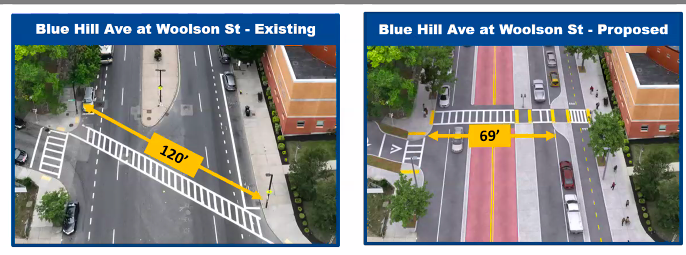
A rendering of changes proposed to the crosswalk on Woolson Street to enhance safety. City of Boston rendering.
Dorchester’s Reggie Stewart noted that he was a public transit rider regularly, but he opposed the plan. He said there is time to study other options without losing federal dollars.
“Certainly, we’ve learned there’s a lot more flexibility in the situation than the fatalist rhetoric from the city and the MBTA would suggest,” he said. “We’ve had enough false choices, ultimatums, and gaslighting.”
Rev. Alan Tanner, a bus rider, said, “There exists no mandate here for a center-running bus lane. I also see the $80 million is not secured yet and we were told many times it was. It was allocated but not received. We need to look at a side-running bus lane with a plan for rail.”
Mattapan’s Mac Hudson said there was never a choice given to the community, but only an ultimatum. “When they were pitching this or selling this to folks, it was selling the idea,” he said. “It wasn’t an ask of what people thought. There needs to be an opportunity to look at alternatives so we can decide for ourselves.
“I ride the bus, and I jog up and down Blue Hill Avenue and I drive up and down Blue Hill Avenue, so I am speaking as an impacted person who will be affected.”
Against that testimony, Elijah Evans, the executive director of Bikes Not Bombs, said that the project needs to move forward without delays.
“We urge you to approve it,” he said. “Blue Hill Avenue is the backbone of Roxbury, Dorchester and Mattapan. This project makes the street safer and the bus more reliable…We can’t wait on another study.”
Another attendee, Carmen Blyden, of Mattapan, said she drives, walks, and bikes on Blue Hill Avenue and feels like this project was a step in the right direction.
“These changes are long overdue,” she said. “Even if you lose a few parking spots or lose a few minutes on your vehicle commute, saving even one life is worth it. I support the project and will be happy to see it move forward.”
Most of the MPO voters didn’t speak on the project, though some were curious about certain aspects.
Jim Nee, of the MetroWest Regional Transit Authority, said he was impressed that the project added the bus lane, safety improvements, and didn’t lose parking.
“You’ve done all of this with a net gain in parking on the corridor,” he said. “I’m struggling to think of an example of net parking increases with this many improvements added. It seems like an amazing project, honestly.”
There was one question about mitigation for businesses who might lose money during the long construction period, and city officials said they are looking into that. In community meetings, however, they have stated there would be a mitigation fund, which was not referenced at the MPO.
“That conversation is going to continue,” said Donald Wright, the deputy director of the city’s Economic Development and Inclusion. He said they are going to have “wayfinding” signs and “do everything we can” to make sure everyone knows Blue Hill Avenue is not closed during construction.
Culpepper, in later comments, took exception to the fund being glossed over.
“They have been telling the businesses they will have a mitigation fund, but no one today mentioned the mitigation fund,” he said. “They don’t have a mitigation fund, and they have no money to put in it.”
For all the back and forth, Thursday’s vote closes a key chapter on the procedural aspect of the Blue Hill Avenue Transportation Plan: The $80.3 million federal grant – the bulk of the $163 million project – can officially be put to use on the project.
