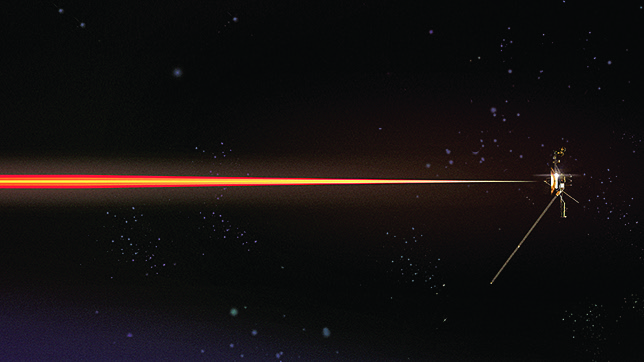
Voyager 1, depicted in this artist’s concept, reached one light-day from Earth on Nov. 18, 2026. NASA/JPL-Caltech image
Last Wednesday morning (Nov. 18) at 5:16 a.m. (EST), a time when most who are reading this were in slumber mode, NASA’s Voyager 1 spacecraft, which rose from its pad in Cape Canaveral, Fla., on Sept. 5, 1977, passed an epochal milestone on its 38,000 mph, 49-year-and-then-some journey through interstellar space, which it entered in 2012:
It reached a distance of one light day from Earth, making it the first human-made object to do so. A light day is not a measure of time. It accounts for a singular distance: How far will light, moving at 186,000 miles per second, travel in a day’s time set at 24 hours. The answer is 16.1 billion miles. Over a year? Some 5.88 trillion (5,880,000,000,000) miles.
In a time when space travel as a normality by earthlings is occupying the dreams of ambitious humans who already have put their wholly owned spaceships beyond the surly bonds of our planet’s air space, there is this mind-bending fact to consider:
The distance between Earth and our nearest star, Proxima Centauri, and its orbiting exo-planets, is 4.2 light years, or 24 trillion miles, or some 77,000 years of travel from Boston, aka the Hub of the Universe.
Said Ray Jayawardhana, president of Caltech, which, with NASA, has guided Voyager’s monumental mission from its launch: “Beyond its immense contributions to science, Voyager also captures something profound about the human spirit. We may never know where its journey will ultimately lead, but it will venture on, an enduring affirmation that humanity was here and we yearned to explore.”