


Thousands face loss of vouchers from Fed trims
City housing officials, looking at potentially catastrophic cuts to federal subsidies that help keep low-income residents in their homes, are alerting landlords to a potential Section 8 crisis and asking that they consider freezing or even reducing rents for some 18,000 vulnerable households in Boston.
They also want impacted Boston property owners — many of them in Dorchester and Mattapan—to lobby Congress and the White House to protect the subsidies.
“If the cut that was proposed in the president’s budget were to be ratified by Congress, the BHA would have to terminate almost 8,000 vouchers,” said Kenzie Bok, the commissioner of the Boston Housing Authority (BHA). “We’d be talking about 8,000 families [going] back into homelessness. We looked at the data and it would be about 11,000 children we’d be making homeless again in our region. So, it’s just a reality that we cannot let come to pass.”
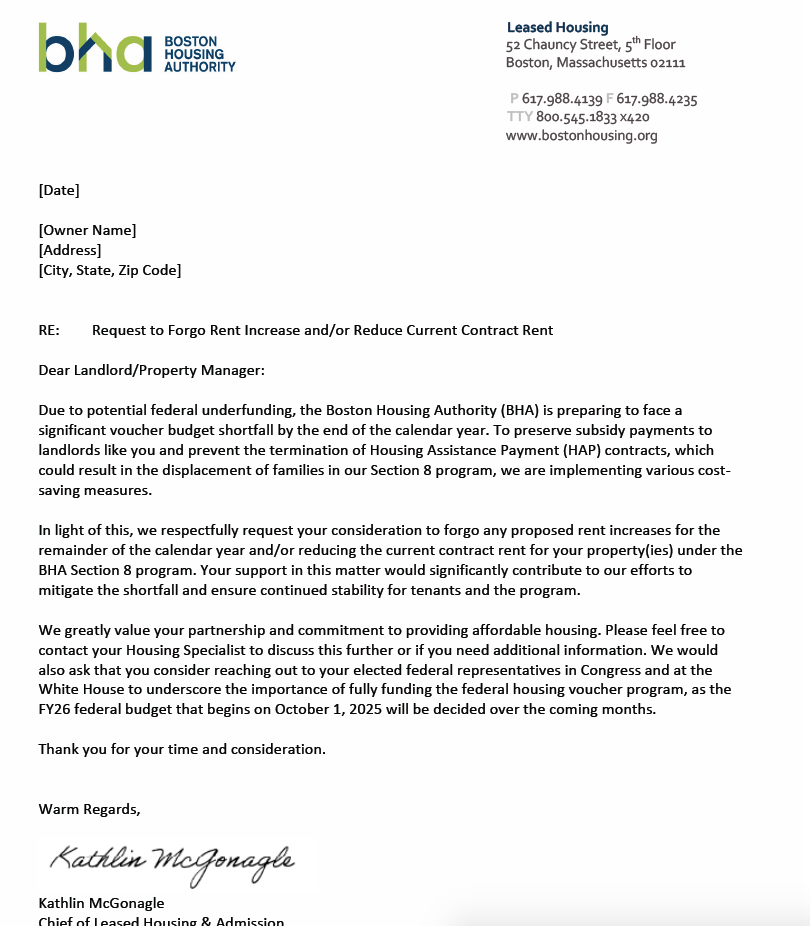
In a letter sent out last week to roughly 6,000 landlords and property managers who are already part of the Section 8 program managed by the Boston Housing Authority (BHA), city officials warned that “potential federal underfunding” would result in a “significant voucher budget shortfall by the end of the calendar year.
Kathlin McGonagle, chief of Leased Housing & Admission for the BHA, wrote that as part of the effort “to preserve subsidy payment to landlords like you and prevent the termination of Housing Assistance Payment (HAP) contracts, which could result in the displacement of families in our Section 8 program, we are implementing various cost-saving measures.”
Year-end shortfalls in federal funds used to subsidize the rental voucher program are a common problem. Inflationary rents have often triggered the need for gap funding from the Department of Housing and Urban Development to prevent interruptions in payments to landlords at the end of the year, for example.
But, Bok said, housing administrators across the nation have heightened concerns this year because of the Trump administration’s overall posture toward funding cuts.
Those anxieties were intensified when the president’s initial budget proposal for the new fiscal year included a 40 percent across-the-board cut to public housing programs, including Section 8 grants. While Congress still has an opportunity to negotiate that amount— or even restore level funding or bump up funding to account for inflation— there’s no assurances that will happen.
The ripple effect of such draconian cuts now under consideration won’t just affect families that would face evictions. Bok said the majority of the 6,000 landlords who rent to Section 8 tenants in Boston are themselves small property owners whose mortgages and other financing plans are often based on the backstop protections afforded by federal programs like Section 8.
“At the Housing Authority, we really see our Section 8 landlords as partners. And so, there are some who are really large landlords, but the vast majority of those are just housing one or two voucher holders,” she said.
“They might be an owner occupant in a [three] decker, and they’re renting a floor to a voucher holder. That means that that voucher rent is helping to pay their mortgage.
“But it also means that the tenant is their neighbor. And the idea that you’d put any landlord in a situation where the federal government might cut off a subsidy that’s expected, and then you’re in the situation of you can’t make your ends meet… The last thing you want to do is evict your tenant because of something that’s happened outside of their control. It would be a terrible position to put people in.”
Greg Vasil, CEO of the Greater Boston Real Estate Board, says his members— most of them larger landlords— are very much aware of the potentially devastating cuts.
“We have a number of members who’ve expressed real concerns about a lot of the federal subsidy programs, particularly Section 8,” said Vasil. “It’s such a vital part of our housing mosaic to be able to make things work for people, and when you start taking that away, we start losing ground even faster. It just doesn’t make any sense.”
Tenants, naturally, are also alarmed, according to Carolyn Chou, a Dorchester resident who now leads the statewide advocacy group Homes for All Massachusetts. The organization was one of several that rallied in front of the State House and the Kennedy federal office building in Boston on Tuesday to call for more protections for tenants.
“What we’re seeing is that these [potential cuts] have not hit people on the ground yet, but there’s a lot of fear. People are already in crisis and can’t afford any more cuts.”
While Boston— and particularly densely packed neighborhoods like Dorchester —would be hard hit by Section 8 disruptions, Chou says people in western Mass and other gateway cities like Lawrence are also alarmed by the possibility of extreme federal cuts.
“Especially right now, with the limits to family shelter here in Massachusetts, we are in a real crisis in which the state is not investing. We’re going to see more and more people in crisis. They’re fearful for many of their basic needs.”
Bok says Boston housing officials have heard directly from many property owners since their letter hit mailboxes last week.
“I think there’s a shared recognition that we really need to be telling the story of the Section 8 program down in DC and making sure that folks there know what a policy success it’s been. I’ve already had several landlords say that they’re going be talking with folks on the appropriations committee down in Washington.
“We really think those are the conversations that have to be had right now,” said Bok. “The Section 8 program deserves to be fully funded, and it can be fully funded by congressional action on the FY 26 budget that goes into effect on October 1. I think it would be a huge collective failure to let a program that’s been so successful suffer this kind of setback.”
