

More than ten years after the closing of the Long Island Bridge, and twenty years into a national opioid crisis, a top official in Boston has declared the city’s efforts to resolve the drug-use problem in its South End neighborhood a failure.
On June 23, graphic video clips depicting the crisis on the streets, sidewalks, and stoops of the South End began to circulate on Instagram, with captions blaming the problem on Mayor Michelle Wu. Over the next three weeks, and dozens of posts later, the account attracted more than 9,000 followers. By mid-July, the very first clip, in which a shirtless man lurches and topples a planter down the stately front steps of a brownstone, had scored 17,400 likes and almost 10,000 shares.
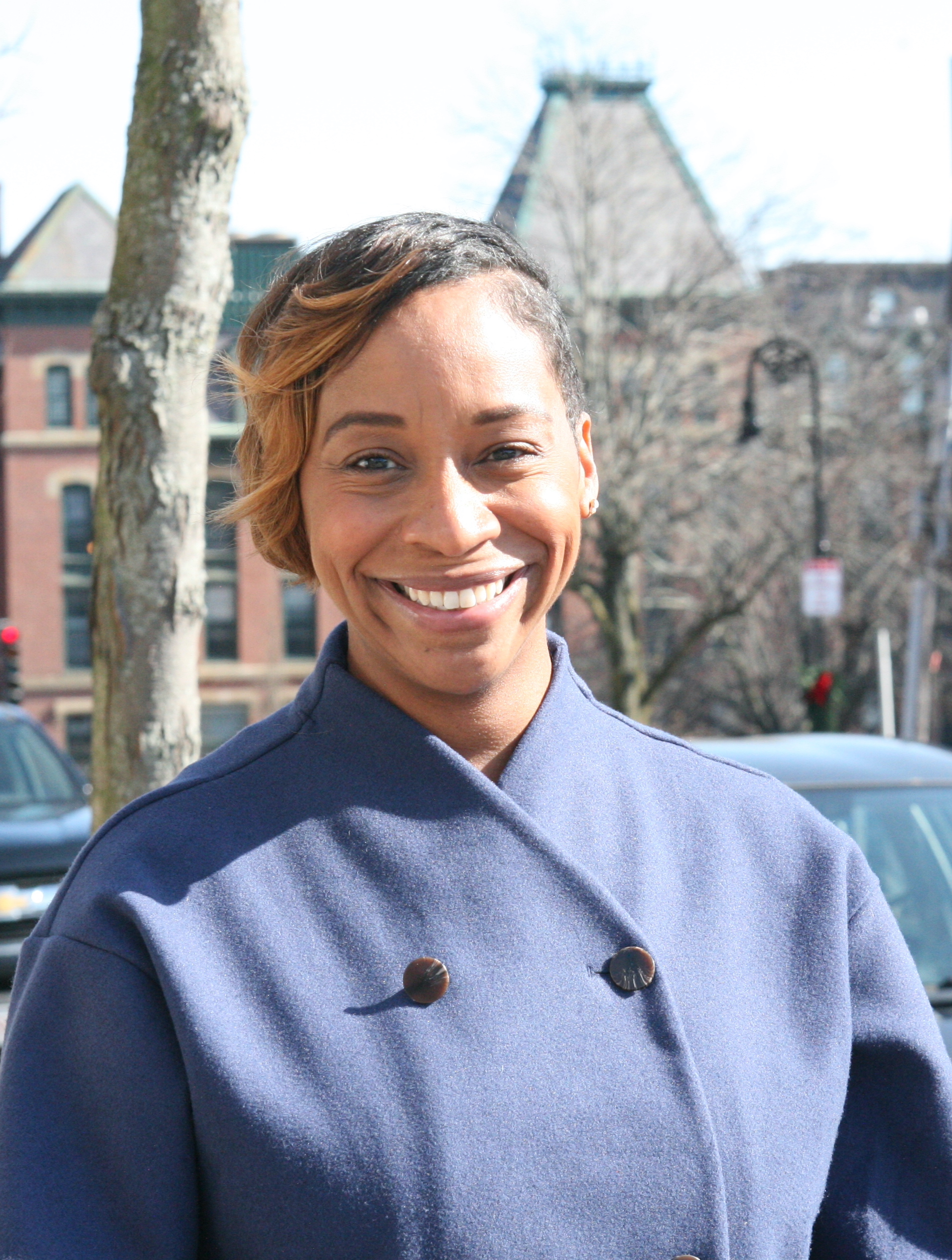
One day after that clip was posted, South End residents were airing complaints to the executive director of the Boston Public Health Commission (BPHC), Dr. Bisola Ojikutu. “It feels as though very little that any of us are doing to combat this drug use epidemic is actually working,” she conceded. “People out in the street, injecting each other in the neck—I mean, nobody wants this. And I think that we have failed in terms of the drug use epidemic.”
If the failure began even before the closing of the bridge and the abrupt loss of access to shelter and treatment facilities, it became more acute as early as 2014, with the first unsuccessful efforts to make up for lost capacity. By early July of this year, the lack of overall progress was also being highlighted by Wu’s most visible challenger in this year’s election, Josh Kraft, and by John FitzGerald of Dorchester, the chair of the City Council’s committee on committee on public health, homelessness, and recovery.
“I just think patience is gone,” said the District 3 councillor on July 8, “and people have that nice round number to point to and say it’s been ten years and nothing has changed.” At a council meeting on following day, FitzGerald filed an order for a hearing to explore addressing the crisis through a regional fund, with other communities also adding facilities and services.
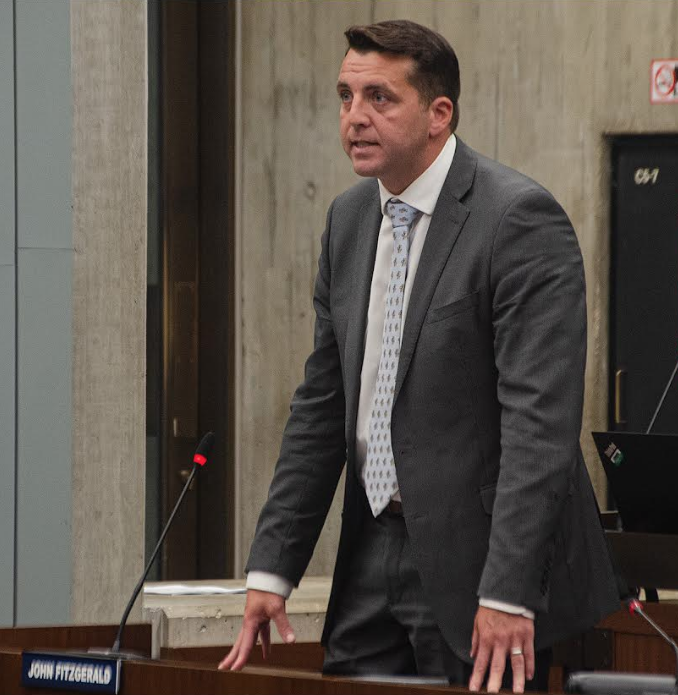
Above, Councillor John FitzGerald spoke at a council meeting in 2024. Chris Lovett photo
“For too long, the city has shouldered the burden of the region and, to a greater degree, the state’s substance abuse and mental health issues,” he argued at the meeting. “We have a concentration of services, the majority in a single city neighborhood that other cities and towns get to dump their issues on, and at no cost to them. The majority of folks at ‘Mass. and Cass’ are not even Boston residents, as we know.”
The two co-filers for the order were District 2 (South Boston, South End, Chinatown) Councillor Ed Flynn and Councillor-At-Large Erin Murphy. “It’s time for every city and town in greater Boston to step up,” Murphy said in support of the order. “We need coordinated funds backed by equitable contributions from all the municipalities whose residents rely on our services. I’m thinking regional housing treatment, wraparound care, not just stopgap approaches.”
Also pursuing a change in approach to the problem is a working group that includes FitzGerald, South End and Newmarket Square leaders, a member of the mayor’s Coordinated Response Team (CRT) and South End State Representative John Moran.
“While I am extremely grateful to all who have been involved in helping to mitigate the impacts of the opioid crisis,” Moran wrote in an email statement, “the time is now to create new, sustainable solutions focused on recovery, public safety, and justice reform. I’ve heard from many constituents in my district from the South End to Roxbury to Dorchester who have been negatively impacted by this situation, and they are running out of patience. So whether you are a care provider, in law enforcement, or an official at the city or state level, the time is now to work together for the greater good.”
The bridge closing resulted in a backflow of unmet needs, much of it concentrated around the intersection of Massachusetts Avenue and Melnea Cass Boulevard. Over most of the next decade, the drug activity, mental illness, and unsheltered homelessness, with its cluster of distress at the intersection, only got worse. As the death toll from opioid use increased through the pandemic and its aftermath, so did related crime and quality-of-life problems.
As the city explained in 2022, seven months after Wu became mayor, the outdoors problems reflected the limits of indoors relief. “The potent and short-acting effects of fentanyl have made it more difficult for people who use opioids to stay in traditional shelters,” officials wrote. “This is a major factor that pushes more individuals to sleep outside.”
The city’s strategy combined harm reduction and “drop-in problem-solving” with a progression from the overnight stabilization of “low-threshold” shelter to transitional, and then permanent housing. By the middle of 2023, “Mass. and Cass” had spun off a new cluster, an encampment one block away, on Atkinson Street. Wu ordered it taken down, after drug trafficking, human trafficking, and violence had become threatening even to outreach workers and teams offering services. After this, the fixed cluster became more like a nomadic shuffle to other locations, including residential streets and parks in surrounding neighborhoods.
In May of 2025, the BPHC announced one clear sign of progress: opioid-related deaths in the city were decreasing after rising every year between 2019 and 2023. In 2024, the total declined by 38 percent, surpassing the national decline, with the figures down by more than 50 percent for Black and Latino men, whose recent mortality rates had been disproportionately high. According to BPHC, the city’s highest number of opioid deaths between 2019 and 2021, a total of 71, was in Dorchester’s 02124 zip code.
A national study conducted between 2017 and 2022 also showed racial disparities in access to medications that could help make treatment less disruptive for work and daily responsibilities. Researchers recommended expanding insurance coverage for the medications and access through treatment settings. “Programs that reduce barriers to buprenorphine—such as eliminating abstinence requirements, allowing home initiation, and offering mobile induction,” they wrote, “have shown promise in reaching patients disconnected from traditional care pathway.”
A study of strategies for preventing opioid-related deaths between 2020 and 2022, funded by the National Institutes of Health (NIH), showed no appreciable advantage for evidence-based interventions by community coalitions. The study trials were in four states, including Massachusetts. Researchers noted that the outcomes may have been affected by the pandemic and an incomplete roll-out of interventions.
The researchers cited one additional factor: the growing prevalence of fentanyl, including its combination with other drugs, and changes in drug distribution. According to results published last year in the New England Journal of Medicine, researchers surmised “that the change in the illicit drug market may have reduced the effectiveness of the intervention, because fentanyl became a more prevalent opioid and a more commonly used adulterant in stimulants and counterfeit pills.”
Even after the decrease in fatalities in Boston, progress was less apparent with outdoor drug activity. According to an update to the City Council by the mayor’s Coordinated Response Team (CRT) on Feb. 26 of this year, the city was strengthening law enforcement while directing harm reduction services indoors and away from congregate sites. But progress around the “Mass. and Cass” area was offset by more problems elsewhere.
“Notwithstanding the significant progress in housing individuals, reducing violent crime, decreasing the average crowd size at Mass. and Cass, and keeping Boston encampment-free,” the team reported, “new congregations of outdoor substance users, and related activity, emerged as the most pressing issue impacting quality of life for residents citywide.” Instead of the “street 2 home” pathway envisioned three years ago, the CRT emphasized that it was offering only a snapshot: “a continuous process of adapting to changing dynamics on the ground.”
The latest adaptation, announced by Wu on July 10, the day after the council meeting, was backed by a $200,000 grant from the Cummins Foundation. The money will enable the CRT and the Gavin Foundation to provide “treatment navigation” and transportation for individuals identified at locations around the city.
And the Wu administration’s reaction to FitzGerald’s measure two days earlier was to highlight common ground.
“The City will continue to advocate for and welcome all state partnership and resources to address a regional challenge concentrated in Boston,” a city spokesperson said in an email response. “Over the last three and half years, the City has deployed all available resources for treatment and housing pathways, and we continue to address quality of life concerns in our neighborhoods.
“The State’s investment of temporary resources in previous years was critical to the real progress in ending encampments in Boston, building clear pathways to recovery and stable housing, and coordinating public safety and public health responses. More is needed, and we continue to work alongside residents and advocates to urge partnership for a regional public health recovery campus and decentralized treatment sites that will meet the scale of the challenge.”
In addition to harm reduction and containment, city officials have, over the years, been trying to add treatment, shelter, and housing capacity. Though some capacity has been added in Boston, other possibilities have met resistance, with the rebuilding of a new Long Island Bridge still under legal challenge by the City of Quincy, even after a key approval for a new span by the state early this year.
In April of 2023, Boston officials joined with counterparts from other communities in asking for more help from the state with access to treatment and different levels of housing—permanent, transitional, and low-threshold— accessible to persons still using drugs. Less than two months later, Gov. Healey picked a coalition including Boston Medical Center to build a “recovery campus” with more than 400 beds on the 13-acre grounds of the Shattuck Hospital, next to Franklin Park. An expansion of an earlier proposal developed by city and state officials in 2017, the plan, which included low-threshold capacity, met with opposition from neighborhood groups and parks advocates, some of them backing a similar facility at the site of the MBTA’s Arborway bus yard in nearby Forest Hills.
In the fall of 2023, business and neighborhood groups proposed a temporary recovery campus at Widett Circle, near the Mass. Ave. exit off US Route 93. That plan faced opposition from Wu and the MBTA.
Among the treatment models recommended in April by Josh Kraft is a work-based rehab facility like the Triangle Residential Options for Substance Abusers (TROSA) campus for 400 people in Durham, North Carolina. According to a 2022 report by the Kaiser Family Foundation, a non-partisan research organization, more than ninety percent of those who finish the program remain sober and employed for a least one year, though the graduation rate was only 25 percent.
Yet another proposal, one offered by Suffolk County Sheriff Steven Tompkins, would provide space for treatment and counselling at either the House of Correction or the jail. His original proposal, in 2021, for involuntary commitment, met with strong opposition, though it was supported by FitzGerald’s predecessor, Frank Baker.
On July 1, a few days after Dr. Ojikutu’s comments, Kraft highlighted his own strategy at a news conference in the South End. His proposals included involuntary commitments to treatment for some people with substance use disorder, along with tougher enforcement against activity such as drug-dealing, human trafficking, and property crime. Instead of anchoring treatment in a “housing first” strategy, he urged “recovery first,” saying:
“People are scared to raise families in this neighborhood because of the open drug use, because of people passed out on doorsteps every day. The residents of this neighborhood, including many children, are forced to witness people selling drugs outside their front door and people injecting drugs, needles littering the ground, people going to the bathroom on the sidewalk.
“This is about more than just being tough. It’s about making it clear that public drug use, indefinite street living, and property crimes are no longer an option – so businesses and residents can feel safe, and people seek and accept the help they need.”
State law allows involuntary commitment up to 90 days for people with substance use disorder who pose a substantial danger to themselves or to the public, though a correctional setting is allowed only for men. In recent years, the law has been contested by advocacy groups, including the American Civil Liberties Union (ACLU) and Prisoners’ Legal Services. Researchers have found that involuntary treatment can sometimes be effective, while raising concerns about vulnerability to quick relapses and risk of fatal overdoses, especially on release from a correctional setting.
Dr. Sarah E. Wakeman, the senior medical director for substance use disorder at Mass General Brigham, expressed a more negative view of involuntary commitment in an op-ed for the health-oriented news website STAT.
“If someone is using chaotically because of trauma and their use has worsened in the context of homelessness,” she wrote in April 2023, “forcibly removing the drug use is not the solution. Giving that person hope, treating them with kindness and compassion, hearing what they need, and partnering with them on whatever they think might make their life better is what actually helps.”
But FitzGerald maintains that involuntary commitment for persons with a history of repeat crisis interventions might at least reduce the amount of open drug use in Boston.
“I think,” he said, “that would drive home the point to folks that are out there congregating and defecating on people’s steps, and leaving needles around and impacting the quality of life of good families and residents that are trying to raise their kids or come here for their jobs and be tax-paying members of society: ‘Hey, we can’t hang around here, or we’re going to end up right there. And we don’t want to be there, so let’s get out of here.’
“I think it just takes a while for that culture to take shape,” he added, “but I believe by backing up policy on both of the law enforcement and medical side — of at some point applying mandatory services to that — that culture will start to be created and you’ll see a difference.”
